

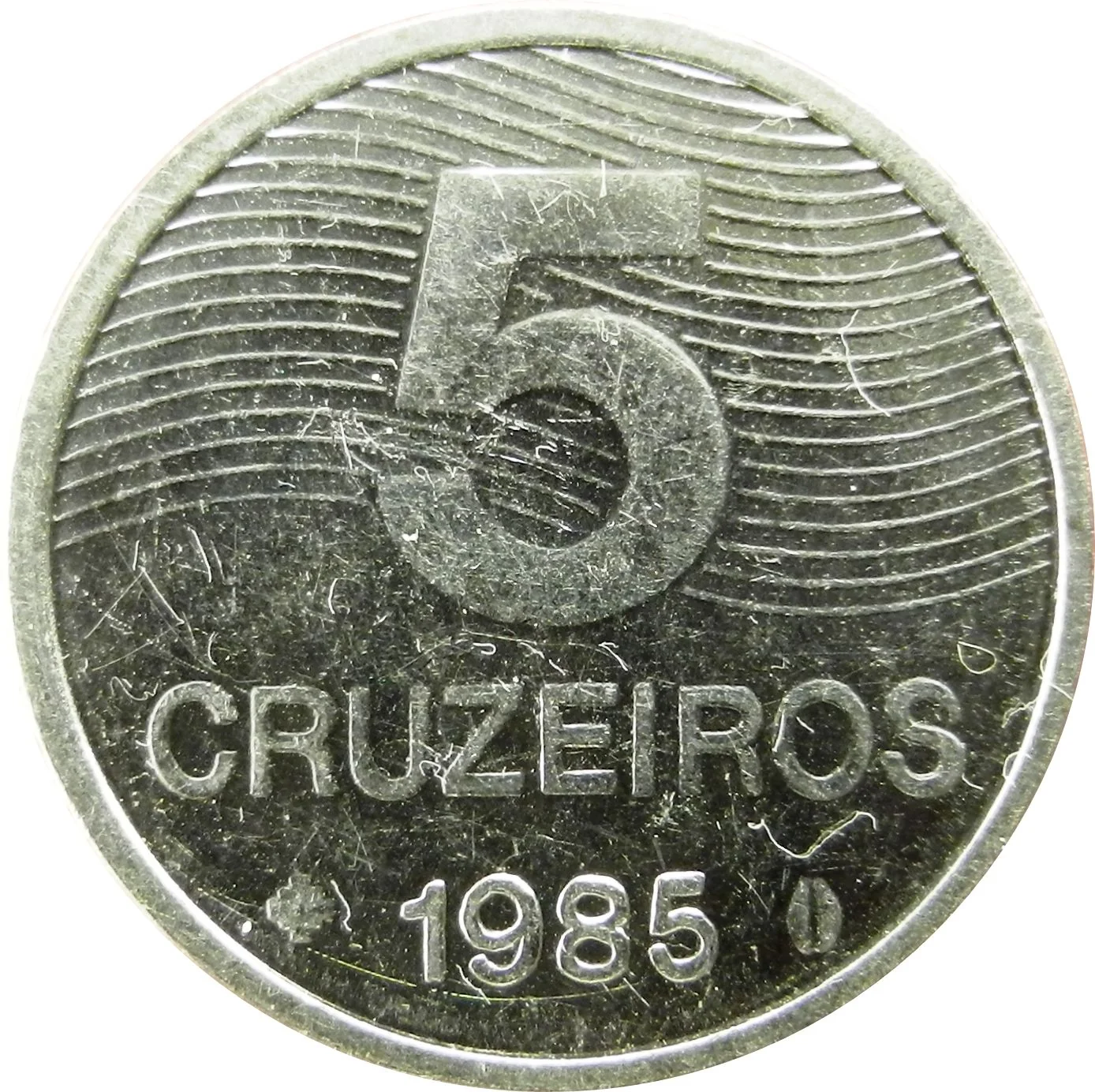
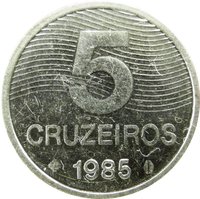
5 Cruzeiros – Brazil
Circulating commemorative coins
Commemoration: F.A.O.
Brazil
Context
Year: 1985
Issuer: Brazil 
Period:
(since 1967)
Currency:
(1967—1986)
Demonetized: Yes
Total mintage: 10,000,000
Material
Diameter: 22 mm
Weight: 4.7 g
Thickness: 1.6 mm
Shape: Round
Composition: Stainless steel
Technique: Milled
Alignment: Coin alignment
flip
References
KM: #Click to copy to clipboard599
Numista: #16637
Value
Exchange value: 5 BRB
Inflation-adjusted value: 112509019385.31 BRB
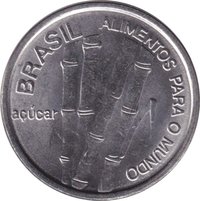
Obverse
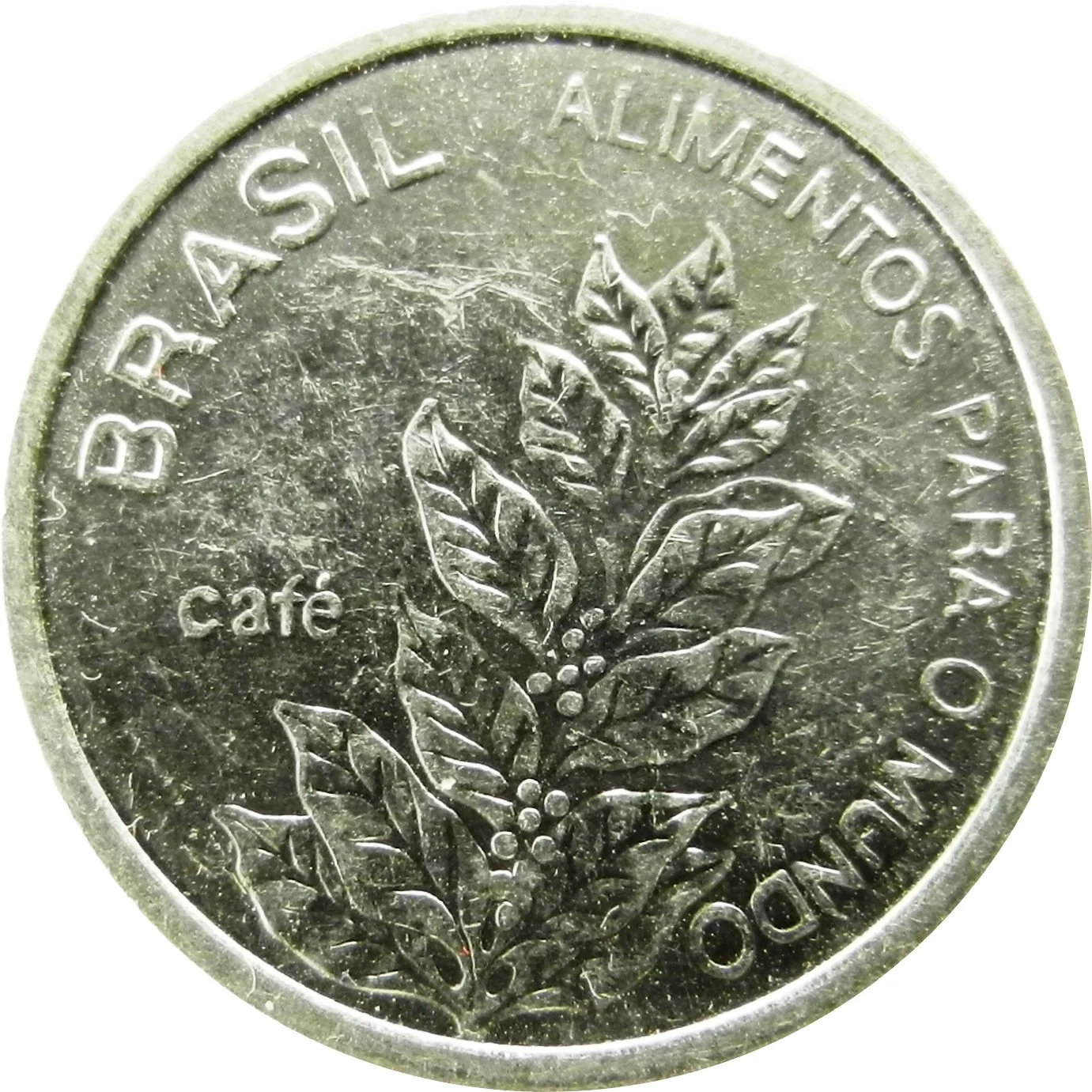
Description:
Coffee shrub
Inscription:
BRASIL
ALIMENTOS PARA O MUNDO
Café
ALIMENTOS PARA O MUNDO
Café
Translation:
Brazil
Food for the World
Coffee
Food for the World
Coffee
Script: Latin
Language: Portuguese
Reverse
Edge
Plain
Categories
| Organization> FAO |
Mintings
| Year | Mint Mark | Mintage | Quality | Collection |
|---|---|---|---|---|
| 1985 | — | 10,000,000 |
Historical background
By 1985, Brazil's currency situation was a symptom of profound economic dysfunction, characterized by hyperinflation and a labyrinth of monetary corrections. The country was in the final years of the military dictatorship, transitioning toward a civilian government with the election of Tancredo Neves. However, the economy was shackled by the legacy of the 1970s "economic miracle," which had been financed by massive foreign debt. To manage the resulting crisis, the government relied heavily on printing money to cover deficits, leading to an inflation rate that would surge to over 200% annually. The currency, the cruzeiro, was losing value at a dizzying pace, eroding wages and savings.
The financial system operated under a complex indexation mechanism, where virtually all contracts—from wages to loans—were automatically adjusted by a government index (like the OTN) to partially keep pace with inflation. This created a perverse feedback loop: indexation institutionalized inflation, as future price increases were baked into the economy, making it incredibly difficult to break the cycle. Everyday economic life was dominated by a "dollarization" of mindsets, with people rushing to spend cruzeiros as soon as they were received, converting them into durable goods or black-market dollars to preserve value.
This unstable environment set the stage for the economic challenges of the new democratic era. The incoming Sarney government inherited this crisis and would soon embark on a series of unsuccessful stabilization plans, beginning with the Cruzado Plan in 1986, which introduced a new currency (the cruzado) in an attempt to break inflationary psychology. Thus, 1985 stands as the chaotic prelude to a decade of monetary experimentation, where the fundamental struggle was to restore trust in the nation's currency itself.
The financial system operated under a complex indexation mechanism, where virtually all contracts—from wages to loans—were automatically adjusted by a government index (like the OTN) to partially keep pace with inflation. This created a perverse feedback loop: indexation institutionalized inflation, as future price increases were baked into the economy, making it incredibly difficult to break the cycle. Everyday economic life was dominated by a "dollarization" of mindsets, with people rushing to spend cruzeiros as soon as they were received, converting them into durable goods or black-market dollars to preserve value.
This unstable environment set the stage for the economic challenges of the new democratic era. The incoming Sarney government inherited this crisis and would soon embark on a series of unsuccessful stabilization plans, beginning with the Cruzado Plan in 1986, which introduced a new currency (the cruzado) in an attempt to break inflationary psychology. Thus, 1985 stands as the chaotic prelude to a decade of monetary experimentation, where the fundamental struggle was to restore trust in the nation's currency itself.
🌱 Common