

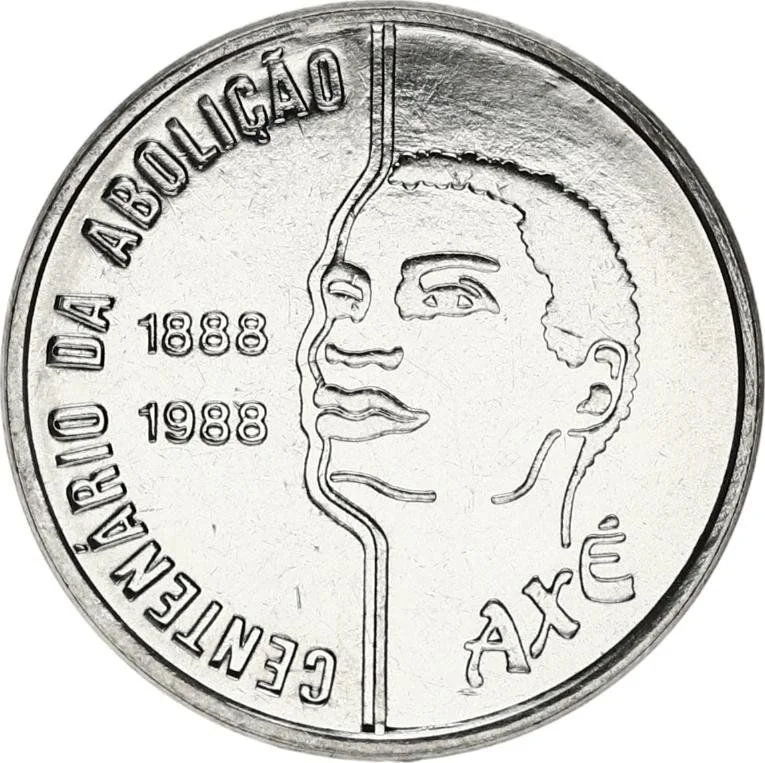

100 cruzados (Abolition of Slavery) – Brazil
Add to wishlist
Circulating commemorative coins
Commemoration: 100th Anniversary of the Abolition of Slavery
Brazil
Context
Year: 1988
Issuer: Brazil
Period:
(since 1967)
Currency:
(1986—1989)
Demonetization: 31 July 1993
Total mintage: 200,000
Material
Diameter: 31 mm
Weight: 9.95 g
Thickness: 1.9 mm
Shape: Round
Composition: Stainless steel
Technique: Milled
Alignment: Coin alignment
flip

References
KM: #
Numista: #15375
Value
Exchange value: 100 BRC
Inflation-adjusted value: 85064082284.34 BRC
Obverse
Description:
Dates left, male head right.
Inscription:
CENTENÁRIO DA ABOLIÇÃO
1888
1988
AXÉ
1888
1988
AXÉ
Translation:
Centenary of the Abolition
1888
1988
Axé
1888
1988
Axé
Script: Latin
Language: Portuguese
Engraver: Aldo Cascardo
Designers: Luciano Dias Araújo, Thereza Regina Barja Fidalgo
Reverse
Description:
Denomination summary
Inscription:
100
CRUZADOS
BRASIL
CRUZADOS
BRASIL
Script: Latin
Engraver: Aldo Cascardo
Designers: Luciano Dias Araújo, Thereza Regina Barja Fidalgo
Edge
Plain
Mintings
| Year | Mint Mark | Mintage | Quality | Collection |
|---|---|---|---|---|
| 1988 | — | 200,000 |
Historical background
In 1988, Brazil was in the throes of a profound economic crisis defined by hyperinflation and a succession of failed currency plans. The period was marked by the final years of the military dictatorship's transition to democracy, culminating in the promulgation of a new democratic constitution that same year. However, this political milestone was overshadowed by severe economic instability, with inflation reaching an annual rate of over 1,000%. The national currency, the Cruzado (which had replaced the old Cruzeiro in 1986), was rapidly losing value, eroding wages and savings and creating immense social hardship.
The currency situation was a direct result of chronic fiscal deficits, indexed financial mechanisms, and a loss of monetary control. The government's response prior to 1988 had been a series of heterodox shock plans, most notably the Cruzado Plan (1986) and the Bresser Plan (1987), which implemented price freezes and created a new currency in an attempt to break inflationary expectations. By 1988, these plans had clearly failed, as suppressed inflation returned with devastating force. The economy was trapped in a cycle where widespread indexation of contracts and wages automatically passed past inflation into future prices, creating an inertial inflation that persisted regardless of demand.
Consequently, 1988 stands as a year of escalating desperation and the prelude to further drastic measures. The failure of the previous plans left the public deeply skeptical of government economic interventions. As price freezes were abandoned, inflation accelerated unchecked, setting the stage for the even more radical Summer Plan (Plano Verão) that would be launched in January 1989. This plan would introduce yet another new currency, the Novo Cruzado, and implement a new set of freezes and fiscal adjustments, continuing a turbulent cycle of crisis and short-lived stabilization that would define the Brazilian economy until the successful Real Plan in 1994.
The currency situation was a direct result of chronic fiscal deficits, indexed financial mechanisms, and a loss of monetary control. The government's response prior to 1988 had been a series of heterodox shock plans, most notably the Cruzado Plan (1986) and the Bresser Plan (1987), which implemented price freezes and created a new currency in an attempt to break inflationary expectations. By 1988, these plans had clearly failed, as suppressed inflation returned with devastating force. The economy was trapped in a cycle where widespread indexation of contracts and wages automatically passed past inflation into future prices, creating an inertial inflation that persisted regardless of demand.
Consequently, 1988 stands as a year of escalating desperation and the prelude to further drastic measures. The failure of the previous plans left the public deeply skeptical of government economic interventions. As price freezes were abandoned, inflation accelerated unchecked, setting the stage for the even more radical Summer Plan (Plano Verão) that would be launched in January 1989. This plan would introduce yet another new currency, the Novo Cruzado, and implement a new set of freezes and fiscal adjustments, continuing a turbulent cycle of crisis and short-lived stabilization that would define the Brazilian economy until the successful Real Plan in 1994.


🌱 Common