

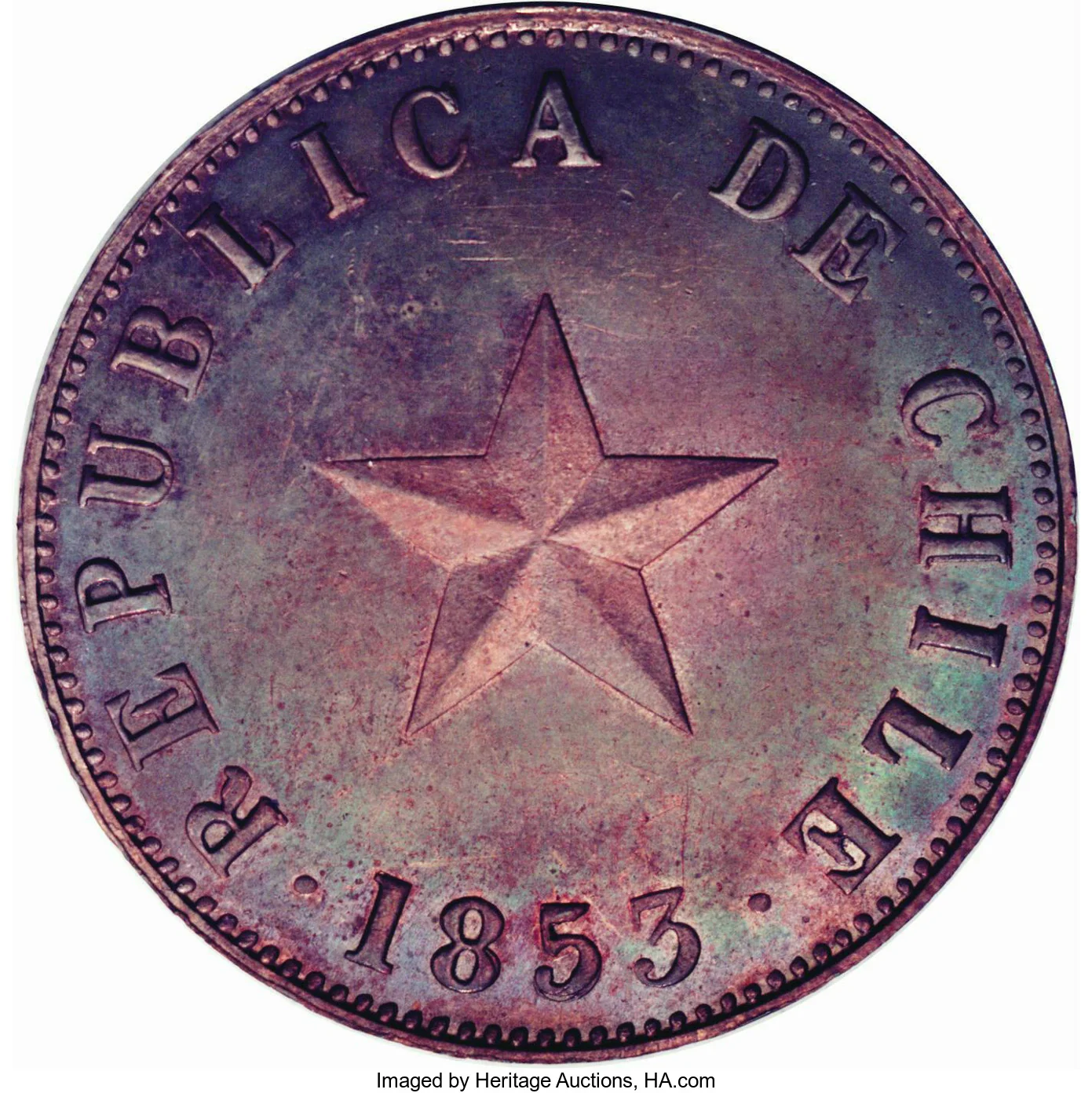
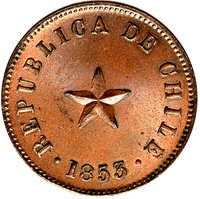
Obverse
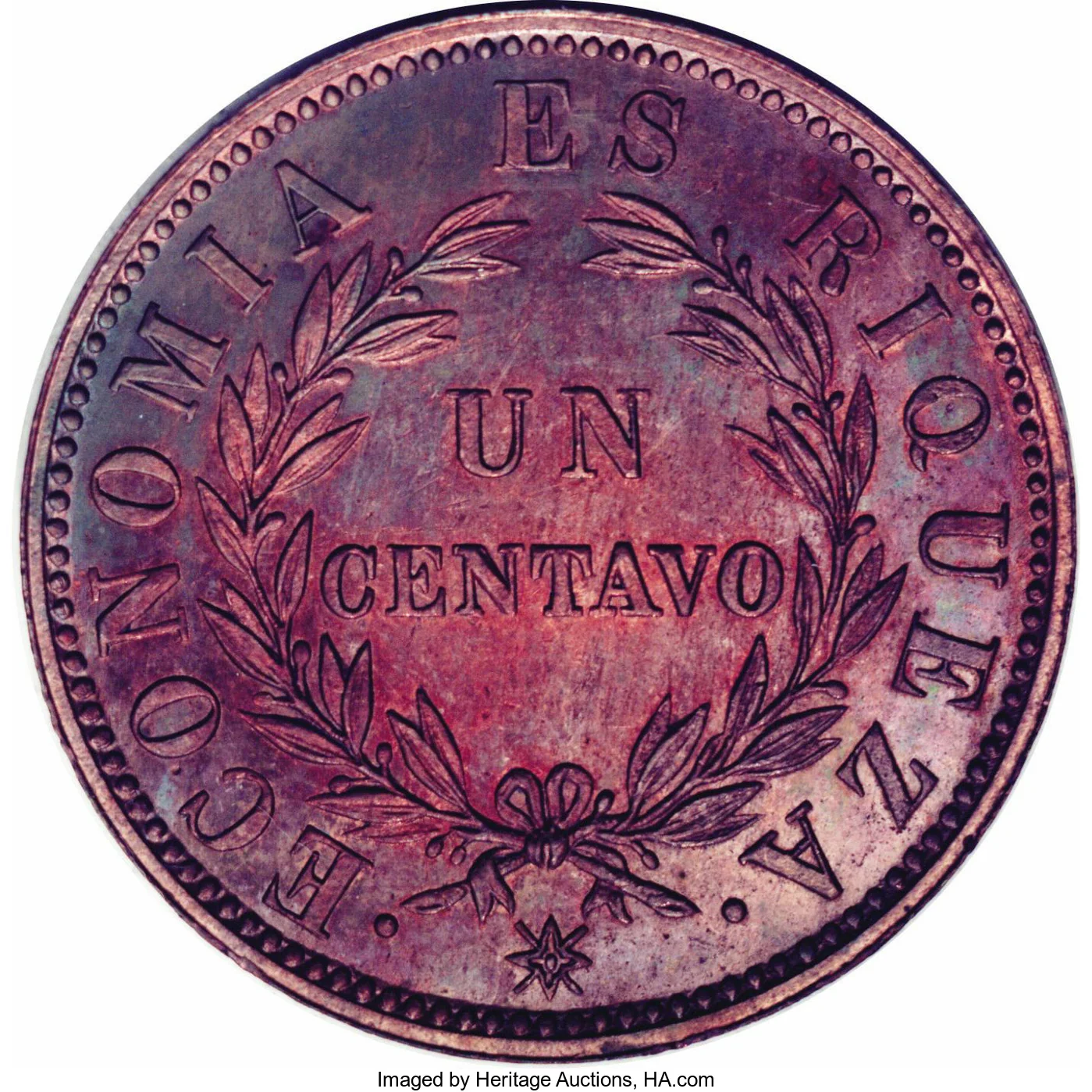
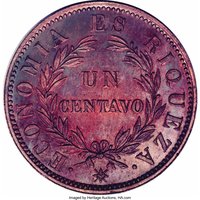
Reverse
Description:
Economy within the wreath; motto: "Economy is wealth."
Inscription:
ECONOMIA ES RIQEZA
UN CENTAVO
UN CENTAVO
Script: Latin
Edge
Plain
Mintings
| Year | Mint Mark | Mintage | Quality | Collection |
|---|---|---|---|---|
| 1853 | — | 2,667,000 | ||
| 1853 | — | — | Proof |
Historical background
In 1853, Chile's currency situation was characterized by a chaotic and unstable system of multiple, competing forms of money. The official currency was the peso, but its value was not anchored to a single metal standard. The most widely recognized coin was the silver peso de plata (weighing 25 grams of fine silver), which served as the theoretical benchmark. However, the system was flooded with a variety of other coins, including gold onzas (16-peso coins), debased silver coins from neighboring republics, and even cut fragments of old Spanish colonial coins, all circulating simultaneously at fluctuating values.
This monetary disorder was a direct legacy of the colonial period and the turbulent early decades of independence. The lack of a strong, centralized minting authority and the free inflow of foreign coins, particularly from Peru and Bolivia, created a complex environment where the value of money was often determined by its metal content and public trust rather than a fixed legal decree. This led to frequent Gresham's Law scenarios, where "bad" debased money drove "good" full-weight silver pesos out of circulation, as people hoarded the higher-value coins.
The situation in 1853 was a point of growing concern for the state and commercial elites, as it hampered domestic trade, complicated government finance, and created uncertainty for foreign commerce. It set the stage for the significant monetary reforms that would follow in the subsequent decades, most notably the establishment of the Caja de Amortización in 1860 and the eventual adoption of the gold standard in the late 1860s. Thus, 1853 represents a late point in Chile's era of monetary pluralism, just before concerted state action began to impose a uniform, national currency.
This monetary disorder was a direct legacy of the colonial period and the turbulent early decades of independence. The lack of a strong, centralized minting authority and the free inflow of foreign coins, particularly from Peru and Bolivia, created a complex environment where the value of money was often determined by its metal content and public trust rather than a fixed legal decree. This led to frequent Gresham's Law scenarios, where "bad" debased money drove "good" full-weight silver pesos out of circulation, as people hoarded the higher-value coins.
The situation in 1853 was a point of growing concern for the state and commercial elites, as it hampered domestic trade, complicated government finance, and created uncertainty for foreign commerce. It set the stage for the significant monetary reforms that would follow in the subsequent decades, most notably the establishment of the Caja de Amortización in 1860 and the eventual adoption of the gold standard in the late 1860s. Thus, 1853 represents a late point in Chile's era of monetary pluralism, just before concerted state action began to impose a uniform, national currency.
🌱 Fairly Common