

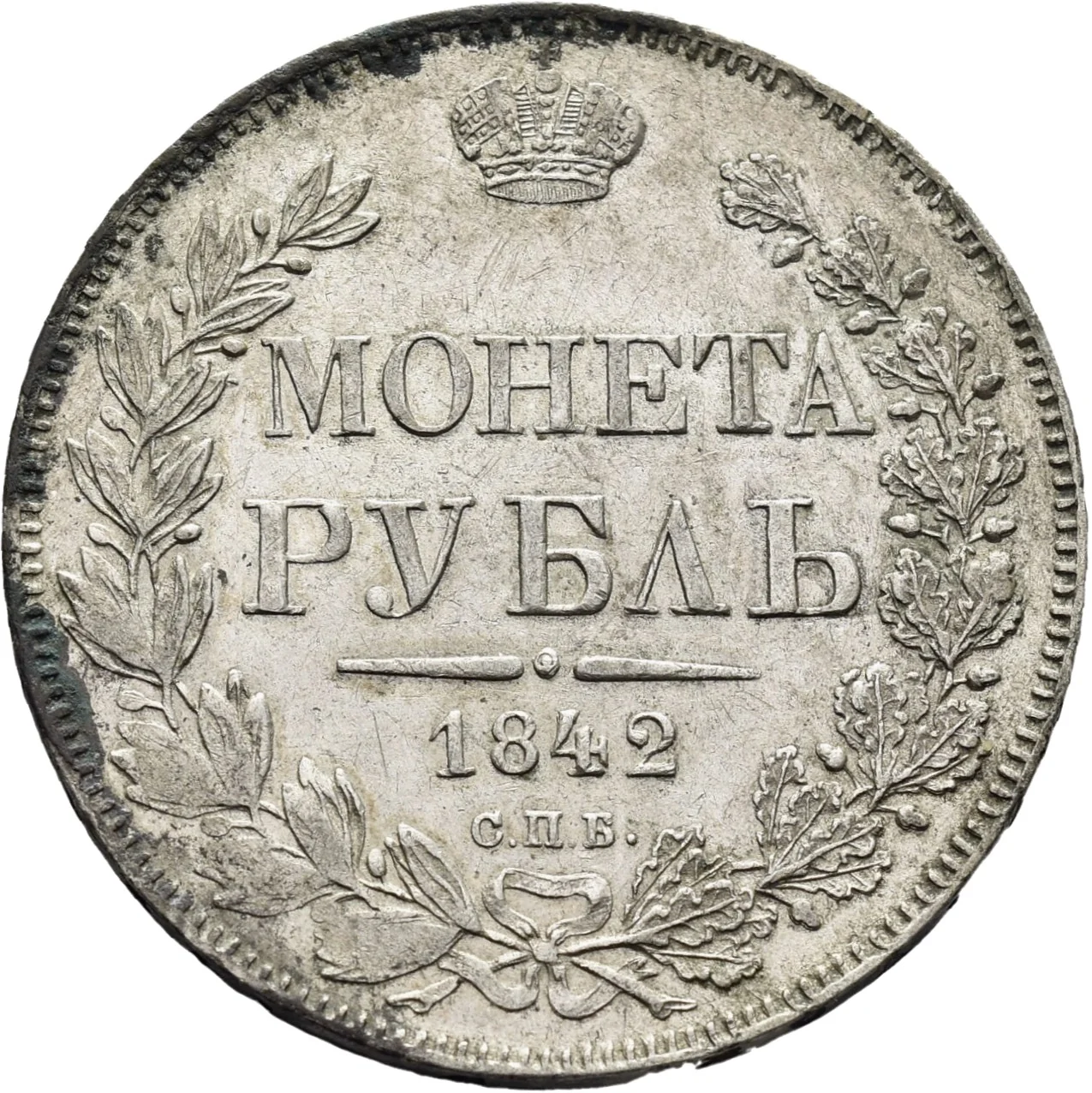
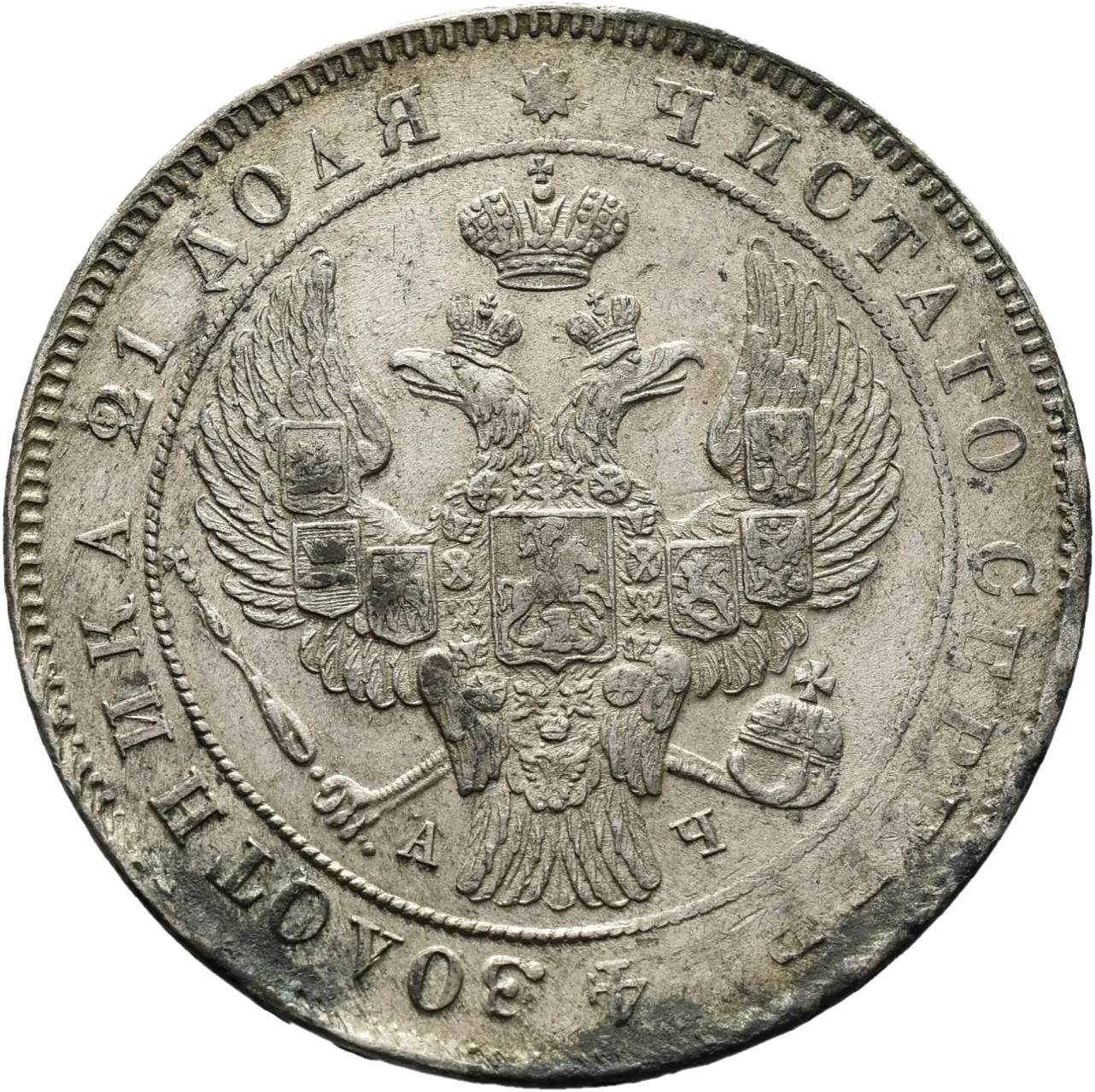
1 ruble – Russian Empire
Add to wishlist
Russia
Context
Years: 1832–1858
Country: Russia
Issuer: Russian Empire
Ruler: Nicholas I
Currency:
(1700—1917)
Demonetized: Yes
Total mintage: 42,472,189
Material
References
Numista: #16514
Value
Bullion value: $45.17
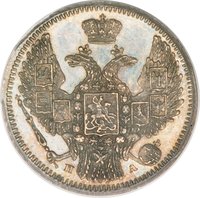
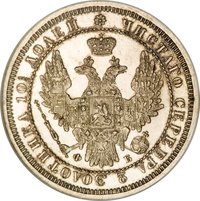
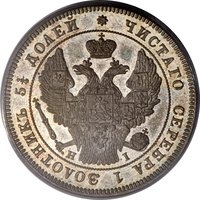
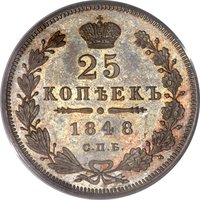
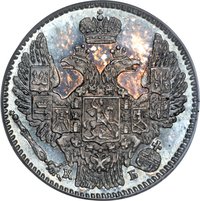
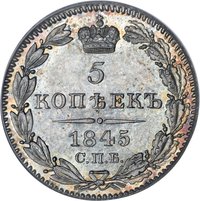
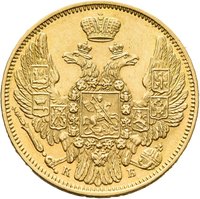
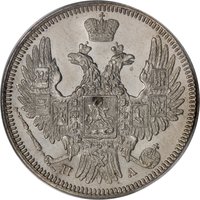
Obverse
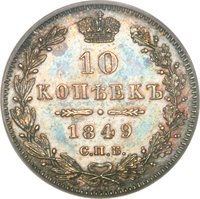
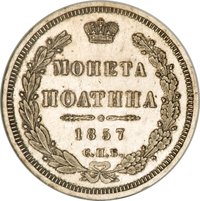
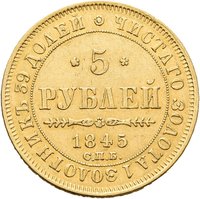
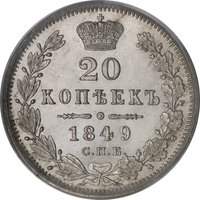
Reverse
Edge
Smooth with inscription
Legend:
СЕР∙83 1/3 ПРОБЫ 4 ЗОЛ∙82 14/25 ДОЛИ
Translation:
SER 83 1/3 PURITY 4 GOLD 82 14/25 PARTS
Language: Russian
Categories
| Symbols> Coat of Arms |
Mints
| Name | Mark |
|---|---|
| Saint Petersburg | СПБ |
Mintings
| Year | Mint Mark | Mintage | Quality | Collection |
|---|---|---|---|---|
| 1832 | СПБ | 1,941,110 | ||
| 1833 | СПБ | 1,711,000 | ||
| 1834 | СПБ | 2,270,011 | ||
| 1835 | СПБ | — | ||
| 1836 | СПБ | 1,101,578 | ||
| 1837 | СПБ | 1,477,407 | ||
| 1838 | СПБ | 232,048 | ||
| 1839 | СПБ | 35,707 | ||
| 1840 | СПБ | 2,627,001 | ||
| 1841 | СПБ | 6,155,000 | ||
| 1842 | СПБ | — | ||
| 1843 | СПБ | 5,320,000 | ||
| 1844 | СПБ | 2,928,585 | ||
| 1845 | СПБ | 682,700 | ||
| 1846 | СПБ | 3,523,011 | ||
| 1847 | СПБ | 562,601 | ||
| 1848 | СПБ | 1,542,101 | ||
| 1849 | СПБ | 1,708,101 | ||
| 1850 | СПБ | — | ||
| 1851 | СПБ | — | ||
| 1852 | СПБ | — | ||
| 1853 | СПБ | 2,160,105 | ||
| 1854 | СПБ | 3,070,103 | ||
| 1855 | СПБ | 1,216,003 | ||
| 1856 | СПБ | 1,388,003 | ||
| 1857 | СПБ | 250,003 | ||
| 1858 | СПБ | 570,011 |
Historical background
By 1832, the Russian Empire's currency system was defined by the persistent use of paper assignats alongside silver coinage, a legacy of the financial strain of the Napoleonic Wars. The assignat ruble, first introduced in 1769, had become a depreciated fiat currency, trading at a significant discount to the silver ruble. This created a complex dual-system where state accounts and international trade were often conducted in silver, while much of the domestic economy operated with the less valuable paper notes, causing confusion and economic inefficiency.
The government, under Tsar Nicholas I and his Finance Minister Count Yegor Kankrin, was actively pursuing monetary stabilization. A key reform was underway: the establishment of a silver standard. This process, which would be formally completed with the 1839-1843 reforms, aimed to retire the assignats and make the silver ruble the sole legal tender. In 1832, the state was accumulating a silver reserve to guarantee the value of a new, fully convertible paper currency, a crucial step toward restoring public confidence in the financial system.
Thus, the currency situation in 1832 was one of transition from wartime inflationary finance to a more stable, metallic-based system. The economy still bore the burdens of a depreciated paper currency and a cumbersome exchange rate between assignats and silver. However, the foundational policies for a major monetary reform were being implemented, setting the stage for the eventual introduction of the silver ruble and the elimination of the assignat legacy in the following decade.
The government, under Tsar Nicholas I and his Finance Minister Count Yegor Kankrin, was actively pursuing monetary stabilization. A key reform was underway: the establishment of a silver standard. This process, which would be formally completed with the 1839-1843 reforms, aimed to retire the assignats and make the silver ruble the sole legal tender. In 1832, the state was accumulating a silver reserve to guarantee the value of a new, fully convertible paper currency, a crucial step toward restoring public confidence in the financial system.
Thus, the currency situation in 1832 was one of transition from wartime inflationary finance to a more stable, metallic-based system. The economy still bore the burdens of a depreciated paper currency and a cumbersome exchange rate between assignats and silver. However, the foundational policies for a major monetary reform were being implemented, setting the stage for the eventual introduction of the silver ruble and the elimination of the assignat legacy in the following decade.
🌱 Fairly Common