

½ Dollar – United States
United States
Context
Years: 1807–1836
Issuer: United States 
Period:
(since 1776)
Currency:
(since 1785)
Subdivision: ½ Dollar = 50 Cents
Total mintage: 53,340,253
Material
References
KM: #Click to copy to clipboard37
Numista: #10637
Value
Exchange value: ½ USD = $0.50
Bullion value: $34.19
Obverse
Description:
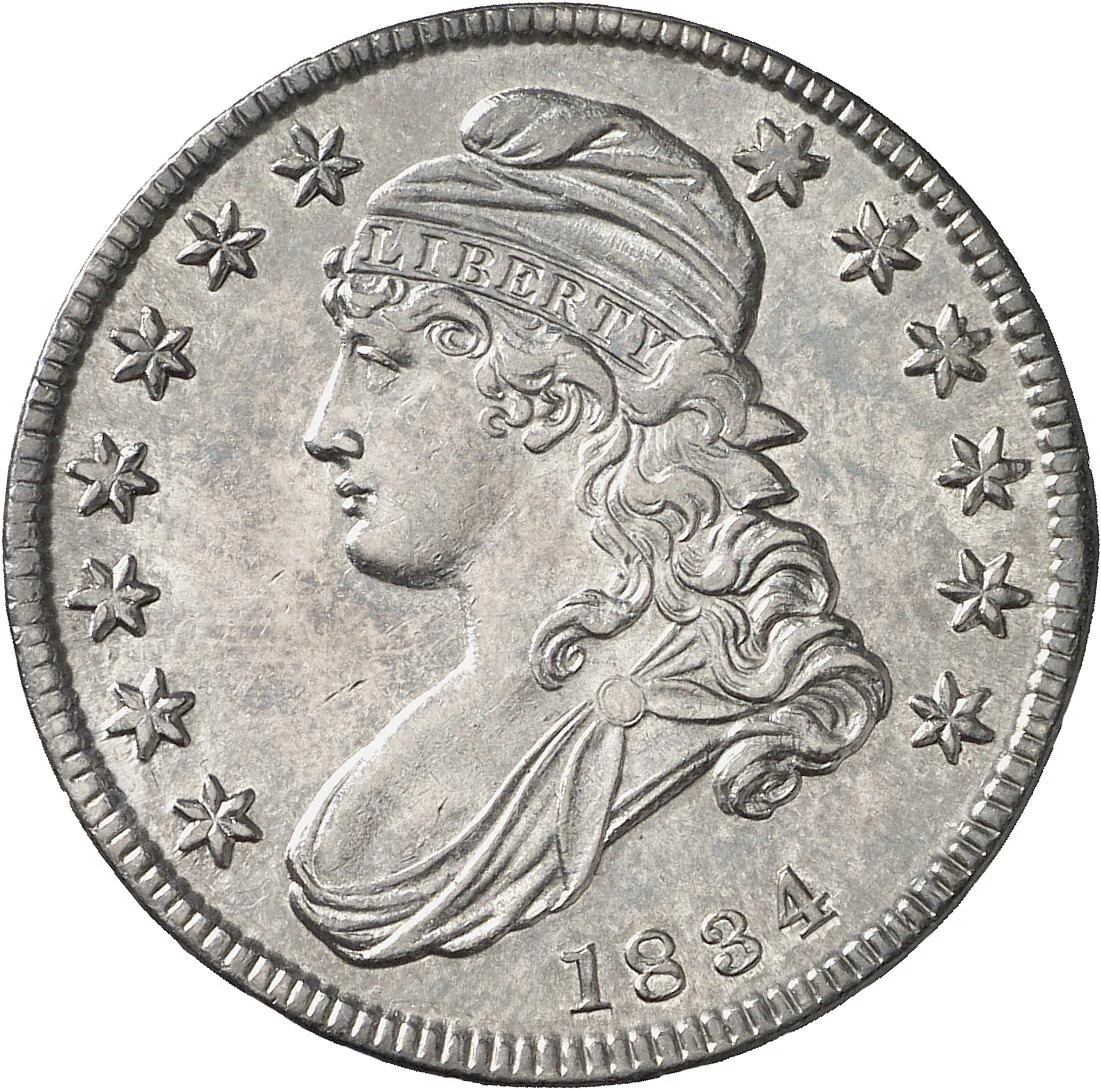
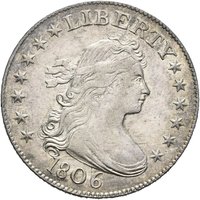
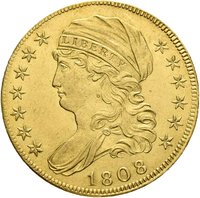
A left-facing Liberty wears a Phrygian cap, with curling hair and a draped gown. Thirteen stars surround the portrait. The headband reads LIBERTY, with the date curved below.
Inscription:
1808
Script: Latin
Engraver: John Reich
Reverse
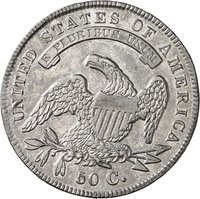
Description:
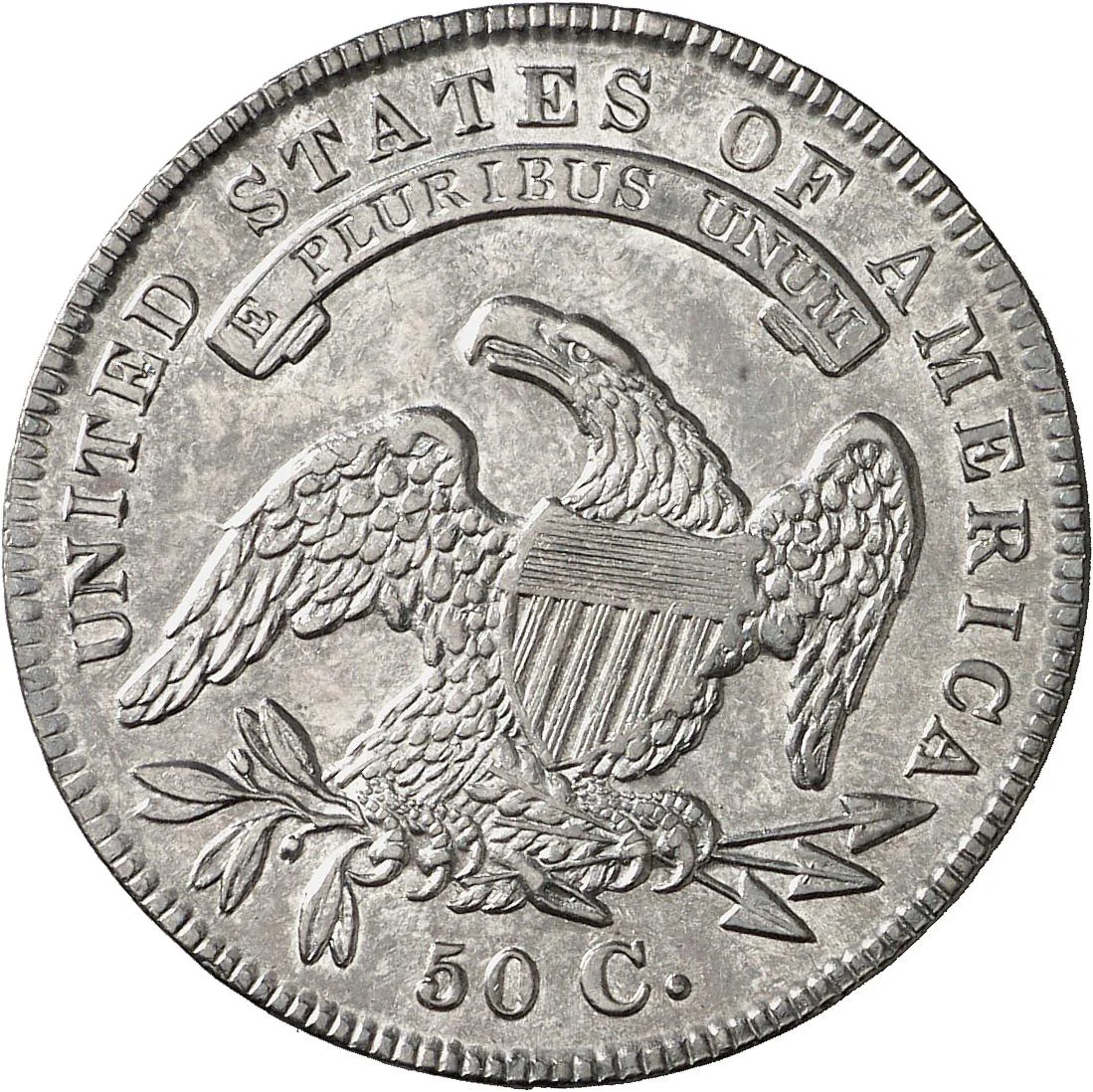
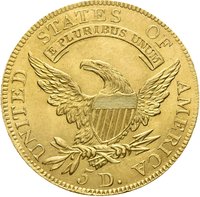
An American Bald Eagle with spread wings, clutching arrows and an olive branch. Above, a scroll reads "E PLURIBUS UNUM," encircled by the country name. The denomination "50 C." is below.
Inscription:
UNITED STATES OF AMERICA
E PLURIBUS UNUM
50 C.
E PLURIBUS UNUM
50 C.
Translation:
UNITED STATES OF AMERICA
OUT OF MANY, ONE
50 CENTS
OUT OF MANY, ONE
50 CENTS
Script: Latin
Engraver: John Reich
Edge
Legend:
FIFTY CENTS OR HALF A DOLLAR
Categories
| Animal> Bird> Eagle |
| Symbol> Phrygian cap |
| Symbol> Allegory |
| Object> Cold weapons |
Mints
| Name | Mark |
|---|---|
| United States Mint of Philadelphia | — |
Mintings
| Year | Mint Mark | Mintage | Quality | Collection |
|---|---|---|---|---|
| 1807 | — | 750,500 | ||
| 1808 | — | 1,368,600 | ||
| 1809 | — | 1,405,810 | ||
| 1810 | — | 1,276,276 | ||
| 1811 | — | — | ||
| 1812 | — | — | ||
| 1813 | — | 1,241,903 | ||
| 1814 | — | — | ||
| 1815 | — | 47,150 | ||
| 1817 | — | — | ||
| 1818 | — | 1,960,322 | ||
| 1819 | — | 2,208,000 | ||
| 1820 | — | — | ||
| 1821 | — | 1,305,797 | ||
| 1822 | — | 1,559,573 | ||
| 1823 | — | — | ||
| 1824 | — | 3,504,954 | ||
| 1825 | — | 2,943,166 | ||
| 1826 | — | 4,004,180 | ||
| 1827 | — | — | ||
| 1828 | — | 3,075,200 | ||
| 1829 | — | 3,712,156 | ||
| 1830 | — | — | ||
| 1831 | — | 5,873,660 | ||
| 1832 | — | — | ||
| 1833 | — | 5,206,000 | ||
| 1834 | — | — | ||
| 1835 | — | 5,352,006 | ||
| 1836 | — | 6,545,000 |
Historical background
In 1807, the United States lacked a uniform national currency, creating a complex and often chaotic monetary landscape. The First Bank of the United States, which had provided some stability, had seen its charter expire in 1811, leaving a void in central financial authority. Consequently, the economy operated on a patchwork of foreign coins (primarily Spanish dollars), banknotes issued by hundreds of state-chartered private banks, and limited amounts of U.S. minted coinage. This system was inherently unstable, as the value and acceptability of any banknote depended entirely on the reputation and solvency of the issuing bank, which could be dubious.
The situation was further strained by the geopolitical tensions of the Napoleonic Wars and, crucially, President Thomas Jefferson's Embargo Act of 1807. This attempt to pressure Britain and France by halting American exports disastrously backfired, crippling U.S. maritime trade and causing widespread economic depression. The sharp decline in import duties—the federal government's primary revenue source—pushed the Treasury toward deficit. Meanwhile, the embargo caused a severe shortage of specie (gold and silver coin), as the inflow of foreign coin from trade dried up. This specie drain made it impossible for many banks to redeem their paper notes for hard currency on demand, leading to bank failures and a collapse in public confidence in paper money.
Thus, by the end of 1807, the nation's currency system was fragile and ill-prepared for future shocks. The lack of a central bank, the proliferation of unreliable paper, a crippling specie shortage, and an ongoing economic crisis set the stage for even greater financial turmoil in the years to come. This precarious environment would ultimately contribute to the economic hardships of the War of 1812 and strengthen the arguments for establishing a new national bank, leading to the charter of the Second Bank of the United States in 1816.
The situation was further strained by the geopolitical tensions of the Napoleonic Wars and, crucially, President Thomas Jefferson's Embargo Act of 1807. This attempt to pressure Britain and France by halting American exports disastrously backfired, crippling U.S. maritime trade and causing widespread economic depression. The sharp decline in import duties—the federal government's primary revenue source—pushed the Treasury toward deficit. Meanwhile, the embargo caused a severe shortage of specie (gold and silver coin), as the inflow of foreign coin from trade dried up. This specie drain made it impossible for many banks to redeem their paper notes for hard currency on demand, leading to bank failures and a collapse in public confidence in paper money.
Thus, by the end of 1807, the nation's currency system was fragile and ill-prepared for future shocks. The lack of a central bank, the proliferation of unreliable paper, a crippling specie shortage, and an ongoing economic crisis set the stage for even greater financial turmoil in the years to come. This precarious environment would ultimately contribute to the economic hardships of the War of 1812 and strengthen the arguments for establishing a new national bank, leading to the charter of the Second Bank of the United States in 1816.
🌱 Common