

Obverse
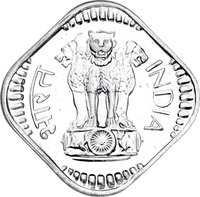
Description:
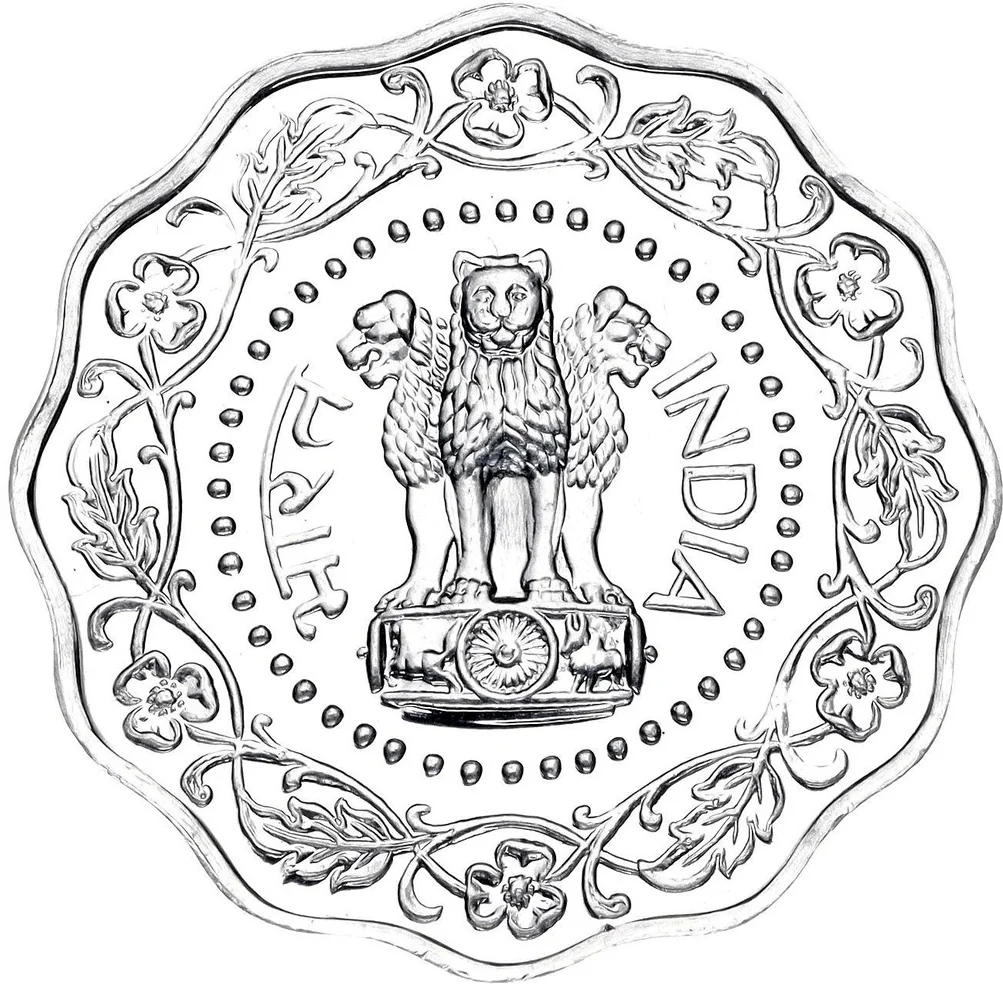
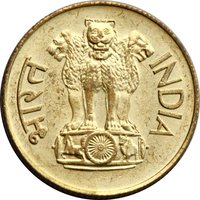
Ashoka Lion Capital encircled by beads and a wreath.
Inscription:
भारत INDIA
Translation:
India
Scripts: Devanagari, Latin
Reverse
Description:
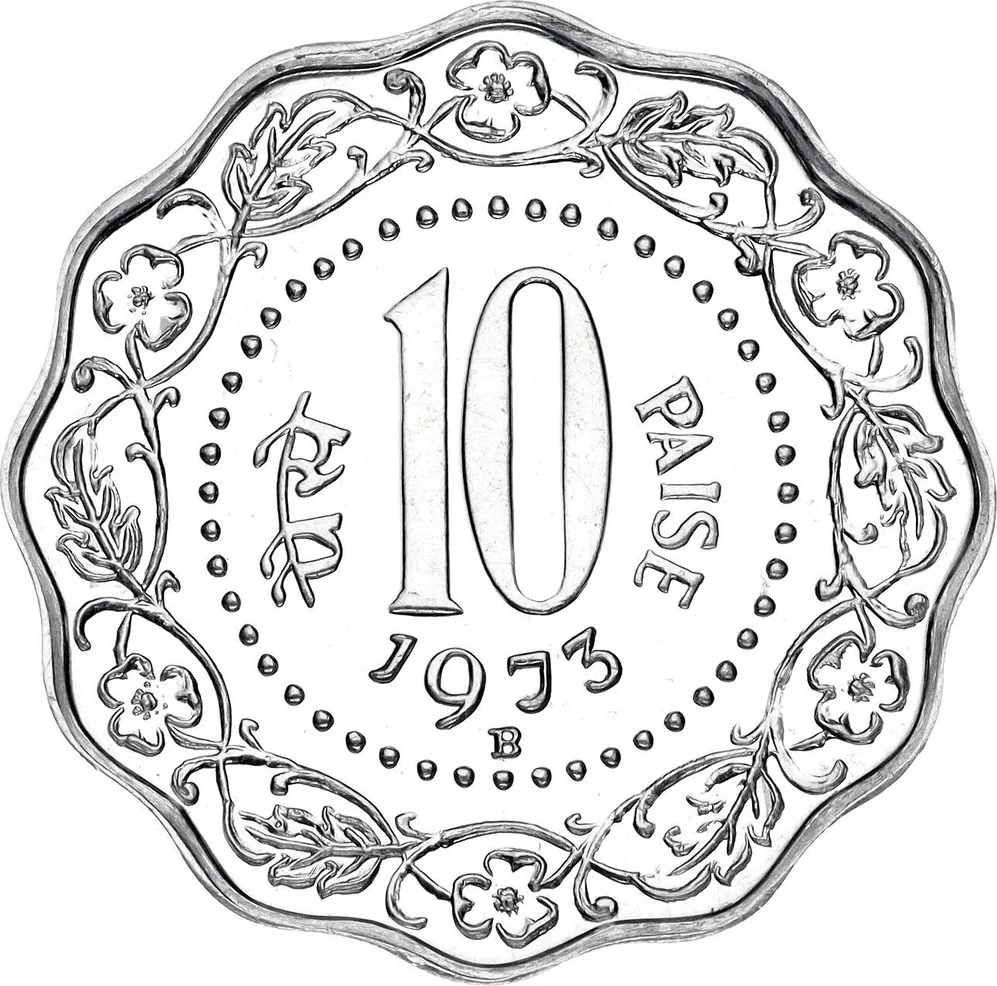
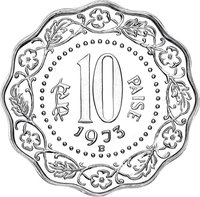
Denomination and date within beaded circle, wreath.
Inscription:
पैसे 10 PAISE
1980
1980
Translation:
Ten Paise
1980
1980
Scripts: Devanagari, Latin
Edge
Plain
Mints
| Name | Mark |
|---|---|
| Kolkata / Calcutta / Murshidabad | — |
| Hyderabad | * |
| Mumbai / Bombay | ♦ |
| Mumbai / Bombay | B |
Mintings
| Year | Mint Mark | Mintage | Quality | Collection |
|---|---|---|---|---|
| 1971 | ♦ | 146,100,000 | ||
| 1971 | — | — | ||
| 1971 | * | — | ||
| 1972 | — | — | ||
| 1972 | ♦ | 735,090,000 | ||
| 1972 | B | 7,895 | Proof | |
| 1973 | — | — | ||
| 1973 | * | — | ||
| 1973 | ♦ | — | ||
| 1973 | B | 7,567 | Proof | |
| 1974 | — | — | ||
| 1974 | * | — | ||
| 1974 | ♦ | — | ||
| 1975 | — | 298,830,000 | ||
| 1975 | ♦ | — | ||
| 1976 | — | — | ||
| 1977 | — | — | ||
| 1977 | ♦ | 25,288,000 | ||
| 1978 | — | — | ||
| 1978 | * | — | ||
| 1978 | ♦ | 48,215,000 | ||
| 1979 | * | — | ||
| 1979 | — | — | ||
| 1979 | ♦ | — | ||
| 1980 | — | — | ||
| 1980 | * | — | ||
| 1980 | ♦ | — | ||
| 1981 | ♦ | — | ||
| 1981 | — | — | ||
| 1982 | — | — | ||
| 1982 | * | — |
Historical background
In 1971, India's currency situation was shaped by the dual pressures of domestic economic challenges and the geopolitical backdrop of the Bangladesh Liberation War. The economy was grappling with persistent inflationary trends, a growing fiscal deficit due to increased government spending, and a strained balance of payments. These issues were exacerbated by the massive influx of over 10 million refugees from East Pakistan (now Bangladesh), which placed an enormous burden on public resources and foreign exchange reserves. The war effort itself, culminating in December 1971, required significant expenditure, further straining the nation's finances.
Monetarily, the Indian rupee was officially pegged to the British pound sterling under the Bretton Woods system of fixed exchange rates. However, the stability of this peg was under threat. Internationally, the year was marked by the Nixon Shock in August, where the United States suspended the convertibility of the US dollar to gold, leading to global monetary instability and the eventual collapse of the Bretton Woods system. This external shock created uncertainty for all currencies tied to the system, including the rupee, and prompted a broader realignment of exchange rates worldwide.
In response to these cumulative pressures, a significant devaluation of the rupee was widely discussed in financial circles throughout 1971, though the actual measure was implemented in December 1971, just after the war. The government, led by Prime Minister Indira Gandhi, devalued the rupee by 36.5% against the US dollar (from ₹4.76 to ₹7.50 per dollar) to improve export competitiveness and stabilize the external account. Thus, the year served as a critical prelude to this decisive monetary action, setting the stage for a major adjustment in India's economic policy to address both the immediate crisis of war and refugees and the longer-term structural issues facing the economy.
Monetarily, the Indian rupee was officially pegged to the British pound sterling under the Bretton Woods system of fixed exchange rates. However, the stability of this peg was under threat. Internationally, the year was marked by the Nixon Shock in August, where the United States suspended the convertibility of the US dollar to gold, leading to global monetary instability and the eventual collapse of the Bretton Woods system. This external shock created uncertainty for all currencies tied to the system, including the rupee, and prompted a broader realignment of exchange rates worldwide.
In response to these cumulative pressures, a significant devaluation of the rupee was widely discussed in financial circles throughout 1971, though the actual measure was implemented in December 1971, just after the war. The government, led by Prime Minister Indira Gandhi, devalued the rupee by 36.5% against the US dollar (from ₹4.76 to ₹7.50 per dollar) to improve export competitiveness and stabilize the external account. Thus, the year served as a critical prelude to this decisive monetary action, setting the stage for a major adjustment in India's economic policy to address both the immediate crisis of war and refugees and the longer-term structural issues facing the economy.
🌱 Very Common