

1 Real – Santiago del Estero
Argentina
Context
Year: 1823
Country: Argentina 
Issuer: Santiago del Estero
Period:
(1810—1831)
Currency:
(1823—1836)
Demonetized: Yes
Material

References
KM: #Click to copy to clipboard4
Numista: #164874
Obverse
Description:
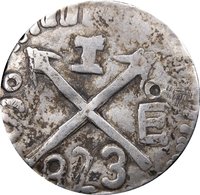
Eo with crossed arrows, date beneath.
Inscription:
So Eo
823
823
Reverse
Description:
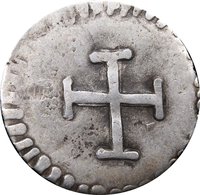
Sun encircled by rays.
Edge
Plain
Mintings
| Year | Mint Mark | Mintage | Quality | Collection |
|---|---|---|---|---|
| 1823 | — | — |
Historical background
In 1823, Santiago del Estero, like much of the newly independent Argentine Republic, was grappling with profound monetary chaos. The province operated within a fragmented economic system where the silver peso fuerte (strong peso) was the official ideal but was scarcely in circulation. Instead, the local economy relied heavily on a confusing mix of low-value copper moneda provincial (provincial coinage), worn Spanish colonial coins, and a flood of debased silver coins from Upper Peru (modern Bolivia). This scarcity of sound currency severely hampered official transactions and long-distance trade, creating a disconnect between the formal economy and daily commerce.
The root of the crisis was the absence of a central mint and the collapse of the colonial monetary authority. The national government in Buenos Aires, itself bankrupt and engaged in civil conflict, could not impose a uniform currency. Consequently, Santiago del Estero's economy became increasingly reliant on primitive barter for local exchange, while for any substantial commercial or fiscal activity, authorities had to accept a wide range of coins of uncertain and fluctuating value. This situation empowered local merchants and caudillos (strongmen) who controlled access to hard currency, further weakening the provincial treasury.
The monetary disarray directly impacted provincial finances and governance. Tax collection was problematic, as revenues came in a worthless mix of tokens and debased coin, making it difficult for the government to pay salaries or fund administrative functions. This economic instability fueled political instability, as competing local factions vied for control over the province's limited fiscal resources. Thus, in 1823, Santiago del Estero's currency situation was not merely an economic inconvenience but a fundamental obstacle to establishing functional statehood in the post-revolutionary period.
The root of the crisis was the absence of a central mint and the collapse of the colonial monetary authority. The national government in Buenos Aires, itself bankrupt and engaged in civil conflict, could not impose a uniform currency. Consequently, Santiago del Estero's economy became increasingly reliant on primitive barter for local exchange, while for any substantial commercial or fiscal activity, authorities had to accept a wide range of coins of uncertain and fluctuating value. This situation empowered local merchants and caudillos (strongmen) who controlled access to hard currency, further weakening the provincial treasury.
The monetary disarray directly impacted provincial finances and governance. Tax collection was problematic, as revenues came in a worthless mix of tokens and debased coin, making it difficult for the government to pay salaries or fund administrative functions. This economic instability fueled political instability, as competing local factions vied for control over the province's limited fiscal resources. Thus, in 1823, Santiago del Estero's currency situation was not merely an economic inconvenience but a fundamental obstacle to establishing functional statehood in the post-revolutionary period.

✨ Legendary