

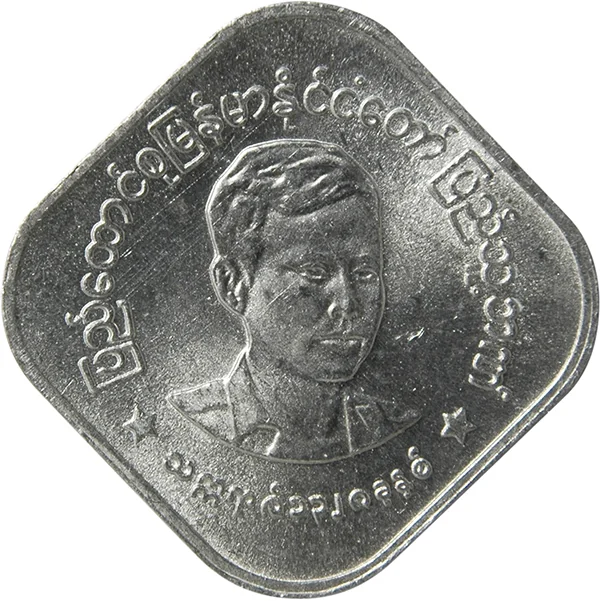
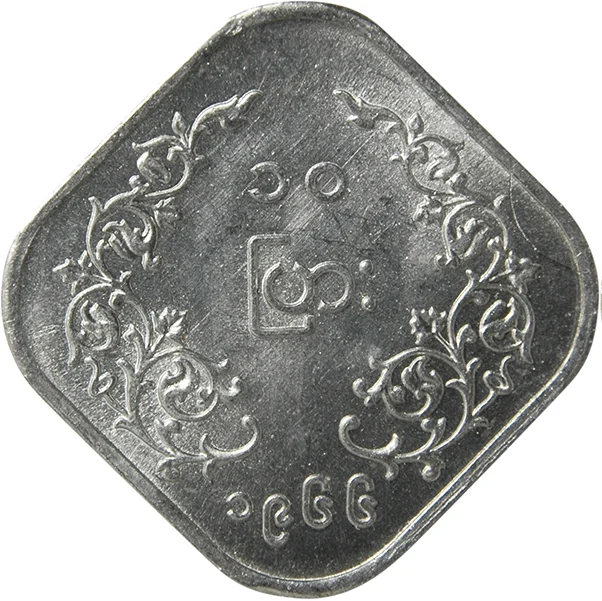
10 Pyas – Myanmar
Myanmar
Context

Material
Weight: 1 g
Thickness: 1.21 mm
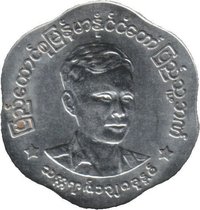
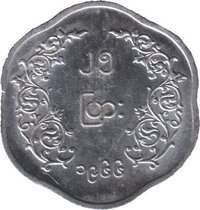
Shape: Square with rounded corners
Composition: Aluminium
Magnetic: No
Technique: Milled
Alignment: Medal alignment
flip
References
KM: #Click to copy to clipboard40
Numista: #1648
Value
Exchange value: 0.10 MMK
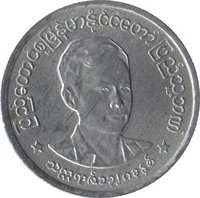
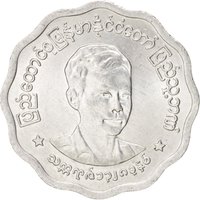
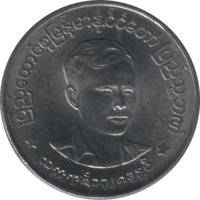
Obverse
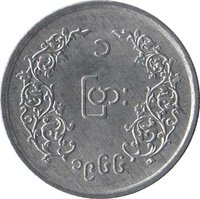
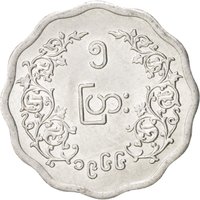
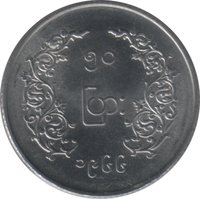
Reverse
Edge
Plain
Categories
| Person> Military leader |
| Person> Politician |
Mints
| Name | Mark |
|---|---|
| Berlin | — |
Mintings
| Year | Mint Mark | Mintage | Quality | Collection |
|---|---|---|---|---|
| 1966 | — | — |
Historical background
In 1966, Myanmar's currency situation was defined by the economic isolation and socialist policies of General Ne Win's Revolutionary Council, which had seized power in 1962. The regime had embarked on the "Burmese Way to Socialism," a radical program that nationalized industry, expelled foreign enterprises, and cut the country off from most international trade and investment. This autarkic approach severely damaged the formal economy, leading to shortages, a thriving black market, and a sharp decline in the value of the official kyat on unofficial exchanges. The government maintained a fixed official exchange rate, but this bore little relation to the currency's real purchasing power or its value on the burgeoning parallel market.
The year was particularly significant as it followed the dramatic demonetization of March 1964, when the government nullified 50- and 100-kyat notes without compensation in an attempt to cripple black marketeers and ethnic insurgents. By 1966, the fallout from this move was deeply felt: public trust in the kyat was shattered, and hoarding of goods and foreign currency became commonplace. The economy was increasingly bifurcated into a crippled official sector using the kyat and a vital underground economy where US dollars, Thai baht, and Indian rupees circulated widely, often at rates many times more favorable than the government's fixed parity.
Consequently, by 1966, Myanmar's currency landscape was one of profound dislocation. The kyat was increasingly irrelevant for international transactions, and the country's foreign reserves were depleted. The black market exchange rate served as the true barometer of economic health, revealing a vast gap between government proclamations and the harsh realities of inflation and scarcity. This monetary crisis was a direct symptom of the wider economic mismanagement under the socialist regime, setting a trajectory of stagnation and informal economic activity that would persist for decades.
The year was particularly significant as it followed the dramatic demonetization of March 1964, when the government nullified 50- and 100-kyat notes without compensation in an attempt to cripple black marketeers and ethnic insurgents. By 1966, the fallout from this move was deeply felt: public trust in the kyat was shattered, and hoarding of goods and foreign currency became commonplace. The economy was increasingly bifurcated into a crippled official sector using the kyat and a vital underground economy where US dollars, Thai baht, and Indian rupees circulated widely, often at rates many times more favorable than the government's fixed parity.
Consequently, by 1966, Myanmar's currency landscape was one of profound dislocation. The kyat was increasingly irrelevant for international transactions, and the country's foreign reserves were depleted. The black market exchange rate served as the true barometer of economic health, revealing a vast gap between government proclamations and the harsh realities of inflation and scarcity. This monetary crisis was a direct symptom of the wider economic mismanagement under the socialist regime, setting a trajectory of stagnation and informal economic activity that would persist for decades.
🌱 Very Common