

20 Mils – British Palestine
Israel
Context
Years: 1942–1944
Country: Israel 
Issuer: British Palestine
Period:
(1920—1948)
Currency:
(1927—1948)
Demonetization: 1952
Total mintage: 2,100,000
Material
Diameter: 30.5 mm
Weight: 11.3 g
Thickness: 2.15 mm
Shape: Round with a round hole
Composition: Bronze
Magnetic: No
Technique: Milled
Alignment: Medal alignment
flip
References
KM: #Click to copy to clipboard5a
Numista: #16464
Obverse
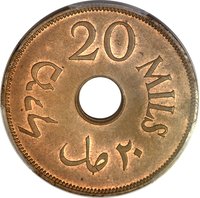
Description:
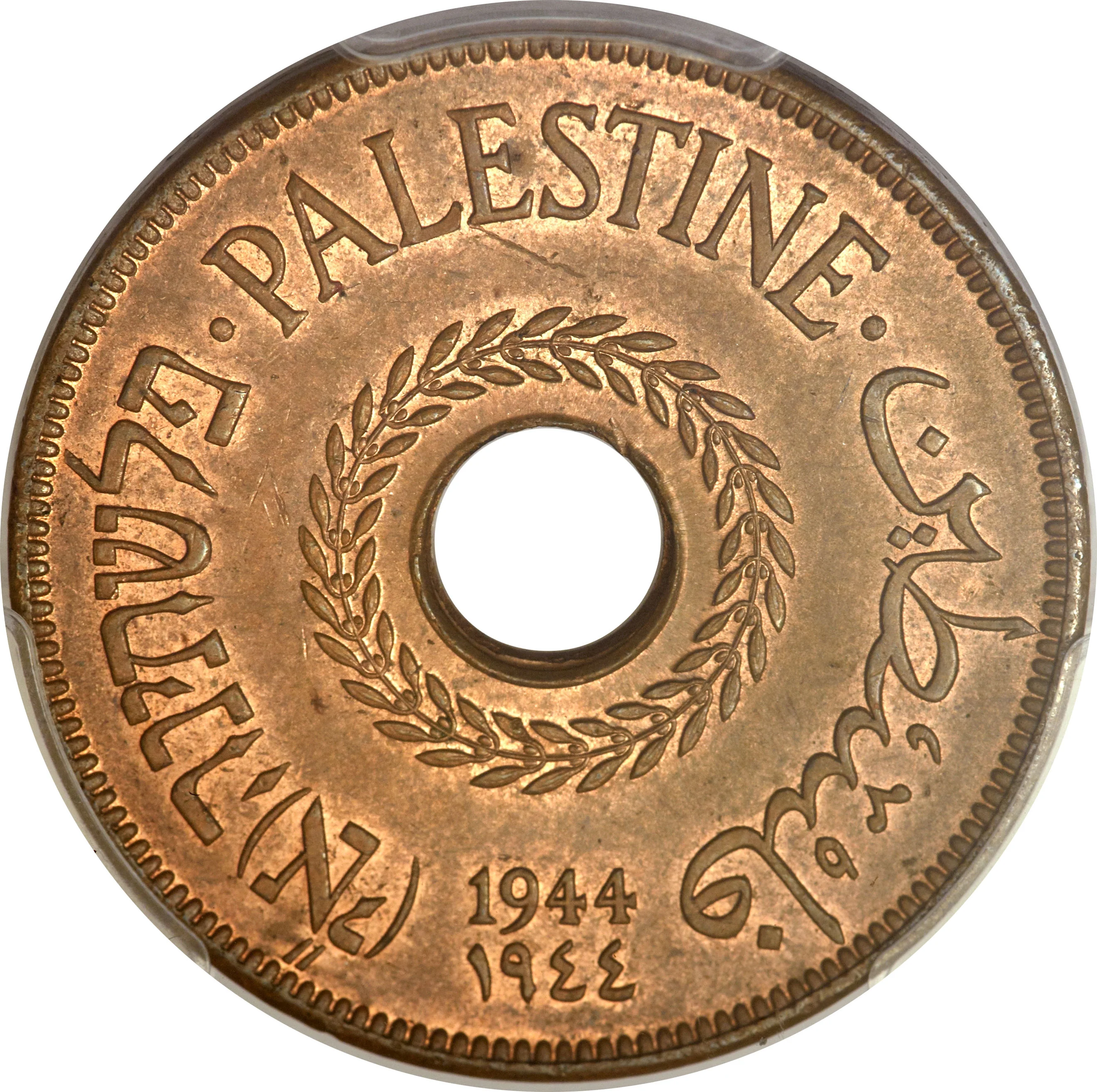
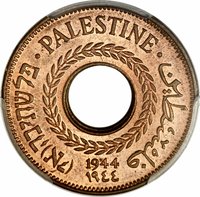
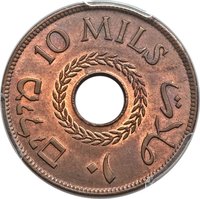
Central hole encircled by a stylized olive wreath. "Palestine" appears in Hebrew, English, and Arabic, with the date below in English and Arabic.
Inscription:
(פלשתינה(א"י • PALESTINE • فلسطين
1944
١٩٤٤
1944
١٩٤٤
Translation:
Palestine (Eretz Yisrael) • PALESTINE • Palestine
1944
1944
1944
1944
Reverse
Edge
Mints
| Name | Mark |
|---|---|
| Royal Mint (Tower Hill) | — |
Mintings
| Year | Mint Mark | Mintage | Quality | Collection |
|---|---|---|---|---|
| 1942 | — | 1,100,000 | ||
| 1944 | — | 1,000,000 |
Historical background
In 1942, the currency situation in British Mandatory Palestine was defined by the Palestine Pound (£P), a currency board system established in 1927 and pegged at parity to the British Pound Sterling. This arrangement provided monetary stability but meant local authorities had no independent control over monetary policy. The currency was issued by the Palestine Currency Board in London, with notes and coins circulating alongside those of other currencies, particularly Egyptian and French, in the wider Levant.
The Second World War profoundly impacted this system. To support the massive British and Allied military presence in the region—a key front against the Axis—huge amounts of currency were imported to pay for troops, supplies, and infrastructure. This led to a significant increase in the money supply, which, combined with wartime shortages and disrupted trade, created strong inflationary pressures. Rationing and price controls were implemented to manage these pressures, but the cost of living rose steadily.
Furthermore, the war accelerated the development of a localized banking and financial sector. The Histadrut (General Federation of Labour) and other Zionist institutions expanded their credit cooperatives and financial operations to support the growing Jewish wartime economy and agricultural settlements. This period saw the strengthening of the financial foundations that would later underpin the future State of Israel, even as the official currency remained the British-administered Palestine Pound until the end of the Mandate.
The Second World War profoundly impacted this system. To support the massive British and Allied military presence in the region—a key front against the Axis—huge amounts of currency were imported to pay for troops, supplies, and infrastructure. This led to a significant increase in the money supply, which, combined with wartime shortages and disrupted trade, created strong inflationary pressures. Rationing and price controls were implemented to manage these pressures, but the cost of living rose steadily.
Furthermore, the war accelerated the development of a localized banking and financial sector. The Histadrut (General Federation of Labour) and other Zionist institutions expanded their credit cooperatives and financial operations to support the growing Jewish wartime economy and agricultural settlements. This period saw the strengthening of the financial foundations that would later underpin the future State of Israel, even as the official currency remained the British-administered Palestine Pound until the end of the Mandate.
🌱 Fairly Common