

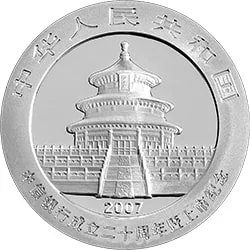
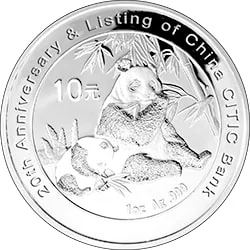
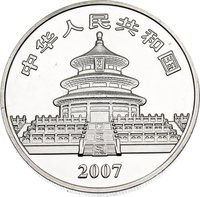
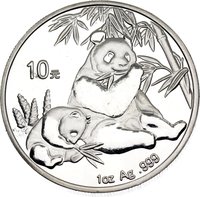
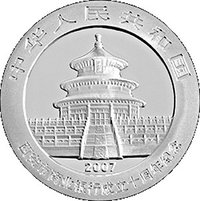
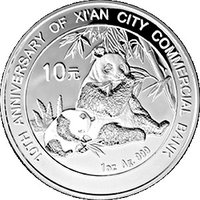
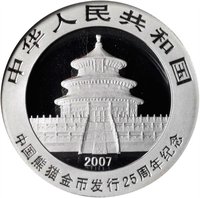
10 yuan – People's Republic of China
Add to wishlist
Non-circulating coins
Series: Panda Bullion
China
Context
Year: 2007
Country: China
Issuer: People's Republic of China
Period:
(since 1949)
Currency:
(since 1955)
Total mintage: 20,000
Material
Diameter: 40 mm
Weight: 31.11 g
Silver Weight:: 31.08 g
Shape: Round
Composition: 99.9% Silver
Standard: Silver ounce
Magnetic: No
Technique: Milled
Alignment: Medal alignment
flip
References
KM: #
Numista: #164565
Value
Exchange value: 10 CNY
Bullion value: $79.42
Inflation-adjusted value: 14.98 CNY
Mintings
| Year | Mint Mark | Mintage | Quality | Collection |
|---|---|---|---|---|
| 2007 | — | 20,000 | Proof |
Historical background
In 2007, the People's Republic of China was navigating a complex currency situation defined by managed appreciation and mounting international pressure. The Chinese yuan (Renminbi, RMB) was effectively pegged to the U.S. dollar until a pivotal reform in July 2005, which revalued it by 2.1% and shifted it to a managed float against a basket of currencies. By 2007, this policy had resulted in a gradual, controlled appreciation of approximately 6% against the dollar for the year, cumulatively around 12% since the reform. This cautious approach was designed to allow domestic export-oriented industries, a cornerstone of China's economic growth, time to adjust without facing sudden competitive shocks.
Domestically, the currency policy intersected with significant macroeconomic challenges, primarily overheating and rising inflation, which hit a then 11-year high of 4.8% for the year. The People's Bank of China (PBOC) faced a difficult trilemma: managing the exchange rate, controlling capital flows, and conducting independent monetary policy. To curb liquidity and inflation, the PBOC raised interest rates six times and reserve requirement ratios ten times in 2007. However, expectations of continued yuan appreciation fueled speculative "hot money" inflows, complicating these tightening efforts and contributing to asset price inflation, particularly in stock and real estate markets.
Internationally, China faced intense criticism, especially from the United States and the European Union, which argued the yuan was significantly undervalued, giving Chinese exports an unfair trade advantage and contributing to global imbalances. Pressure from the U.S. Congress for punitive tariffs was a constant backdrop. Chinese authorities defended their gradualist stance as essential for maintaining domestic financial and social stability. The year ended with the RMB's appreciation accelerating slightly in the fourth quarter, signaling a response to both external pressure and internal economic imperatives, while firmly retaining state control over the currency's pace and trajectory.
Domestically, the currency policy intersected with significant macroeconomic challenges, primarily overheating and rising inflation, which hit a then 11-year high of 4.8% for the year. The People's Bank of China (PBOC) faced a difficult trilemma: managing the exchange rate, controlling capital flows, and conducting independent monetary policy. To curb liquidity and inflation, the PBOC raised interest rates six times and reserve requirement ratios ten times in 2007. However, expectations of continued yuan appreciation fueled speculative "hot money" inflows, complicating these tightening efforts and contributing to asset price inflation, particularly in stock and real estate markets.
Internationally, China faced intense criticism, especially from the United States and the European Union, which argued the yuan was significantly undervalued, giving Chinese exports an unfair trade advantage and contributing to global imbalances. Pressure from the U.S. Congress for punitive tariffs was a constant backdrop. Chinese authorities defended their gradualist stance as essential for maintaining domestic financial and social stability. The year ended with the RMB's appreciation accelerating slightly in the fourth quarter, signaling a response to both external pressure and internal economic imperatives, while firmly retaining state control over the currency's pace and trajectory.
Series: Panda Bullion
✨ Legendary