

2000 yuan – People's Republic of China
Add to wishlist
China
Context
Year: 2001
Country: China
Issuer: People's Republic of China
Period:
(since 1949)
Currency:
(since 1955)
Total mintage: 288
Material
Diameter: 60 mm
Weight: 155.52 g
Gold Weight:: 155.36 g
Shape: Round
Composition: 99.9% Gold
Standard: Silver 5 ounces
Magnetic: No
Technique: Milled
Alignment: Medal alignment
flip
References
KM: #
Numista: #164475
Value
Exchange value: 2000 CNY
Bullion value: $23916.44
Inflation-adjusted value: 3254.90 CNY
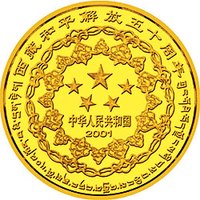
Obverse
Description:
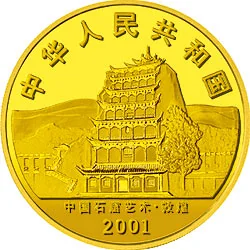
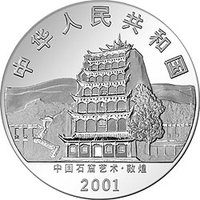
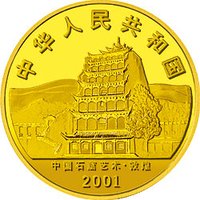
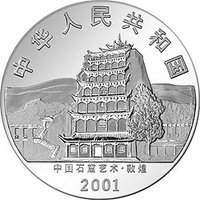
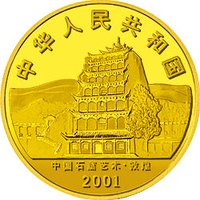
Eight-story building
Script: Chinese
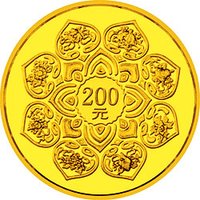
Reverse
Description:
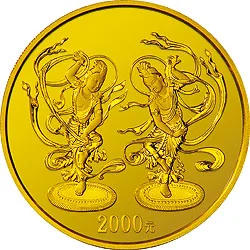
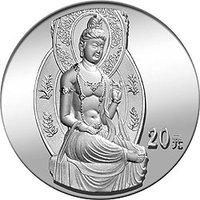
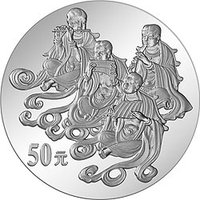
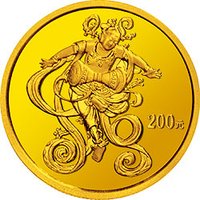
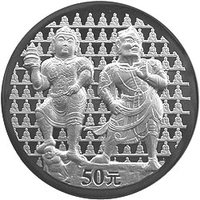
Two dancers.
Script: Chinese
Edge
Reeded
Mintings
| Year | Mint Mark | Mintage | Quality | Collection |
|---|---|---|---|---|
| 2001 | — | 288 | Proof |
Historical background
In 2001, the People's Republic of China's currency, the Renminbi (RMB), with its primary unit the yuan (CNY), operated under a tightly managed exchange rate regime, pegged to the US dollar at approximately 8.28. This fixed peg, established in the aftermath of the 1997 Asian Financial Crisis to ensure stability, was a cornerstone of China's economic policy. It provided a predictable environment for the booming export-oriented manufacturing sector, which was a critical engine of growth and a major source of foreign exchange reserves. However, this policy drew increasing international criticism, particularly from trading partners like the United States, which argued the yuan was significantly undervalued, giving Chinese exports an unfair price advantage and contributing to large global trade imbalances.
Domestically, the currency regime supported China's pivotal year of 2001, which was marked by its accession to the World Trade Organization (WTO) in December. Entry into the WTO promised further integration into the global economy and an influx of foreign investment, but it also intensified external pressure for financial liberalization and a more flexible, market-driven currency. Internally, the People's Bank of China (PBOC) faced the complex task of maintaining monetary control under the peg, as large trade surpluses and capital inflows created persistent pressures for yuan appreciation and complicated domestic liquidity management.
Thus, the currency situation in 2001 was one of apparent stability masking underlying tensions. The fixed peg served as a shield during a period of major economic transition and global integration, but it was increasingly seen as unsustainable. The year ended with China committed to its WTO obligations, which would necessitate broader financial reforms, setting the stage for the eventual but carefully calibrated move toward greater exchange rate flexibility that would begin in 2005.
Domestically, the currency regime supported China's pivotal year of 2001, which was marked by its accession to the World Trade Organization (WTO) in December. Entry into the WTO promised further integration into the global economy and an influx of foreign investment, but it also intensified external pressure for financial liberalization and a more flexible, market-driven currency. Internally, the People's Bank of China (PBOC) faced the complex task of maintaining monetary control under the peg, as large trade surpluses and capital inflows created persistent pressures for yuan appreciation and complicated domestic liquidity management.
Thus, the currency situation in 2001 was one of apparent stability masking underlying tensions. The fixed peg served as a shield during a period of major economic transition and global integration, but it was increasingly seen as unsustainable. The year ended with China committed to its WTO obligations, which would necessitate broader financial reforms, setting the stage for the eventual but carefully calibrated move toward greater exchange rate flexibility that would begin in 2005.
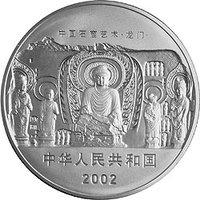
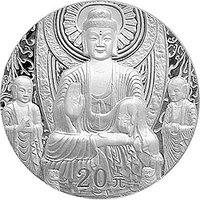
Series: Grotto Art
✨ Legendary