

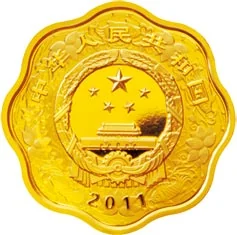
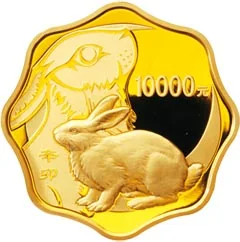
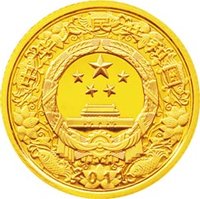
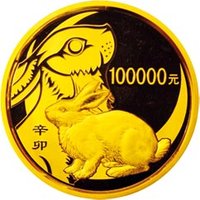
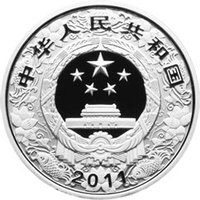
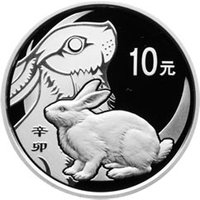
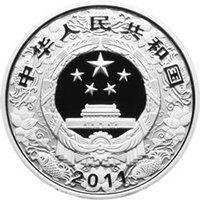
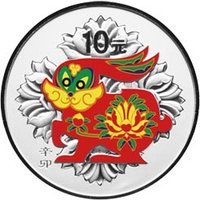
10000 Yuan – People's Republic of China
China
Context
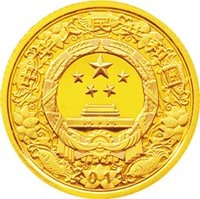
Year: 2011
Country: China 
Issuer: People's Republic of China
Period:
(since 1949)
Currency:
(since 1955)
Total mintage: 118
Material
Diameter: 100 mm
Weight: 1000 g
Gold weight: 999.00 g
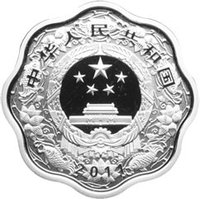
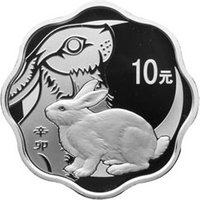
Shape: Scalloped
Composition: 99.9% Gold
Standard: Silver kilo
Magnetic: No
Technique: Milled
Alignment: Medal alignment
flip
References
KM: #Click to copy to clipboard1961
Numista: #164413
Value
Exchange value: 10000 CNY = $1461.71
Bullion value: $166566.91
Inflation-adjusted value: 13175.50 CNY
Categories
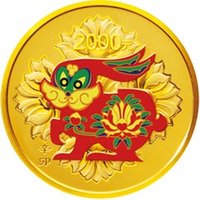
| Animal> Rabbit |
| Astrology> Chinese calendar |
Mintings
| Year | Mint Mark | Mintage | Quality | Collection |
|---|---|---|---|---|
| 2011 | — | 118 | Proof |
Historical background
In 2011, the People's Republic of China was navigating a complex currency landscape defined by controlled internationalization and mounting external pressure. The Chinese yuan (Renminbi, RMB) remained under a managed float regime, pegged to a basket of currencies rather than just the US dollar, but with its daily trading band tightly restricted by the People's Bank of China (PBOC). A primary focus was the gradual promotion of the RMB for use in cross-border trade settlement, a key pillar of the government's long-term strategy to reduce reliance on the US dollar in global commerce and enhance its financial influence. This period saw significant expansion of pilot programs, allowing more Chinese and foreign companies to invoice and settle transactions in RMB.
Internationally, 2011 was a year of intensified political and economic scrutiny on China's currency policy. The United States and other major trading partners continued to accuse China of deliberately undervaluing the RMB to gain an unfair export advantage, leading to calls for faster appreciation. In response to both external pressure and domestic inflationary concerns, the PBOC allowed the RMB to appreciate modestly against the dollar throughout the year, by approximately 4-5%. However, this measured pace failed to satisfy critics, and the currency issue remained a persistent point of tension in international forums like the G20.
Domestically, the currency policy was intertwined with broader macroeconomic challenges. China was grappling with high inflation, driven partly by massive stimulus spending in the wake of the 2008 global financial crisis. Allowing faster currency appreciation was seen as a tool to help curb imported inflation by making foreign goods cheaper. Simultaneously, authorities were cautiously laying the groundwork for the RMB's future role as a reserve currency, establishing offshore RMB hubs (starting with Hong Kong) and authorizing the issuance of "dim sum bonds." Thus, 2011 represented a careful balancing act: managing gradual appreciation for domestic and international stability while methodically building the architecture for the RMB's global ambitions.
Internationally, 2011 was a year of intensified political and economic scrutiny on China's currency policy. The United States and other major trading partners continued to accuse China of deliberately undervaluing the RMB to gain an unfair export advantage, leading to calls for faster appreciation. In response to both external pressure and domestic inflationary concerns, the PBOC allowed the RMB to appreciate modestly against the dollar throughout the year, by approximately 4-5%. However, this measured pace failed to satisfy critics, and the currency issue remained a persistent point of tension in international forums like the G20.
Domestically, the currency policy was intertwined with broader macroeconomic challenges. China was grappling with high inflation, driven partly by massive stimulus spending in the wake of the 2008 global financial crisis. Allowing faster currency appreciation was seen as a tool to help curb imported inflation by making foreign goods cheaper. Simultaneously, authorities were cautiously laying the groundwork for the RMB's future role as a reserve currency, establishing offshore RMB hubs (starting with Hong Kong) and authorizing the issuance of "dim sum bonds." Thus, 2011 represented a careful balancing act: managing gradual appreciation for domestic and international stability while methodically building the architecture for the RMB's global ambitions.
Series: Chinese Zodiac Bullion
✨ Legendary