

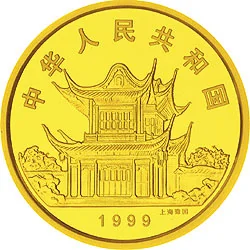
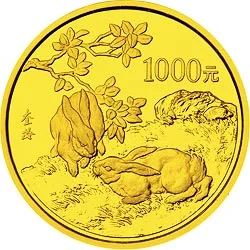
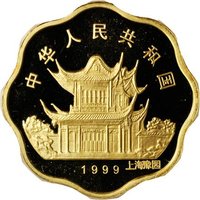
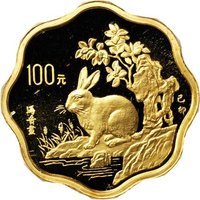
1000 yuan – People's Republic of China
Add to wishlist
China
Context
Year: 1999
Country: China
Issuer: People's Republic of China
Period:
(since 1949)
Currency:
(since 1955)
Total mintage: 99
Material
References
KM: #
Numista: #164103
Value
Exchange value: 1000 CNY
Bullion value: $56845.59
Inflation-adjusted value: 1610.28 CNY
Mintings
| Year | Mint Mark | Mintage | Quality | Collection |
|---|---|---|---|---|
| 1999 | — | 99 | Proof |
Historical background
In 1999, the People's Republic of China was navigating a crucial period of economic stability and international integration following the turbulence of the 1997 Asian Financial Crisis. The cornerstone of the currency situation was a de facto peg of the Renminbi (RMB) to the US dollar at approximately 8.28 RMB/USD, a policy maintained since 1994. This fixed exchange rate regime was a deliberate tool of the People's Bank of China (PBOC) to provide certainty for exporters and foreign investment, which were vital engines of the country's rapid growth. The policy proved successful in shielding China from the competitive devaluations and capital flight that afflicted many regional neighbors, bolstering the country's foreign exchange reserves and reinforcing its reputation as a stable economic haven.
Domestically, the currency was strictly non-convertible on the capital account, meaning it could not be freely exchanged for foreign currencies for investment purposes. This "capital controls firewall" allowed Chinese authorities to manage monetary policy independently and prevent speculative attacks on the currency. However, the RMB was convertible for current account transactions (trade in goods and services), facilitating the country's booming export sector. A significant background issue was the dual exchange rate system that had officially ended in 1994, but in practice, a gap persisted between the official rate and the black-market rate, reflecting underlying pressures and demand for foreign currency.
Looking forward, 1999 was a year of laying groundwork for future reform. While steadfastly maintaining the peg for stability, Chinese policymakers and economists were actively debating the long-term path toward greater exchange rate flexibility and eventual full convertibility. This period of enforced stability after the regional crisis provided China with the time and accumulating reserves (which grew steadily throughout the year) to build a stronger financial system, a necessary precursor to the more market-oriented exchange rate reforms that would gradually unfold in the following decade, particularly after 2005.
Domestically, the currency was strictly non-convertible on the capital account, meaning it could not be freely exchanged for foreign currencies for investment purposes. This "capital controls firewall" allowed Chinese authorities to manage monetary policy independently and prevent speculative attacks on the currency. However, the RMB was convertible for current account transactions (trade in goods and services), facilitating the country's booming export sector. A significant background issue was the dual exchange rate system that had officially ended in 1994, but in practice, a gap persisted between the official rate and the black-market rate, reflecting underlying pressures and demand for foreign currency.
Looking forward, 1999 was a year of laying groundwork for future reform. While steadfastly maintaining the peg for stability, Chinese policymakers and economists were actively debating the long-term path toward greater exchange rate flexibility and eventual full convertibility. This period of enforced stability after the regional crisis provided China with the time and accumulating reserves (which grew steadily throughout the year) to build a stronger financial system, a necessary precursor to the more market-oriented exchange rate reforms that would gradually unfold in the following decade, particularly after 2005.
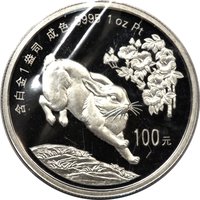
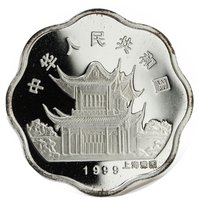
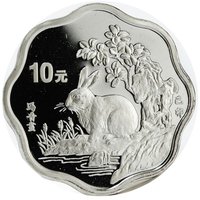
Series: Chinese Zodiac Bullion

✨ Legendary