

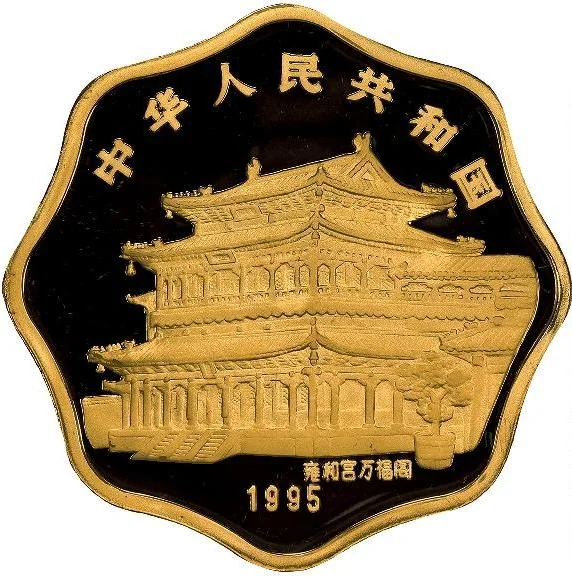
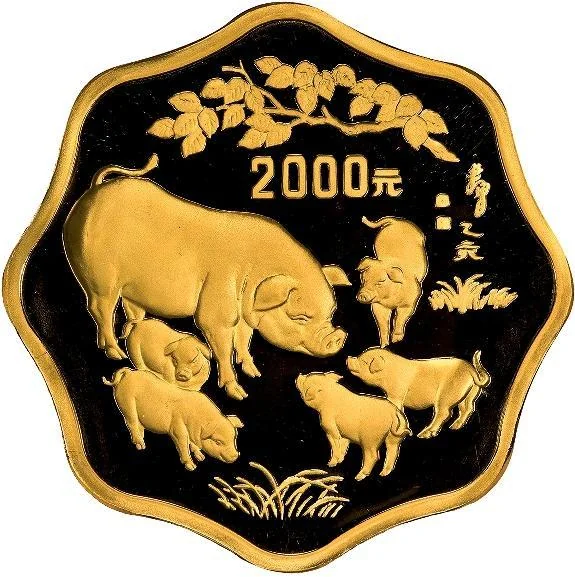
2000 Yuan – People's Republic of China
China
Context
Year: 1995
Country: China 
Issuer: People's Republic of China
Period:
(since 1949)
Currency:
(since 1955)
Total mintage: 15
Material
Diameter: 100 mm
Weight: 1000 g
Gold weight: 999.00 g
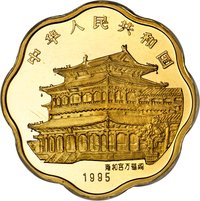
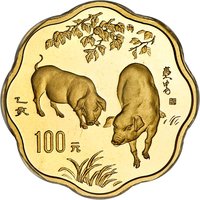
Shape: Scalloped
Composition: 99.9% Gold
Standard: Silver kilo
Magnetic: No
Technique: Milled
Alignment: Medal alignment
flip
References
KM: #Click to copy to clipboard754
Numista: #163989
Value
Exchange value: 2000 CNY = $292.34
Bullion value: $166563.70
Inflation-adjusted value: 4155.28 CNY
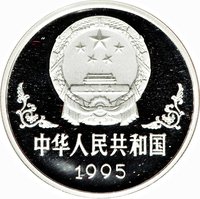
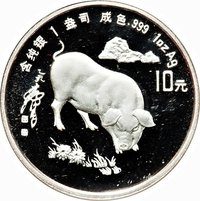
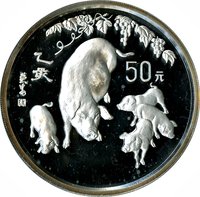
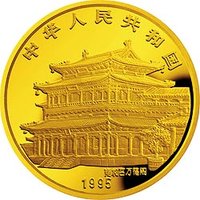
Obverse
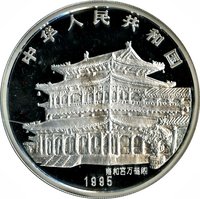
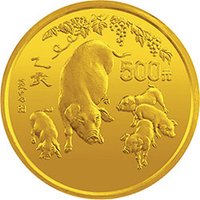
Reverse
Edge
Plain
Categories
| Astrology> Chinese calendar |
Mintings
| Year | Mint Mark | Mintage | Quality | Collection |
|---|---|---|---|---|
| 1995 | — | 15 | Proof |
Historical background
In 1995, the People's Republic of China was navigating a critical juncture in its economic transformation, with its currency, the Renminbi (RMB), at the center of complex policy challenges. Following the landmark economic reforms of the late 1970s and early 1980s, China had established a dual-exchange rate system to manage its integration into the global economy. This system consisted of an official fixed rate, used for planned economic activities, and a more market-driven swap rate (in the Foreign Exchange Adjustment Centers, or "swap centers") for trade and investment transactions. By 1994, a major unification reform had collapsed these rates, creating a single managed floating rate pegged to the US dollar at approximately 8.7 RMB. The primary goal for 1995 was to consolidate this reform, stabilize the new unified rate, and combat high inflation that had exceeded 20% in 1994.
The currency situation was tightly managed by the People's Bank of China (PBOC) to serve broader macroeconomic stabilization goals. Authorities intervened heavily in the foreign exchange market to maintain the peg, accumulating substantial foreign exchange reserves in the process. This peg provided crucial stability for export-oriented industries, which were becoming the engine of China's economic growth. However, the RMB was not freely convertible on the capital account; strict controls remained on cross-border financial flows to prevent speculative capital movements and maintain monetary policy independence. Domestically, the success in reducing inflation through tight credit policies in 1995 helped bolster confidence in the currency's value.
Internationally, the RMB in 1995 was considered a largely inconvertible and undervalued currency, reflecting China's status as a developing economy with a rapidly expanding trade surplus. While the unification reform was a significant step toward a more market-based system, it did not signify a move toward full convertibility. The situation set the stage for the next two decades of gradual internationalization, with the stability achieved in 1995 providing the foundation for China's export boom and its eventual rise as a global trading power, while deferring more liberal currency reforms to the distant future.
The currency situation was tightly managed by the People's Bank of China (PBOC) to serve broader macroeconomic stabilization goals. Authorities intervened heavily in the foreign exchange market to maintain the peg, accumulating substantial foreign exchange reserves in the process. This peg provided crucial stability for export-oriented industries, which were becoming the engine of China's economic growth. However, the RMB was not freely convertible on the capital account; strict controls remained on cross-border financial flows to prevent speculative capital movements and maintain monetary policy independence. Domestically, the success in reducing inflation through tight credit policies in 1995 helped bolster confidence in the currency's value.
Internationally, the RMB in 1995 was considered a largely inconvertible and undervalued currency, reflecting China's status as a developing economy with a rapidly expanding trade surplus. While the unification reform was a significant step toward a more market-based system, it did not signify a move toward full convertibility. The situation set the stage for the next two decades of gradual internationalization, with the stability achieved in 1995 providing the foundation for China's export boom and its eventual rise as a global trading power, while deferring more liberal currency reforms to the distant future.
Series: Chinese Zodiac Bullion
✨ Legendary