

10 centavos – São Tomé and Príncipe
Add to wishlist
Sao Tome and Principe
Context
Year: 1971
Country: Sao Tome and Principe
Issuer: São Tomé and Príncipe
Period:
(1951—1975)
Currency:
(1914—1974)
Demonetized: Yes
Total mintage: 1,000,000
Material
References
KM: #
Numista: #16380
Obverse
Description:
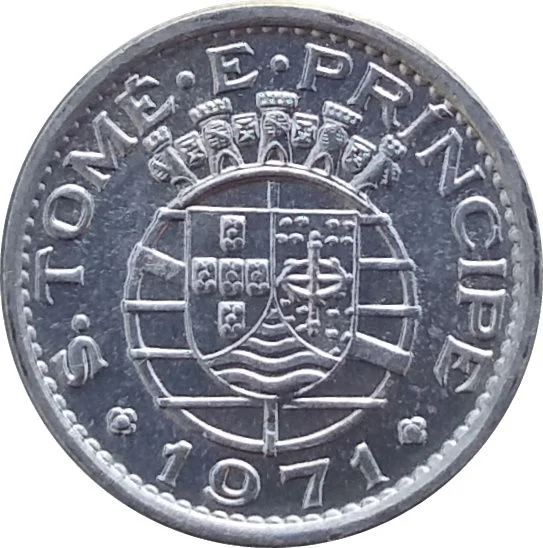
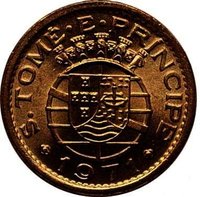
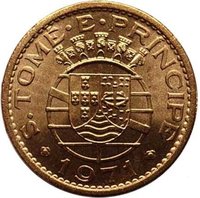
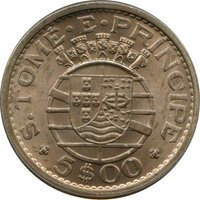
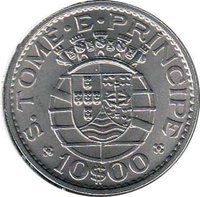
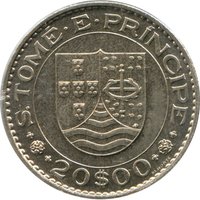
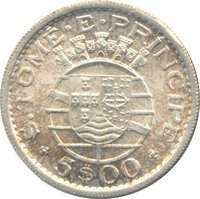
Portuguese São Tomé and Príncipe coat of arms (1951–1975)
Inscription:
S. TOME. E. PRINCIPE 1971
Script: Latin
Reverse
Inscription:
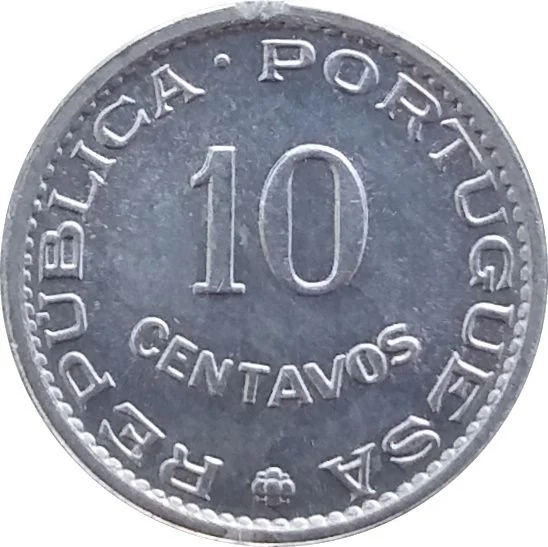
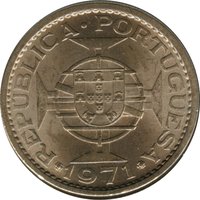
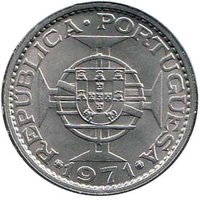
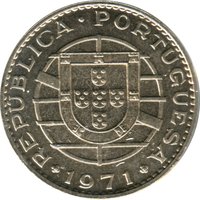
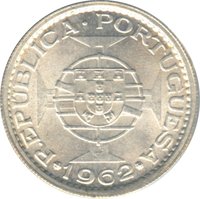
REPUBLICA PORTUGUESA
10 CENTAVOS
10 CENTAVOS
Translation:
Portuguese Republic
10 Centavos
10 Centavos
Script: Latin
Language: Portuguese
Edge
Plain
Categories
| Symbols> Coat of Arms |
Mints
| Name | Mark |
|---|---|
| Imprensa Nacional - Casa da Moeda | — |
Mintings
| Year | Mint Mark | Mintage | Quality | Collection |
|---|---|---|---|---|
| 1971 | — | 1,000,000 |
Historical background
In 1971, São Tomé and Príncipe was an overseas province of Portugal, and its currency situation was entirely dictated by the colonial metropole. The official currency in circulation was the São Tomé and Príncipe escudo (STPE), which had been introduced in 1929 to replace the real. Crucially, it was pegged at par with the Portuguese escudo (PTE), meaning the two currencies were considered equivalent in value and fully interchangeable within the Portuguese monetary area. This peg ensured that the island's economy was financially integrated with and subordinate to Portugal's, with monetary policy set entirely in Lisbon.
The economy itself was dominated by Portuguese-owned plantation agriculture, primarily for cocoa, coffee, and copra. This export-oriented structure meant that foreign exchange earnings were controlled by a small number of rogas (plantations) and channeled through the Portuguese banking system. The Banco Nacional Ultramarino (BNU), as the issuing bank for Portugal's overseas territories, was the sole note-issuing authority and the central financial institution on the islands. There was no independent monetary authority or exchange control specific to São Tomé and Príncipe; its currency's stability and convertibility were entirely dependent on the Portuguese escudo's performance on the international stage.
This arrangement would remain firmly in place until the April 1974 Carnation Revolution in Portugal, which set the process of decolonization in motion. Following independence in 1975, the new government initially maintained the peg, but soon moved to establish distinct national financial institutions. In 1977, the dobra (STD) was introduced to replace the escudo, marking the first step toward an independent monetary policy for the newly sovereign nation.
The economy itself was dominated by Portuguese-owned plantation agriculture, primarily for cocoa, coffee, and copra. This export-oriented structure meant that foreign exchange earnings were controlled by a small number of rogas (plantations) and channeled through the Portuguese banking system. The Banco Nacional Ultramarino (BNU), as the issuing bank for Portugal's overseas territories, was the sole note-issuing authority and the central financial institution on the islands. There was no independent monetary authority or exchange control specific to São Tomé and Príncipe; its currency's stability and convertibility were entirely dependent on the Portuguese escudo's performance on the international stage.
This arrangement would remain firmly in place until the April 1974 Carnation Revolution in Portugal, which set the process of decolonization in motion. Following independence in 1975, the new government initially maintained the peg, but soon moved to establish distinct national financial institutions. In 1977, the dobra (STD) was introduced to replace the escudo, marking the first step toward an independent monetary policy for the newly sovereign nation.
🌱 Common