

100 Soles (Peru-Spain Naval Battle) – Peru
Non-circulating coins
Commemoration: 100th Anniversary of Peru-Spain Naval Battle
Peru
Material
References
KM: #Click to copy to clipboard251
Numista: #106134
Value
Exchange value: 100 PEH
Bullion value: $7027.03
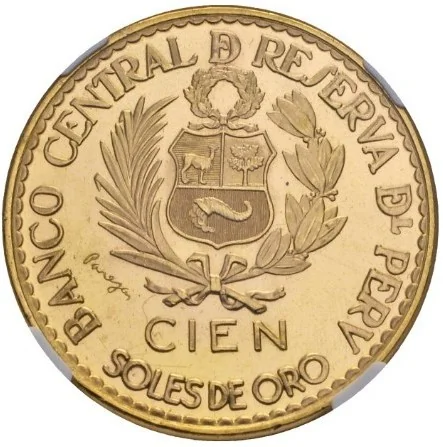
Obverse
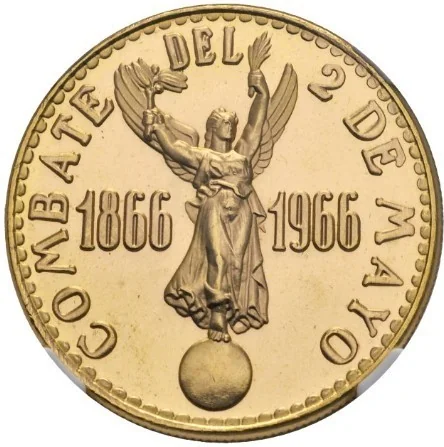
Reverse
Description:
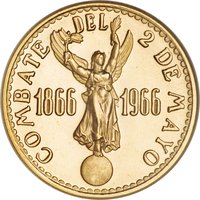
Victory on globe splits dates.
Inscription:
COMBATE DEL 2 DE MAYO
1866 1966
1866 1966
Script: Latin
Edge
Mintings
| Year | Mint Mark | Mintage | Quality | Collection |
|---|---|---|---|---|
| 1966 | — | 6,253 | Proof |
Historical background
In 1966, Peru operated under a fixed exchange rate system, with the sol pegged to the U.S. dollar at a rate of 26.82 soles per dollar, a parity established in 1960. This period fell within the moderate and relatively stable early years of the first government of President Fernando Belaúnde Terry (1963-1968). The economy was experiencing growth, driven by exports of minerals, fishmeal, and agricultural products, which provided sufficient foreign exchange reserves to maintain the peg. The currency regime was managed by the Central Reserve Bank of Peru, and the sol was considered stable, with inflation under control by regional standards.
However, underlying pressures were beginning to mount. A significant fiscal deficit, fueled by Belaúnde's ambitious public infrastructure and social spending programs, was increasingly financed by monetary expansion from the central bank. Furthermore, while export revenues were strong, they were vulnerable to commodity price fluctuations. A critical and growing strain was the overvaluation of the sol, which made imports artificially cheap and exports less competitive over time, subtly eroding the country's trade balance. These imbalances were not yet acute in 1966, but they sowed the seeds for future instability.
Consequently, 1966 represents a calm before the storm in Peru's monetary history. The fixed exchange rate provided a facade of stability, but the macroeconomic policies supporting it were becoming unsustainable. The pressures building beneath the surface would, within a few years, culminate in a severe balance of payments crisis, leading to a major devaluation in 1967 and the eventual abandonment of the fixed peg, setting the stage for the economic turmoil and political changes of the early 1970s.
However, underlying pressures were beginning to mount. A significant fiscal deficit, fueled by Belaúnde's ambitious public infrastructure and social spending programs, was increasingly financed by monetary expansion from the central bank. Furthermore, while export revenues were strong, they were vulnerable to commodity price fluctuations. A critical and growing strain was the overvaluation of the sol, which made imports artificially cheap and exports less competitive over time, subtly eroding the country's trade balance. These imbalances were not yet acute in 1966, but they sowed the seeds for future instability.
Consequently, 1966 represents a calm before the storm in Peru's monetary history. The fixed exchange rate provided a facade of stability, but the macroeconomic policies supporting it were becoming unsustainable. The pressures building beneath the surface would, within a few years, culminate in a severe balance of payments crisis, leading to a major devaluation in 1967 and the eventual abandonment of the fixed peg, setting the stage for the economic turmoil and political changes of the early 1970s.
✨ Legendary