


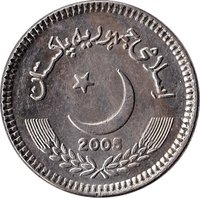
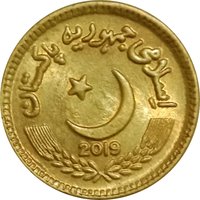
Obverse
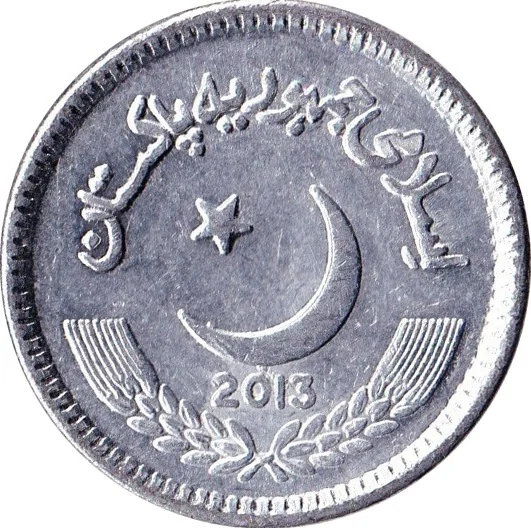
Description:
Crescent moon and star.
Inscription:
2013
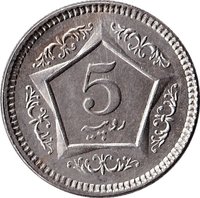
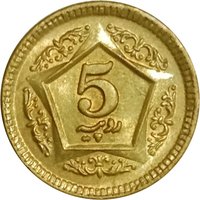
Reverse
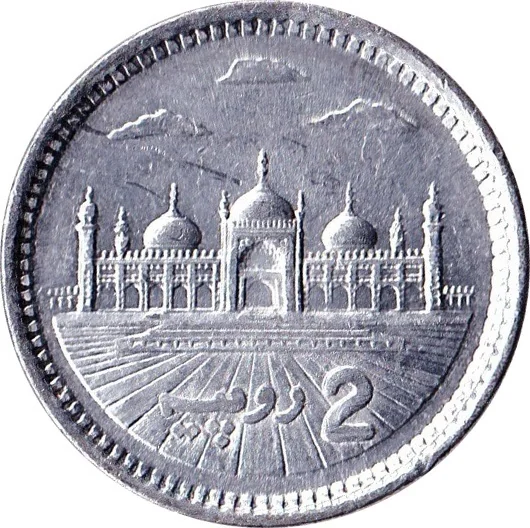
Description:
Badshahi Mosque, Lahore, Pakistan.
Inscription:
2
Edge
Plain
Categories
| Building> Religious building |
| Person> Politician |
Mintings
| Year | Mint Mark | Mintage | Quality | Collection |
|---|---|---|---|---|
| 2005 | — | — | ||
| 2007 | — | 100,848,000 | ||
| 2008 | — | — | ||
| 2009 | — | 100,000,000 | ||
| 2010 | — | 5,337,000 | ||
| 2011 | — | — | ||
| 2012 | — | — | ||
| 2013 | — | — | ||
| 2014 | — | — | ||
| 2015 | — | — | ||
| 2016 | — | — | ||
| 2018 | — | — | ||
| 2019 | — | — | ||
| 2020 | — | — | ||
| 2021 | — | — | ||
| 2022 | — | — | ||
| 2023 | — | — |
Historical background
In 2005, Pakistan's currency situation was characterized by relative stability and strength, a marked contrast to the volatility of preceding and following decades. This period fell within a broader phase of macroeconomic stabilization under President Pervez Musharraf's government and Prime Minister Shaukat Aziz's economic team. Key factors contributing to this stability included robust economic growth averaging 7% annually, significant inflows of foreign direct investment and remittances, and a successful debt rescheduling agreement with the Paris Club in late 2004. These elements bolstered foreign exchange reserves, which rose to comfortable levels, reducing pressure on the Pakistani Rupee (PKR).
The State Bank of Pakistan (SBP) maintained a managed float exchange rate regime, where the rupee was allowed to fluctuate within a narrow band. Throughout 2005, the PKR demonstrated remarkable steadiness, trading in a tight range around 59-60 against the US Dollar. This stability was actively supported by the SBP's interventions in the foreign exchange market to smooth out excessive volatility. The strong rupee helped contain import-led inflation and provided a sense of predictability for businesses and foreign investors, contributing to a positive economic sentiment during the year.
However, this stability was not without underlying pressures. The economy was experiencing strong domestic demand, leading to a widening current account deficit as imports, particularly of oil and machinery, grew rapidly. While substantial foreign exchange inflows masked this deficit in the short term, it sowed the seeds for future vulnerability. Furthermore, the aftermath of the devastating October 2005 earthquake imposed a significant fiscal and reconstruction burden. By the end of 2005, while the currency market remained calm, economists began to flag the growing imbalances, which would eventually contribute to renewed pressure on the rupee in the coming years as external conditions tightened.
The State Bank of Pakistan (SBP) maintained a managed float exchange rate regime, where the rupee was allowed to fluctuate within a narrow band. Throughout 2005, the PKR demonstrated remarkable steadiness, trading in a tight range around 59-60 against the US Dollar. This stability was actively supported by the SBP's interventions in the foreign exchange market to smooth out excessive volatility. The strong rupee helped contain import-led inflation and provided a sense of predictability for businesses and foreign investors, contributing to a positive economic sentiment during the year.
However, this stability was not without underlying pressures. The economy was experiencing strong domestic demand, leading to a widening current account deficit as imports, particularly of oil and machinery, grew rapidly. While substantial foreign exchange inflows masked this deficit in the short term, it sowed the seeds for future vulnerability. Furthermore, the aftermath of the devastating October 2005 earthquake imposed a significant fiscal and reconstruction burden. By the end of 2005, while the currency market remained calm, economists began to flag the growing imbalances, which would eventually contribute to renewed pressure on the rupee in the coming years as external conditions tightened.
🌱 Very Common