

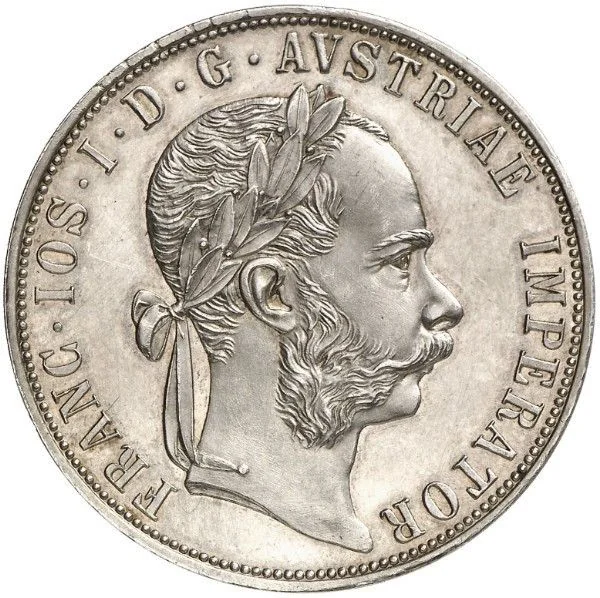
2 gulden – Austrian Empire
Add to wishlist
Circulating commemorative coins
Commemoration: For the reopening of the Kuttenburg silver mines
Austria
Context
Year: 1887
Country: Austria
Issuer: Austrian Empire
Ruler: Francis Joseph I
Currency:
(1857—1892)
Demonetized: Yes
Total mintage: 400
Material
References
KM: #
Numista: #163009
Value
Bullion value: $55.78
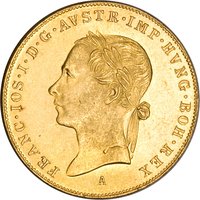
Obverse
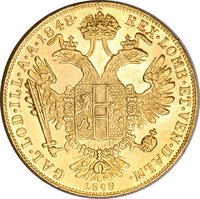
Reverse
Description:
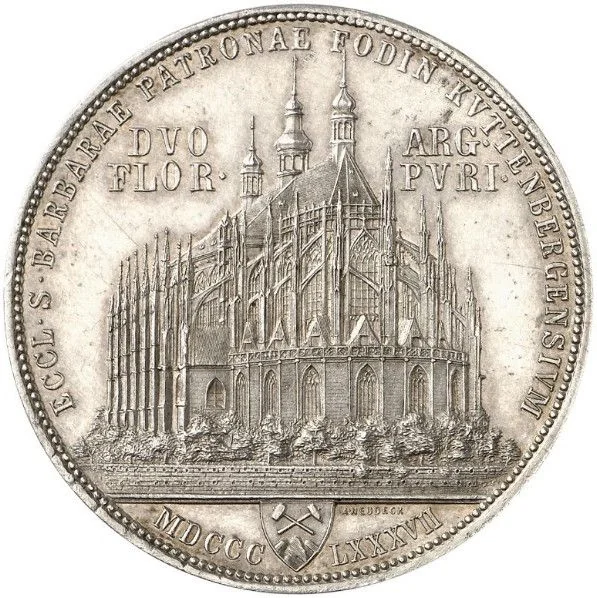
Church of Saint Barbara in Kutná Hora, Bohemia, with small shield below.
Inscription:
ECCL. S. BARBARAE PATRONAE FODIN KVTTENBERGENSIUM
DVO FLOR. ARG.PVRI.
MDCCCLXXXVII
DVO FLOR. ARG.PVRI.
MDCCCLXXXVII
Script: Latin
Edge
Script:Latin
Legend:
PRIMITIAE FODIN KUTTENB. AB AERARIO ITERUM SUSCEPTARUM
Categories
| Building> Religious building |
Mints
| Name | Mark |
|---|---|
| Münze Österreich | — |
Mintings
| Year | Mint Mark | Mintage | Quality | Collection |
|---|---|---|---|---|
| 1887 | — | 400 |
Historical background
In 1887, the Austro-Hungarian Empire operated under a complex and relatively modernized monetary system, having transitioned from its earlier silver standard to a de facto gold standard. The legal foundation was the Currency Reform of 1892, which was already in active preparation and would fully establish the gold crown (Krone) as the sole legal tender. However, in 1887, the empire was in a transitional period, with the old silver gulden (Gulden or Florin, divided into 100 kreuzer) still circulating alongside the new gold-based crown currency. The official exchange rate was fixed at 1 gold crown = 0.5 gulden, creating a dual system that required careful management by the Austro-Hungarian Bank.
The empire's currency situation was fundamentally stable at this time, a marked improvement from the financial chaos of earlier decades. The Austro-Hungarian Bank, the central bank for both halves of the Dual Monarchy, successfully maintained the convertibility of paper banknotes into gold, which instilled domestic and international confidence. This stability was crucial for financing the empire's significant infrastructure projects and for its integration into European capital markets, particularly in Vienna, which was a major financial center. The system facilitated trade and economic growth, though it also tied the empire's economy to the fluctuations of the international gold standard.
Nevertheless, underlying tensions persisted. The dual monarchy structure meant monetary policy required delicate negotiation between the Austrian and Hungarian governments, often leading to political complications. Furthermore, while the gold standard promoted stability, it also imposed strict fiscal discipline, limiting the state's ability to use monetary policy to address economic downturns. The year 1887 thus represents a point of cautious optimism—a moment after the severe economic crises of the 1870s and just before the formal completion of the currency reform, with the empire enjoying a period of hard-won monetary credibility on the world stage.
The empire's currency situation was fundamentally stable at this time, a marked improvement from the financial chaos of earlier decades. The Austro-Hungarian Bank, the central bank for both halves of the Dual Monarchy, successfully maintained the convertibility of paper banknotes into gold, which instilled domestic and international confidence. This stability was crucial for financing the empire's significant infrastructure projects and for its integration into European capital markets, particularly in Vienna, which was a major financial center. The system facilitated trade and economic growth, though it also tied the empire's economy to the fluctuations of the international gold standard.
Nevertheless, underlying tensions persisted. The dual monarchy structure meant monetary policy required delicate negotiation between the Austrian and Hungarian governments, often leading to political complications. Furthermore, while the gold standard promoted stability, it also imposed strict fiscal discipline, limiting the state's ability to use monetary policy to address economic downturns. The year 1887 thus represents a point of cautious optimism—a moment after the severe economic crises of the 1870s and just before the formal completion of the currency reform, with the empire enjoying a period of hard-won monetary credibility on the world stage.
✨ Legendary