

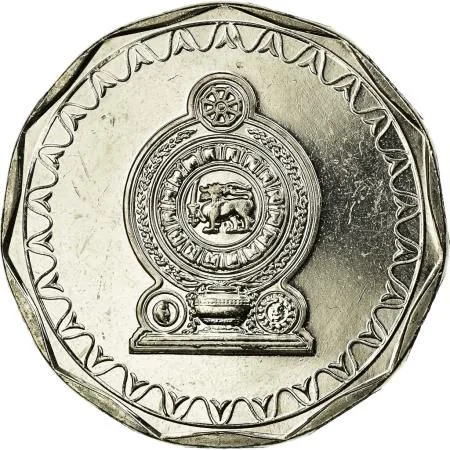
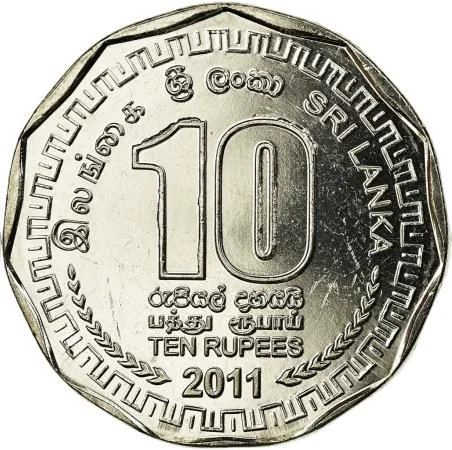
10 rupees – Sri Lanka
Add to wishlist
Sri Lanka
Context
Years: 2009–2011
Issuer: Sri Lanka
Period:
(since 1978)
Currency:
(since 1972)
Total mintage: 100,000,000
Material
Diameter: 26.4 mm
Weight: 8.61 g
Thickness: 2.1 mm
Shape: Hendecagonal
Technique: Milled
Alignment: Medal alignment
flip
References
KM: #
Numista: #16281
Value
Exchange value: 10 LKR
Obverse
Description:
National flag of Sri Lanka
Reverse
Edge
Plain
Mints
| Name | Mark |
|---|---|
| Royal Mint | — |
Mintings
| Year | Mint Mark | Mintage | Quality | Collection |
|---|---|---|---|---|
| 2009 | — | 35,000,000 | ||
| 2011 | — | 65,000,000 |
Historical background
In 2009, Sri Lanka's currency situation was fundamentally shaped by the culmination of its 26-year civil war, which ended in May of that year. The government, having financed a massive military offensive, faced severe fiscal and balance of payments pressures. Foreign exchange reserves were under strain due to high defense imports, rising global oil and food prices, and a drop in export earnings and worker remittances amid the global financial crisis. Consequently, the Central Bank of Sri Lanka (CBSL) actively defended the Sri Lankan Rupee (LKR) through heavy intervention, depleting reserves to maintain an overvalued official exchange rate around LKR 114-115 per US dollar.
This created a significant divergence between the official rate and a thriving black market, where the rupee traded at a steep discount. The defense of the peg was unsustainable, leading to the imposition of strict import controls and efforts to curb non-essential foreign exchange outflows. Despite the war's end, which boosted investor sentiment and led to a surge in the Colombo Stock Exchange, the immediate macroeconomic picture remained precarious. The country was in an IMF standby arrangement, with a $2.6 billion bailout approved in July to address the balance of payments crisis, contingent on fiscal consolidation and greater exchange rate flexibility.
Thus, the currency situation in 2009 was a pivotal transition period. The war's conclusion offered long-term hope for stability and growth, but in the short term, the economy grappled with the legacy of wartime fiscal policies and external shocks. The stage was set for a difficult post-war economic adjustment, with the overvalued rupee and low reserves pointing toward the inevitable need for a substantial devaluation, which would occur in the following years as the country struggled to rebuild its external sector.
This created a significant divergence between the official rate and a thriving black market, where the rupee traded at a steep discount. The defense of the peg was unsustainable, leading to the imposition of strict import controls and efforts to curb non-essential foreign exchange outflows. Despite the war's end, which boosted investor sentiment and led to a surge in the Colombo Stock Exchange, the immediate macroeconomic picture remained precarious. The country was in an IMF standby arrangement, with a $2.6 billion bailout approved in July to address the balance of payments crisis, contingent on fiscal consolidation and greater exchange rate flexibility.
Thus, the currency situation in 2009 was a pivotal transition period. The war's conclusion offered long-term hope for stability and growth, but in the short term, the economy grappled with the legacy of wartime fiscal policies and external shocks. The stage was set for a difficult post-war economic adjustment, with the overvalued rupee and low reserves pointing toward the inevitable need for a substantial devaluation, which would occur in the following years as the country struggled to rebuild its external sector.
🌱 Very Common