

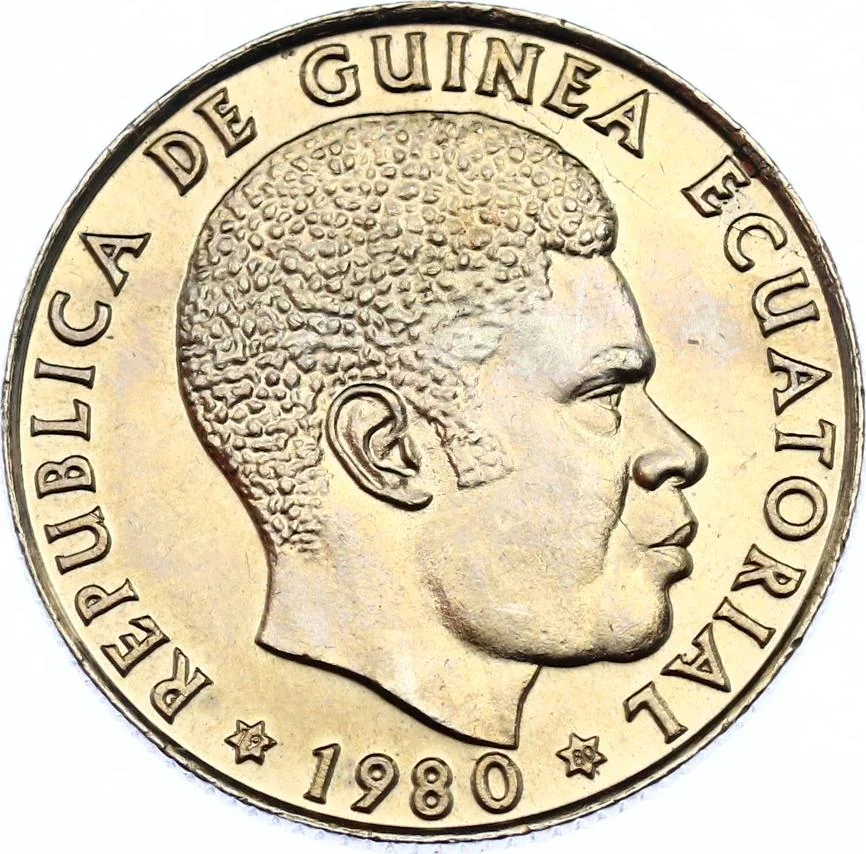
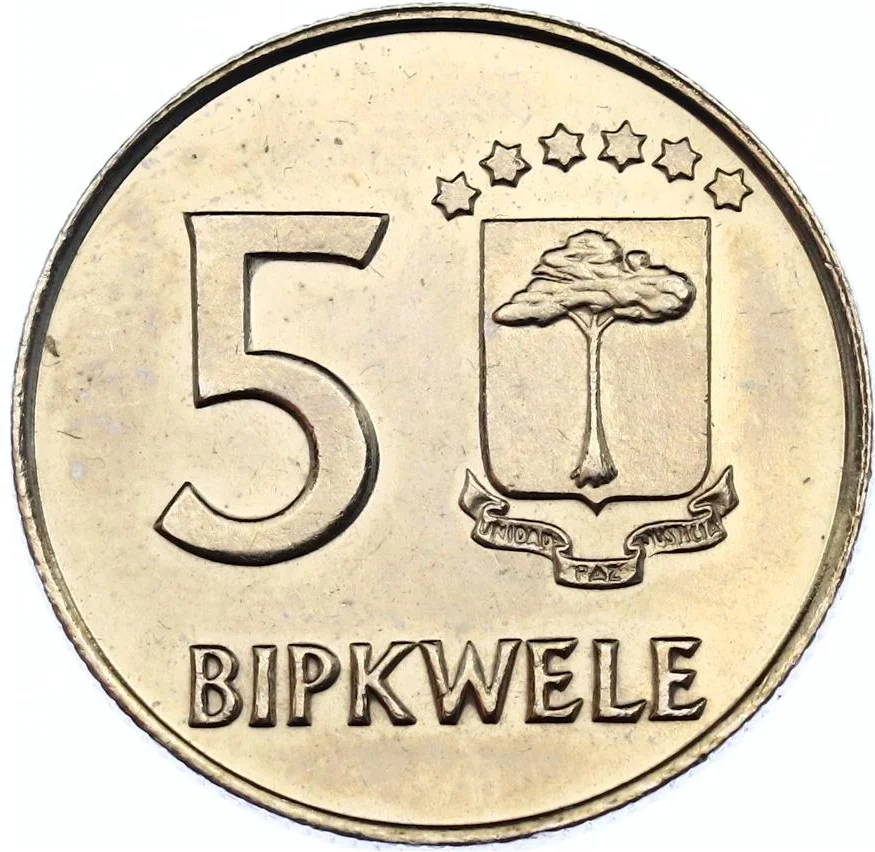
5 bipkwele – Equatorial Guinea
Add to wishlist
Equatorial Guinea
Context
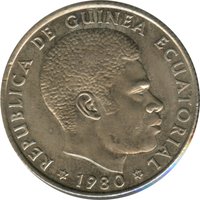
Year: 1980
Issuer: Equatorial Guinea
Period:
(since 1968)
Currency:
(1975—1985)
Demonetization: 1 January 1985
Total mintage: 200,000
Material
References
KM: #
Numista: #16158
Value
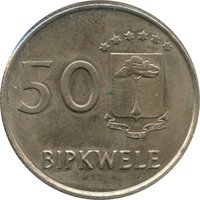
Exchange value: 5 GQE
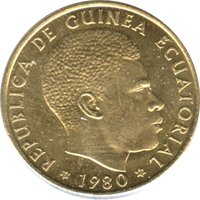
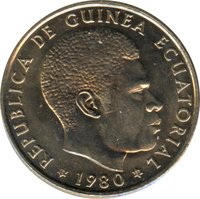
Obverse
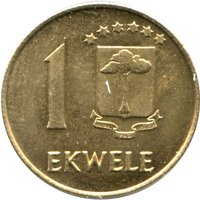
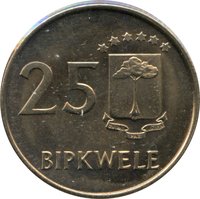
Reverse
Edge
Reeded
Categories
| Person> Politician |
| Symbols> Coat of Arms |
Mints
| Name | Mark |
|---|---|
| Royal Mint of Madrid | — |
Mintings
| Year | Mint Mark | Mintage | Quality | Collection |
|---|---|---|---|---|
| 1980 | — | 200,000 |
Historical background
In 1980, Equatorial Guinea's currency situation was defined by its recent and troubled transition from Spanish colonial rule. The country had gained independence in 1968 under the dictatorial regime of Francisco Macías Nguema, whose eleven-year rule had devastated the economy through neglect, corruption, and the expulsion of skilled foreign workers. The national currency, the ekwele (divided into 100 céntimos), was introduced in 1975 to replace the Spanish peseta, but it existed more in name than as a functional financial instrument. By 1980, the formal monetary system had virtually collapsed due to a lack of foreign reserves, negligible export earnings (despite some cocoa production), and the government's inability to manage basic economic functions.
The year 1980, however, marked a pivotal moment of political and potential monetary change. Macías Nguema was overthrown in a coup in August 1979, and his nephew, Teodoro Obiang Nguema Mbasogo, assumed power. While 1980 was a period of early consolidation for the new regime, the economic and currency landscape inherited was one of utter ruin. Barter and informal trade were widespread, and the ekwele suffered from severe inflation and public mistrust. There was little international confidence, and the currency was essentially non-convertible, isolating the country financially.
Consequently, the currency situation in 1980 was one of stagnation and anticipation. The Obiang government's immediate focus was on political stabilization and seeking international rehabilitation, leaving comprehensive monetary reform for the future. The foundational economic weakness—a lack of diversified exports and infrastructure—meant that substantive currency stability was impossible without broader recovery. This dire context set the stage for the later formal monetary shift, as Equatorial Guinea would eventually abandon the ekwele altogether and adopt the CFA franc in 1985, pegging its economy to the French treasury in a bid for stability and integration into the Central African monetary zone.
The year 1980, however, marked a pivotal moment of political and potential monetary change. Macías Nguema was overthrown in a coup in August 1979, and his nephew, Teodoro Obiang Nguema Mbasogo, assumed power. While 1980 was a period of early consolidation for the new regime, the economic and currency landscape inherited was one of utter ruin. Barter and informal trade were widespread, and the ekwele suffered from severe inflation and public mistrust. There was little international confidence, and the currency was essentially non-convertible, isolating the country financially.
Consequently, the currency situation in 1980 was one of stagnation and anticipation. The Obiang government's immediate focus was on political stabilization and seeking international rehabilitation, leaving comprehensive monetary reform for the future. The foundational economic weakness—a lack of diversified exports and infrastructure—meant that substantive currency stability was impossible without broader recovery. This dire context set the stage for the later formal monetary shift, as Equatorial Guinea would eventually abandon the ekwele altogether and adopt the CFA franc in 1985, pegging its economy to the French treasury in a bid for stability and integration into the Central African monetary zone.
⭐ Rare