

Obverse
Description:
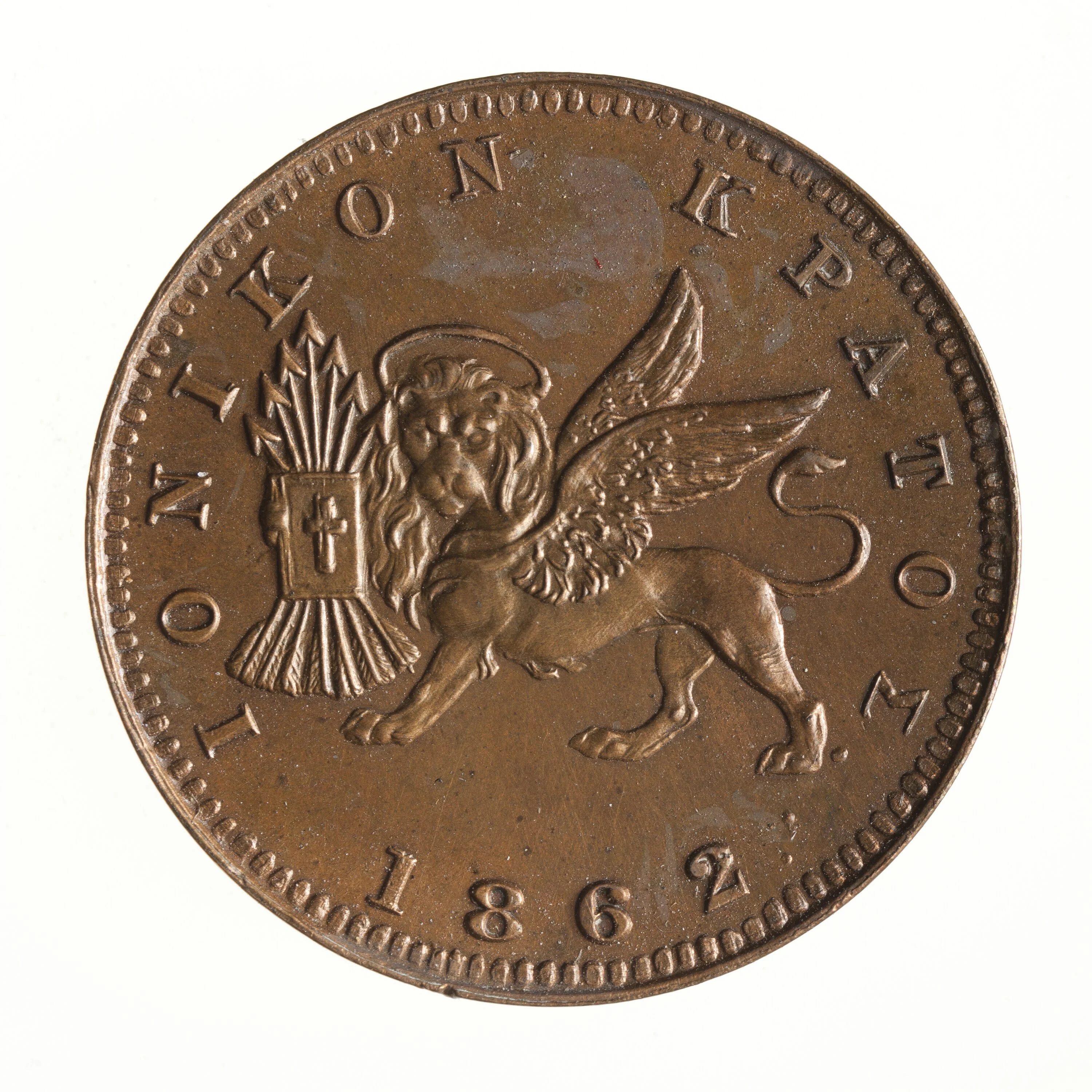
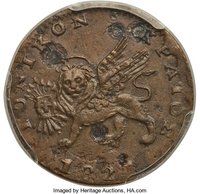
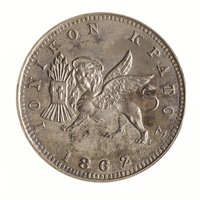
St. Mark's winged lion, left-facing, holding a Bible and seven arrows.
Inscription:
ΙΟΝΙΚΟΝ ΚΡΑΤΟΣ.
1857
1857
Translation:
IONIAN STATE.
1857
1857
Script: Greek
Language: Greek
Designer: William Wyon
Reverse
Edge
Plain
Categories
| Animal> Feline |
| Mythology> Fantastic animal |
| Object> Armour |
| Symbol> Allegory |
| Symbol> Cross |
| Object> Cold weapons |
Mintings
| Year | Mint Mark | Mintage | Quality | Collection |
|---|---|---|---|---|
| 1834 | . | — | ||
| 1835 | — | — | ||
| 1835 | . | — | ||
| 1848 | — | — | ||
| 1848 | . | 13,483,000 | ||
| 1849 | — | — | Proof | |
| 1849 | . | — | ||
| 1851 | . | — | ||
| 1853 | — | — | ||
| 1853 | — | — | Proof | |
| 1853 | . | 1,344,000 | ||
| 1857 | — | — | ||
| 1857 | . | — | ||
| 1862 | — | — | Proof | |
| 1862 | . | — |
Historical background
In 1834, the currency situation in the United States of the Ionian Islands, a British protectorate since 1815, was characterized by a complex and chaotic multiplicity of circulating coins. The official currency was the Ionian Obol or Obolus, divided into 100 Lepta, but this system existed largely on paper for accounting purposes. The real daily circulation was a jumble of foreign and historic coins, including British sovereigns and shillings, Venetian zecchini and lira, Turkish piastres, Spanish dollars, and Russian roubles. This proliferation created significant challenges for trade and administration, as merchants and officials constantly had to calculate exchange rates and contend with the varying weights and purities of the coins.
The British administration, seeking to impose order and integrate the islands more firmly into its economic sphere, had been attempting monetary reform for years. A key step was the opening of the Ionian Bank in 1833, which was granted the privilege of issuing paper money. By 1834, the bank had begun issuing notes denominated in Ionian Oboli, representing one of the first modern paper currencies in the Greek-speaking world. However, these notes initially circulated alongside, rather than replaced, the myriad of metallic coins, adding another layer to the already complicated monetary environment.
Thus, the 1834 currency situation was one of transition and friction. The British authorities were actively promoting a standardized, sterling-linked currency system through the Ionian Bank's notes, aiming to simplify governance and commerce. Yet, in practice, the economy still relied on an entrenched and international mix of specie, reflecting the islands' long history of Venetian, French, and Mediterranean trade. This duality—between the modernizing vision of the protectorate and the persistent, practical reality of a traditional multi-currency marketplace—defined the monetary landscape of the Ionian Islands at the time.
The British administration, seeking to impose order and integrate the islands more firmly into its economic sphere, had been attempting monetary reform for years. A key step was the opening of the Ionian Bank in 1833, which was granted the privilege of issuing paper money. By 1834, the bank had begun issuing notes denominated in Ionian Oboli, representing one of the first modern paper currencies in the Greek-speaking world. However, these notes initially circulated alongside, rather than replaced, the myriad of metallic coins, adding another layer to the already complicated monetary environment.
Thus, the 1834 currency situation was one of transition and friction. The British authorities were actively promoting a standardized, sterling-linked currency system through the Ionian Bank's notes, aiming to simplify governance and commerce. Yet, in practice, the economy still relied on an entrenched and international mix of specie, reflecting the islands' long history of Venetian, French, and Mediterranean trade. This duality—between the modernizing vision of the protectorate and the persistent, practical reality of a traditional multi-currency marketplace—defined the monetary landscape of the Ionian Islands at the time.
🌱 Common