

1 obol – United States of the Ionian Islands
Add to wishlist
Greece
Context
Year: 1819
Country: Greece
Ruler: George III
Currency:
(1819—1834)
Demonetized: Yes
Total mintage: 8,279,040
Material
References
KM: #
Numista: #16149
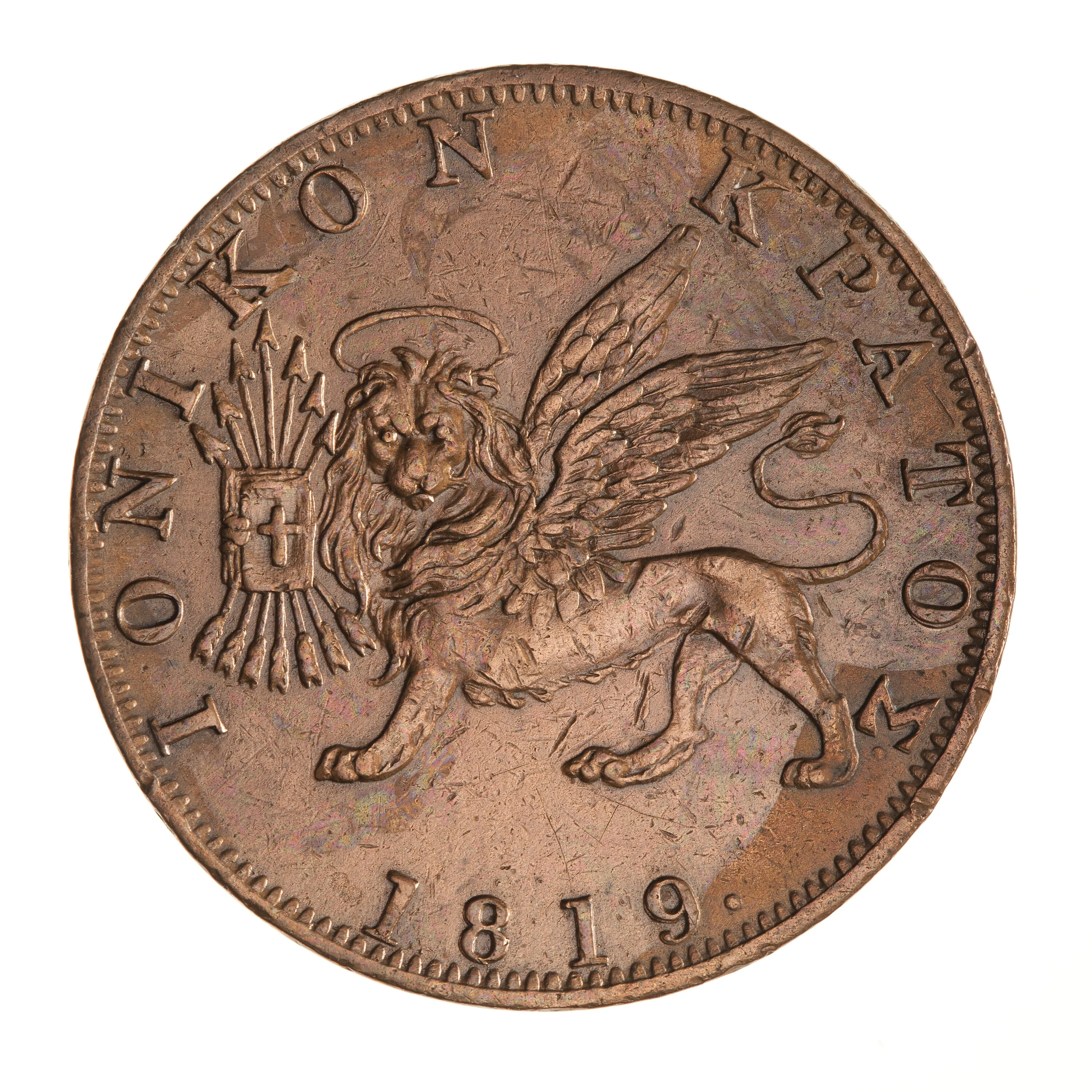
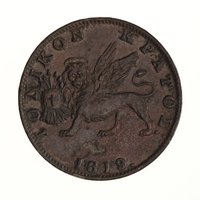
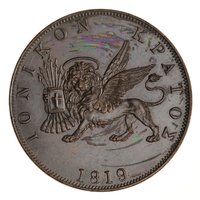
Obverse
Description:
Venice's symbol.
Inscription:
ΙΟΝΙΚΟΝ ΚΡΑΤΟΣ
1819.
1819.
Translation:
IONIAN STATE
1819.
1819.
Script: Greek
Language: Greek
Engraver: William Wyon
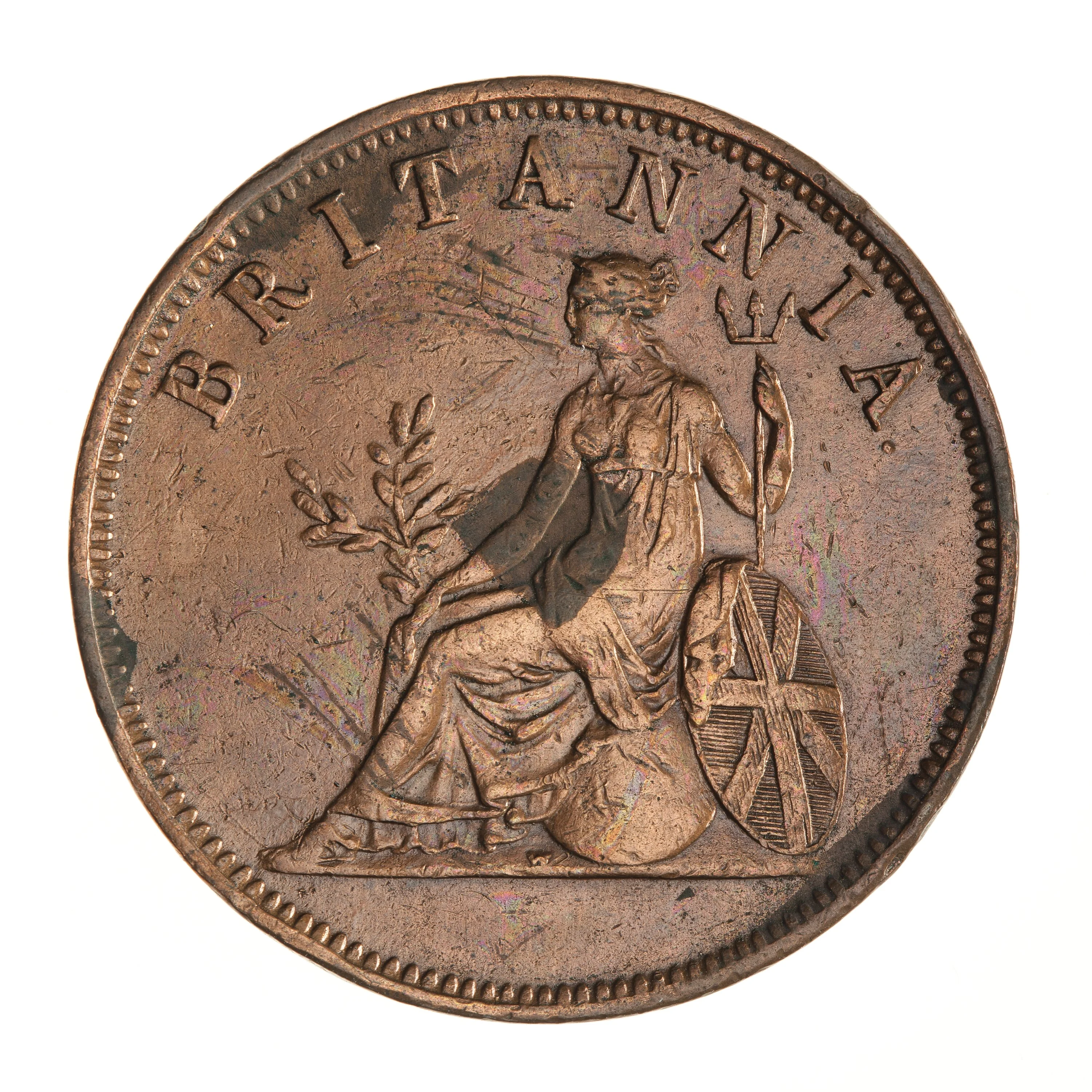
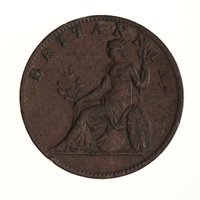
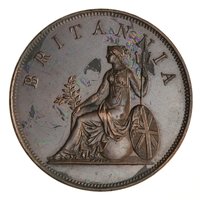
Reverse
Description:
Britannia seated facing left.
Inscription:
BRITANNIA.
Translation:
Britannia.
Script: Latin
Language: Latin
Engraver: William Wyon
Edge
Plain
Categories
| Animal> Feline |
| Mythology> Fantastic animal |
| Symbol> Allegory |
| Symbol> Cross |
| Object> Cold weapons |
Mints
| Name | Mark |
|---|---|
| Royal Mint (Tower Hill) | — |
Mintings
| Year | Mint Mark | Mintage | Quality | Collection |
|---|---|---|---|---|
| 1819 | — | — | Proof | |
| 1819 | . | 8,279,040 |
Historical background
In 1819, the United States of the Ionian Islands existed as a unique British protectorate, having been formally established under the Treaty of Paris in 1815. This arrangement followed a period of French and Russo-Ottoman control, and the islands were governed under a constitution that granted them a degree of internal autonomy while ultimate authority rested with a British Lord High Commissioner. The currency situation reflected this complex political reality, being a hybrid system born of the islands' recent history and commercial needs. The official currency was the Ionian ghirli (or lira), but this unit was largely a notational standard for accounting, as a multitude of physical coins from different empires circulated in daily use.
The actual coins in circulation were a tangible record of Mediterranean trade and former rulers. Most prominent were the Turkish kuruş (piasters) and Spanish silver dollars (pieces of eight), alongside residual Venetian zecchino gold coins and various other European and Ottoman issues. This created a chaotic and inefficient monetary environment where merchants and officials had to constantly reference complex exchange rates and contend with the varying weights and purities of coins. The British administration, seeking to impose order and facilitate trade within its strategic Mediterranean holding, recognized the necessity for a unified and stable currency.
Consequently, 1819 fell within a period of transition and reform. The Ionian government, under British direction, was actively working toward introducing a new, decimalized coinage system. This effort would culminate in the 1819 "Proclamation for Regulating the Currency" and the subsequent minting of distinct Ionian coinage from 1820 onward. These new coins, denominated in lepta and ghirli, were pegged to the British pound sterling (with 1 ghirli = 1 shilling 4 pence) and were intended to supplant the heterogeneous mix of foreign specie, thereby simplifying commerce and strengthening the protectorate's fiscal sovereignty. Thus, the background of 1819 is one of concluding monetary disorder and the active implementation of a modern, standardized currency under British oversight.
The actual coins in circulation were a tangible record of Mediterranean trade and former rulers. Most prominent were the Turkish kuruş (piasters) and Spanish silver dollars (pieces of eight), alongside residual Venetian zecchino gold coins and various other European and Ottoman issues. This created a chaotic and inefficient monetary environment where merchants and officials had to constantly reference complex exchange rates and contend with the varying weights and purities of coins. The British administration, seeking to impose order and facilitate trade within its strategic Mediterranean holding, recognized the necessity for a unified and stable currency.
Consequently, 1819 fell within a period of transition and reform. The Ionian government, under British direction, was actively working toward introducing a new, decimalized coinage system. This effort would culminate in the 1819 "Proclamation for Regulating the Currency" and the subsequent minting of distinct Ionian coinage from 1820 onward. These new coins, denominated in lepta and ghirli, were pegged to the British pound sterling (with 1 ghirli = 1 shilling 4 pence) and were intended to supplant the heterogeneous mix of foreign specie, thereby simplifying commerce and strengthening the protectorate's fiscal sovereignty. Thus, the background of 1819 is one of concluding monetary disorder and the active implementation of a modern, standardized currency under British oversight.
⭐ Somewhat Rare