

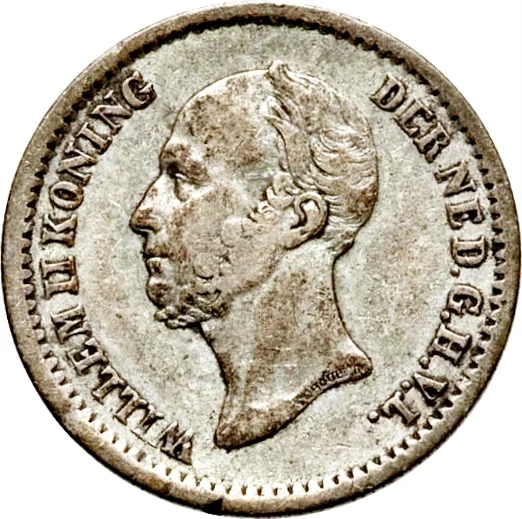
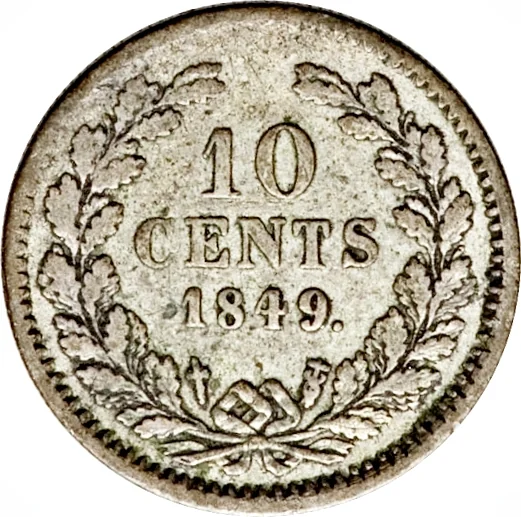
10 Cents – Netherlands
Netherlands
Context
Years: 1848–1849
Issuer: Netherlands 
Ruler: William II
Currency:
(1817—2001)
Demonetized: Yes
Total mintage: 10,909,595
Material
References
KM: #Click to copy to clipboard75
Numista: #16121
Value
Exchange value: 0.10 NLG
Bullion value: $2.54
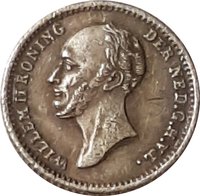
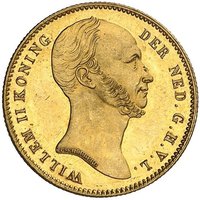
Obverse
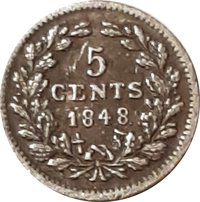
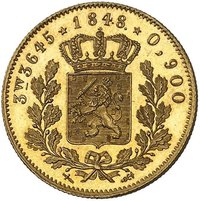
Reverse
Edge
Milled
Mints
| Name | Mark |
|---|---|
| Royal Dutch Mint | — |
Mintings
| Year | Mint Mark | Mintage | Quality | Collection |
|---|---|---|---|---|
| 1848 | — | 6,859,006 | ||
| 1848 | — | — | Proof | |
| 1849 | — | 4,050,589 |
Historical background
In 1848, the Netherlands operated under a bimetallic monetary system, formally established by the Coin Act of 1816. This law fixed the value of the silver guilder (also called the florin) and the gold ten-guilder coin at a specific ratio (1:15.873). However, this system was under significant strain due to global market fluctuations in the value of gold and silver. The discovery of new gold sources was beginning to destabilize the fixed ratio, making it increasingly difficult for the Dutch central bank, De Nederlandsche Bank (DNB), to maintain both coins in circulation, a problem common across Europe.
The political context of 1848 was transformative, as revolutions swept across the continent. In the Netherlands, King William II, fearing unrest, reluctantly accepted a major constitutional revision that transferred substantial power from the monarchy to the parliament and ministers. While this liberal constitution, spearheaded by Johan Rudolf Thorbecke, primarily focused on political rights and governance, it indirectly set the stage for future economic and monetary reforms by creating a more modern, accountable state apparatus. The immediate currency issues, however, were seen as technical financial matters to be managed by the government and DNB rather than addressed within the constitutional document itself.
Consequently, the currency situation in 1848 was one of underlying vulnerability within a stable facade. The guilder was a trusted and established currency, but the bimetallic system was becoming an anachronism. The political upheaval of the year delayed immediate monetary action, but the new parliamentary system would soon be compelled to confront the issue. This ultimately led to the pivotal Coin Act of 1847 (which took full effect later) and the later adoption of a gold standard with the Silver Coin Act of 1874, phasing out the unstable bimetallism that characterized the mid-century period.
The political context of 1848 was transformative, as revolutions swept across the continent. In the Netherlands, King William II, fearing unrest, reluctantly accepted a major constitutional revision that transferred substantial power from the monarchy to the parliament and ministers. While this liberal constitution, spearheaded by Johan Rudolf Thorbecke, primarily focused on political rights and governance, it indirectly set the stage for future economic and monetary reforms by creating a more modern, accountable state apparatus. The immediate currency issues, however, were seen as technical financial matters to be managed by the government and DNB rather than addressed within the constitutional document itself.
Consequently, the currency situation in 1848 was one of underlying vulnerability within a stable facade. The guilder was a trusted and established currency, but the bimetallic system was becoming an anachronism. The political upheaval of the year delayed immediate monetary action, but the new parliamentary system would soon be compelled to confront the issue. This ultimately led to the pivotal Coin Act of 1847 (which took full effect later) and the later adoption of a gold standard with the Silver Coin Act of 1874, phasing out the unstable bimetallism that characterized the mid-century period.
🌱 Fairly Common