

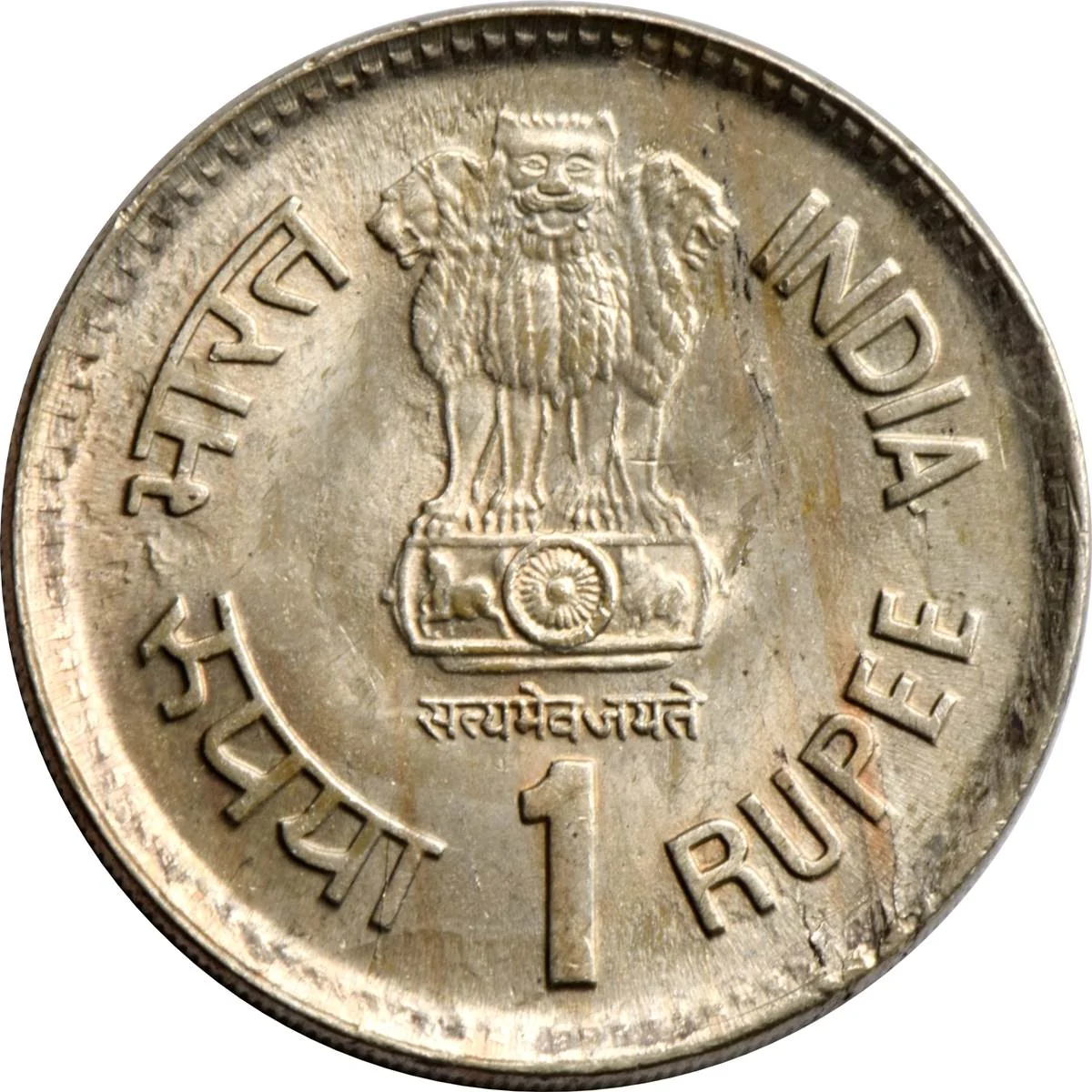
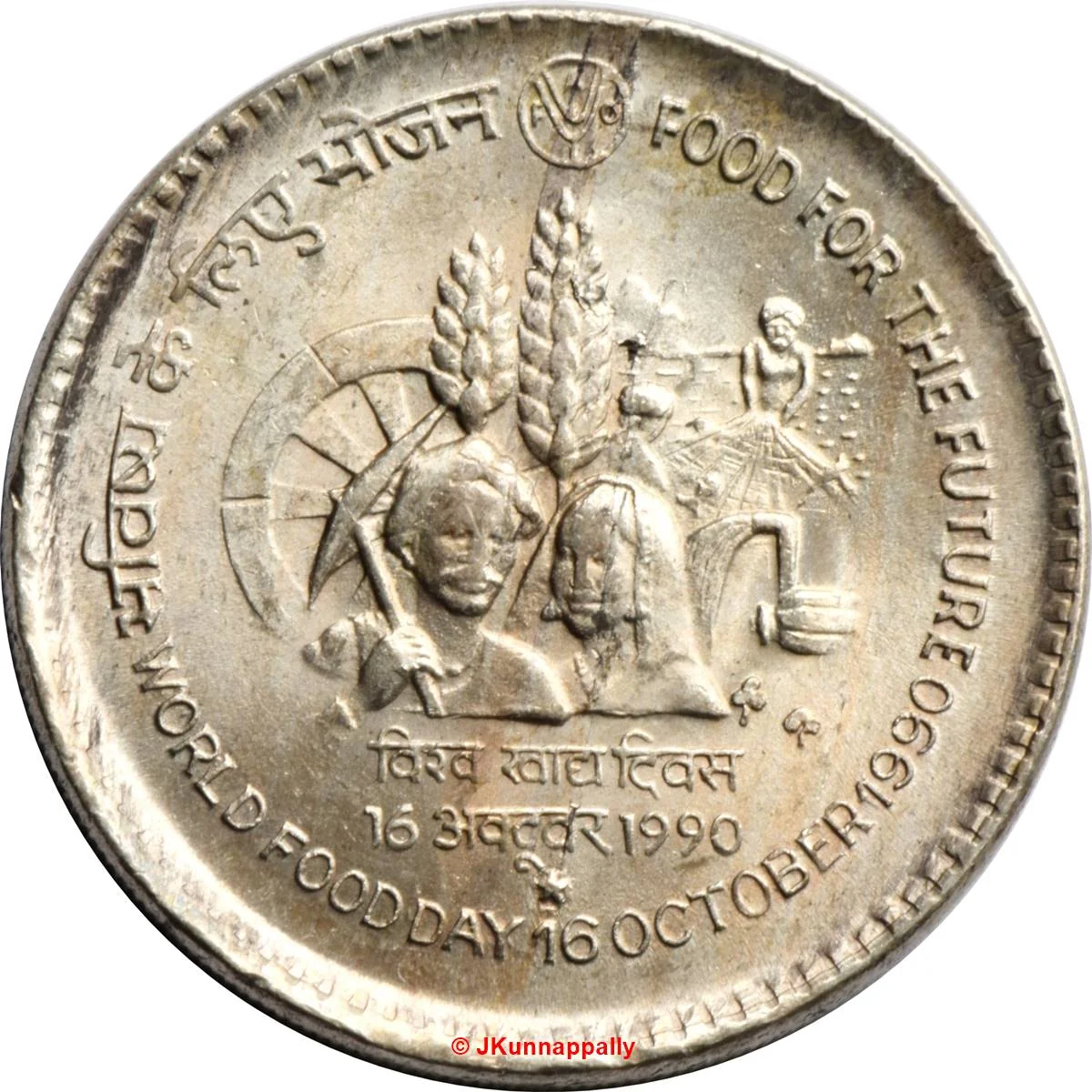
1 Rupee – India
Circulating commemorative coins
Commemoration: FAO - World Food Day
India

Obverse
Reverse
Edge
Reeded or Smooth
Categories
| Organization> FAO |
Mints
| Name | Mark |
|---|---|
| Kolkata / Calcutta / Murshidabad | — |
| Hyderabad | ★ |
Mintings
| Year | Mint Mark | Mintage | Quality | Collection |
|---|---|---|---|---|
| 1990 | ★ | — | ||
| 1990 | — | — |
Historical background
In 1990, India faced a severe balance of payments crisis, marking one of the most critical economic junctures since independence. Years of fiscal profligacy, high inflation, and a reliance on external borrowing to finance imports had left the country with dangerously low foreign exchange reserves. By mid-1991, reserves had plummeted to approximately $1.2 billion, enough to cover just two weeks of essential imports, pushing India to the brink of sovereign default. The immediate trigger was the Gulf War, which caused a spike in global oil prices and a loss of remittances from Indian workers in the Middle East, further straining the external account.
The crisis exposed the structural weaknesses of India's inward-looking, license-permit Raj economy. A persistent trade deficit, coupled with low export competitiveness due to an overvalued fixed exchange rate, meant the country was living beyond its means. The government, led by Prime Minister Chandra Shekhar, took emergency measures, including airlifting 47 tonnes of gold to the Bank of England and 20 tonnes to the Union Bank of Switzerland as collateral for urgent loans. These desperate actions underscored the gravity of the situation and set the stage for monumental change.
Consequently, the currency situation of 1990 became the catalyst for the historic economic reforms of 1991. When a new government under Prime Minister P.V. Narasimha Rao took office, with Dr. Manmohan Singh as Finance Minister, it initiated a paradigm shift. Key measures included a two-step devaluation of the rupee, dismantling of the complex import licensing system, and a move towards a market-determined exchange rate. This crisis and the subsequent reforms marked India's decisive turn away from a closed, controlled economy towards liberalization and global integration.
The crisis exposed the structural weaknesses of India's inward-looking, license-permit Raj economy. A persistent trade deficit, coupled with low export competitiveness due to an overvalued fixed exchange rate, meant the country was living beyond its means. The government, led by Prime Minister Chandra Shekhar, took emergency measures, including airlifting 47 tonnes of gold to the Bank of England and 20 tonnes to the Union Bank of Switzerland as collateral for urgent loans. These desperate actions underscored the gravity of the situation and set the stage for monumental change.
Consequently, the currency situation of 1990 became the catalyst for the historic economic reforms of 1991. When a new government under Prime Minister P.V. Narasimha Rao took office, with Dr. Manmohan Singh as Finance Minister, it initiated a paradigm shift. Key measures included a two-step devaluation of the rupee, dismantling of the complex import licensing system, and a move towards a market-determined exchange rate. This crisis and the subsequent reforms marked India's decisive turn away from a closed, controlled economy towards liberalization and global integration.
🌱 Common