

50 Centimes – Belgium
Belgium
Context
Years: 1866–1899
Issuer: Belgium 
Ruler: Leopold II
Currency:
(1832—2001)
Demonetization: 30 July 1932
Total mintage: 4,751,000
Material
References
KM: #Click to copy to clipboard27
Numista: #16053
Value
Exchange value: 0.50 BEF
Bullion value: $6.06
Obverse
Description:
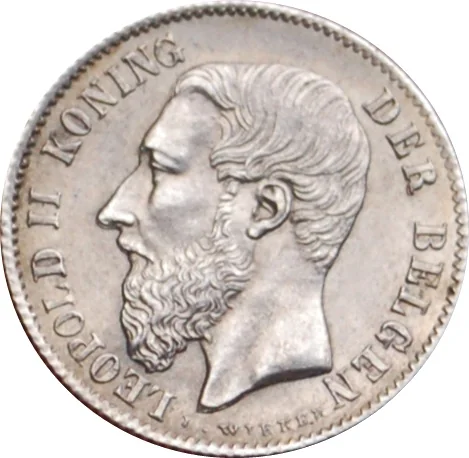
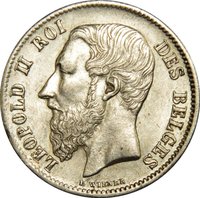
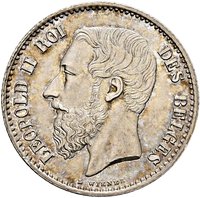
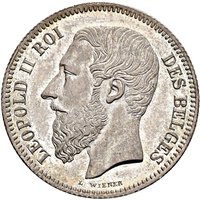
Leopold II of Belgium in left profile, Dutch legend, designer below.
Inscription:
LEOPOLD II KONING DER BELGEN
L.WIENER
L.WIENER
Translation:
Leopold II King of the Belgians
L. Wiener
L. Wiener
Script: Latin
Language: Dutch
Engraver: Léopold Wiener
Reverse
Description:
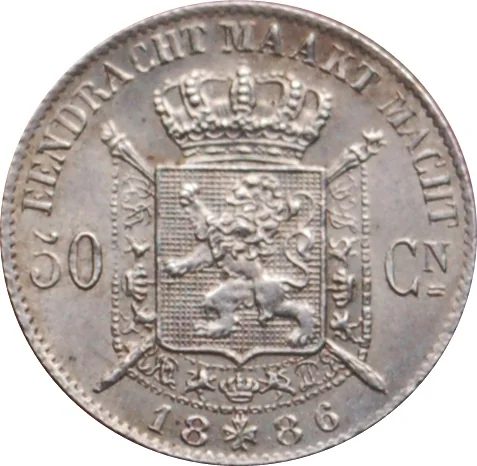
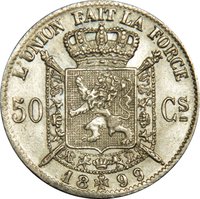
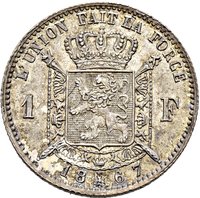
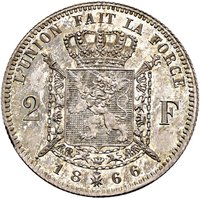
Belgium's coat of arms divides the face value, with the date below and Dutch motto above.
Inscription:
EENDRACHT MAAKT MACHT
50 Cn
1886
50 Cn
1886
Translation:
Unity makes strength
50 Cents
1886
50 Cents
1886
Script: Latin
Language: Dutch
Engraver: Léopold Wiener
Edge
Reeded
Categories
| Symbol> Crown |
| Symbols> Coat of Arms |
Mints
| Name | Mark |
|---|---|
| Royal Mint of Belgium | — |
Mintings
| Year | Mint Mark | Mintage | Quality | Collection |
|---|---|---|---|---|
| 1866 | — | — | ||
| 1886 | — | 3,750,000 | ||
| 1898 | — | 501,000 | ||
| 1899 | — | 500,000 |
Historical background
In 1866, Belgium operated under a complex and transitional monetary system, a legacy of its recent independence and the broader European context. The country was part of the Latin Monetary Union (LMU), established in 1865, which Belgium had helped to found. This treaty standardized gold and silver coinage (bimetallism) among member nations like France, Italy, and Switzerland, making their currencies mutually acceptable at fixed values. Belgium's national currency, the Belgian franc, was thus legally pegged to the French franc and backed by both precious metals.
However, this system was under significant strain. A global oversupply of silver, following major discoveries, was driving down its market value relative to gold. This created a persistent problem: silver coins, whose metallic value was falling below their face value, flooded circulation, while gold coins were often hoarded or exported (Gresham's Law in action). For Belgium, a small, trade-intensive nation, this instability was particularly disruptive to commerce and international payments, as the theoretical bimetallic standard functioned as a de facto silver standard.
Consequently, 1866 found Belgian authorities and the National Bank grappling with the practical challenges of maintaining convertibility and a stable currency within a flawed union. The year was part of a broader period of monetary uncertainty that would ultimately lead the LMU to limit silver coinage and move toward a "limping gold standard" in the following years. Belgium's monetary policy was therefore not fully autonomous but was a careful navigation of international treaty obligations and the pressing economic need for a reliable medium of exchange.
However, this system was under significant strain. A global oversupply of silver, following major discoveries, was driving down its market value relative to gold. This created a persistent problem: silver coins, whose metallic value was falling below their face value, flooded circulation, while gold coins were often hoarded or exported (Gresham's Law in action). For Belgium, a small, trade-intensive nation, this instability was particularly disruptive to commerce and international payments, as the theoretical bimetallic standard functioned as a de facto silver standard.
Consequently, 1866 found Belgian authorities and the National Bank grappling with the practical challenges of maintaining convertibility and a stable currency within a flawed union. The year was part of a broader period of monetary uncertainty that would ultimately lead the LMU to limit silver coinage and move toward a "limping gold standard" in the following years. Belgium's monetary policy was therefore not fully autonomous but was a careful navigation of international treaty obligations and the pressing economic need for a reliable medium of exchange.
Series: 1866 Belgium circulation coins
🌱 Common