

3 Pence – Guernsey
Context
Years: 1959–1966
Country: British Crown dependencies
Issuer: Guernsey
Ruler: Elizabeth II
Currency:
(1808—1971)
Demonetized: Yes
Total mintage: 490,000
Material
Diameter: 21 mm
Weight: 6.72 g
Thickness: 2.5 mm
Shape: Scalloped
Composition: Copper-nickel
Technique: Milled
Alignment: Medal alignment
flip
References
KM: #Click to copy to clipboard18
Numista: #10578
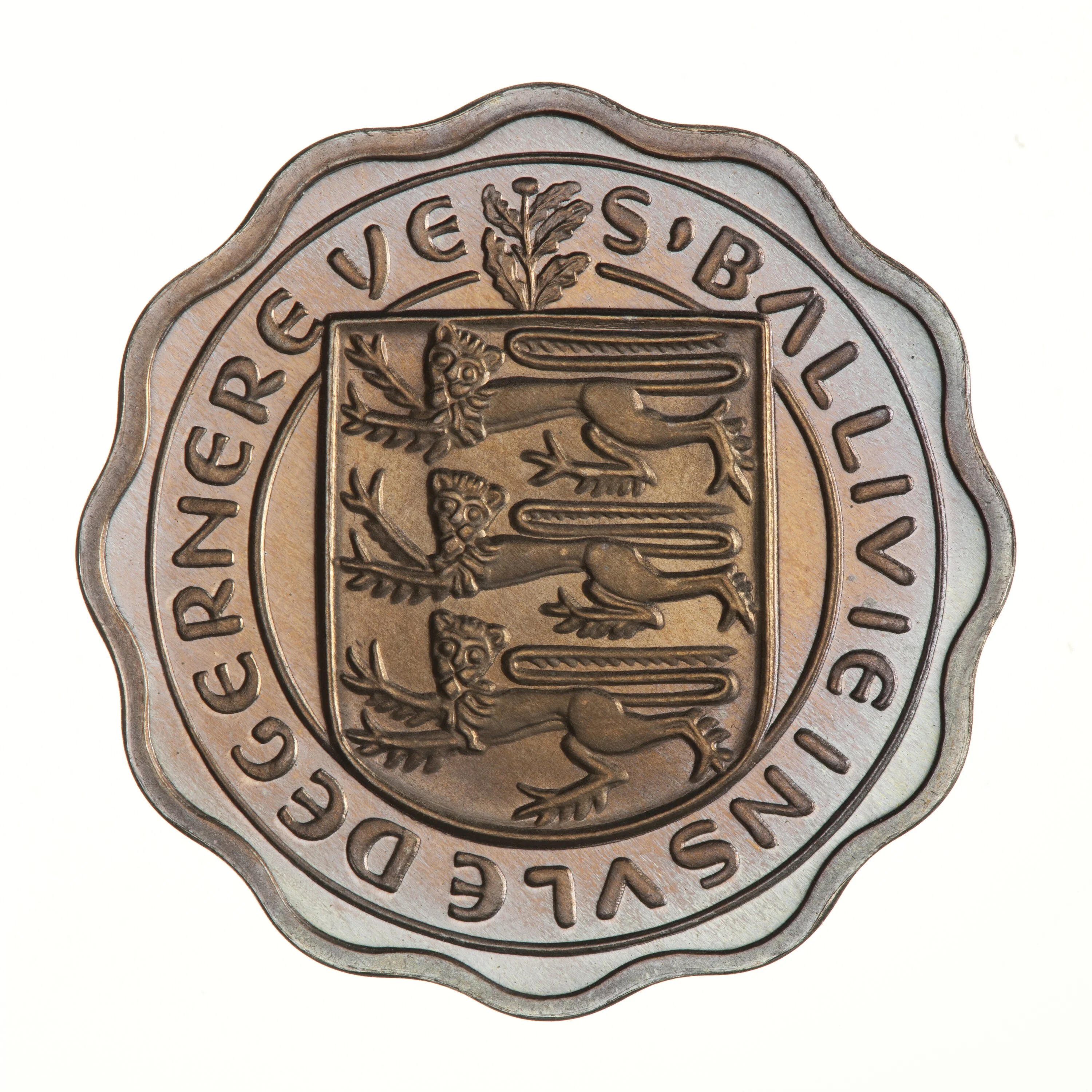
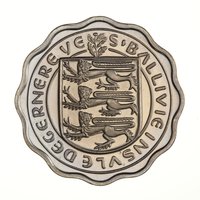
Obverse
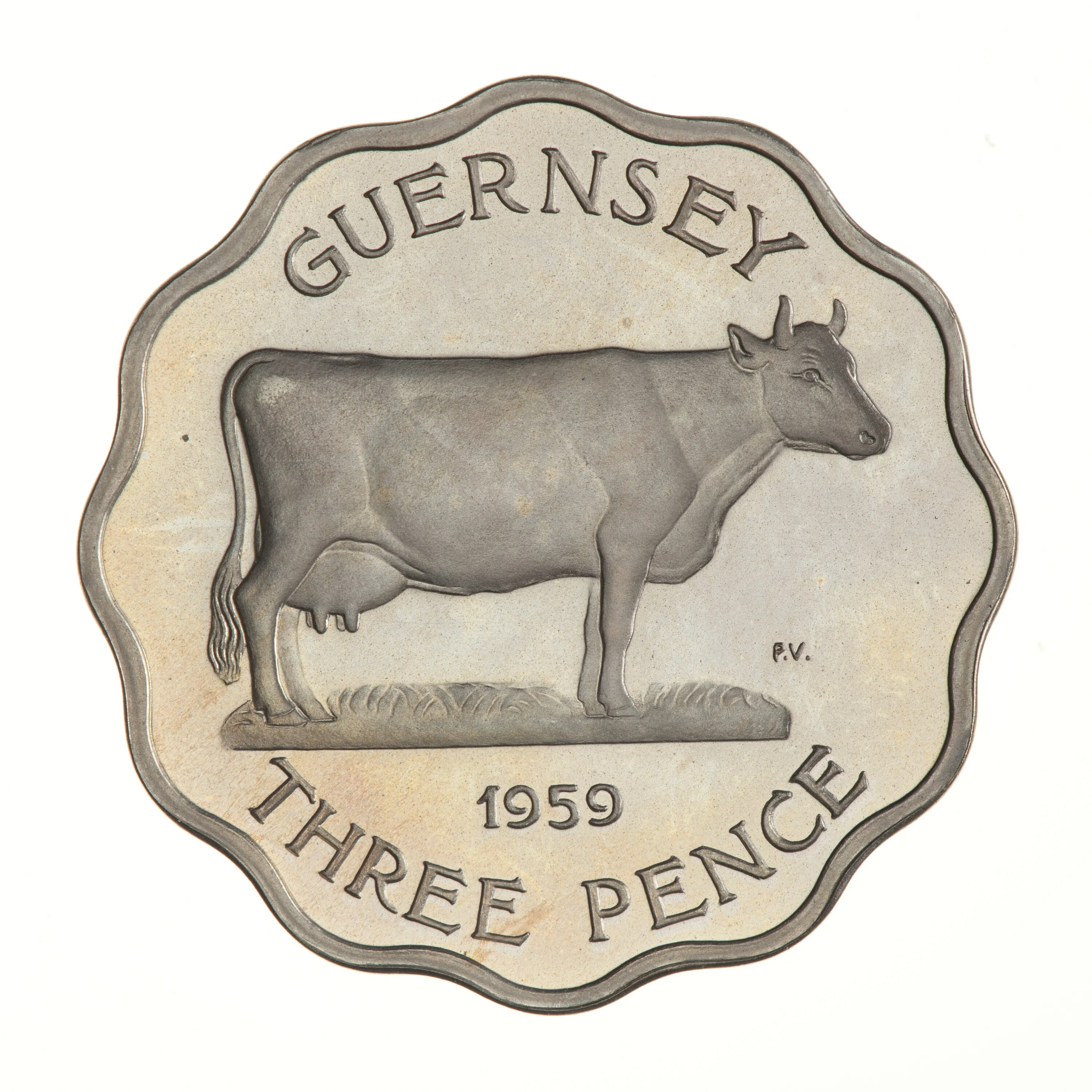
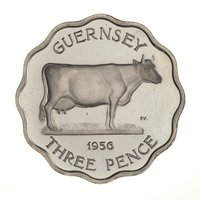
Reverse
Description:
Guernsey cattle
Inscription:
GUERNSEY
1959
THREE PENCE
1959
THREE PENCE
Script: Latin
Engraver: Paul Vincze
Edge
Plain
Mints
| Name | Mark |
|---|---|
| Royal Mint (Tower Hill) | — |
Mintings
| Year | Mint Mark | Mintage | Quality | Collection |
|---|---|---|---|---|
| 1959 | — | 480,000 | ||
| 1959 | — | — | Proof | |
| 1966 | — | 10,000 | Proof |
Historical background
In 1959, Guernsey's currency situation was characterised by a practical and locally controlled system, operating under the overarching sovereignty of the British pound sterling. The island issued its own banknotes and coinage, a right it has held since the early 19th century. These Guernsey pounds (£) were not a separate currency but local issues, pegged at par with sterling and fully backed by reserves held in UK government securities and cash. This ensured stability and guaranteed their acceptance alongside Bank of England notes within the island.
The system was managed with notable fiscal prudence by the States of Guernsey. A key feature was that new currency was only issued to finance specific public works, such as infrastructure projects, without incurring debt or interest. This "debt-free" creation of money for socially useful investment was a point of local pride and economic principle. Consequently, the volume of Guernsey currency in circulation was directly tied to the island's development needs and its accumulated reserves, rather than monetary policy in the traditional sense.
While sterling was legally tender and circulated freely, Guernsey's own notes and coins formed the predominant physical cash used in everyday transactions on the island. The situation was one of seamless duality for residents and businesses, but required visitors from the UK to be aware that while their sterling was accepted, Guernsey notes might not be readily accepted back in Britain. Thus, 1959 represented a period of stability for this longstanding system, underpinning local autonomy and sound public finance nearly a decade before the UK's decimalisation would eventually bring change to the island's coinage.
The system was managed with notable fiscal prudence by the States of Guernsey. A key feature was that new currency was only issued to finance specific public works, such as infrastructure projects, without incurring debt or interest. This "debt-free" creation of money for socially useful investment was a point of local pride and economic principle. Consequently, the volume of Guernsey currency in circulation was directly tied to the island's development needs and its accumulated reserves, rather than monetary policy in the traditional sense.
While sterling was legally tender and circulated freely, Guernsey's own notes and coins formed the predominant physical cash used in everyday transactions on the island. The situation was one of seamless duality for residents and businesses, but required visitors from the UK to be aware that while their sterling was accepted, Guernsey notes might not be readily accepted back in Britain. Thus, 1959 represented a period of stability for this longstanding system, underpinning local autonomy and sound public finance nearly a decade before the UK's decimalisation would eventually bring change to the island's coinage.
🌱 Common