

5 centavos – Chile
Add to wishlist
Chile
Obverse
Description:
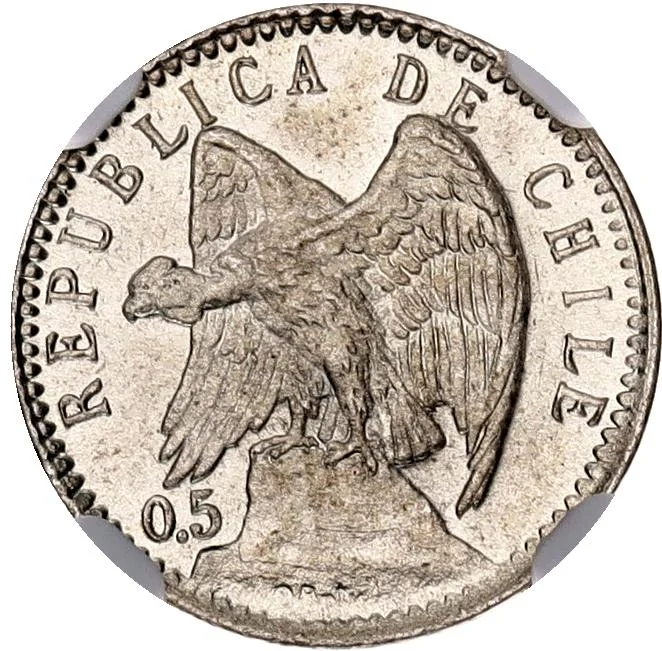
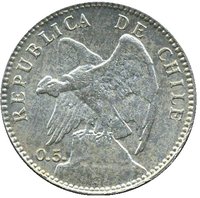
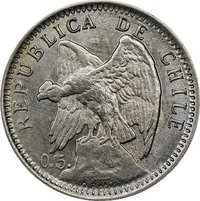
Andean Condor on rock. Note: Varieties exist with "0.5", "0/5.5", "0,5", or "05" inscribed below.
Inscription:
REPUBLICA DE CHILE
0.5
O.Roty
0.5
O.Roty
Translation:
REPUBLIC OF CHILE
0.5
O.Roty
0.5
O.Roty
Script: Latin
Engraver: Louis-Oscar Roty
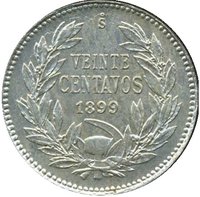
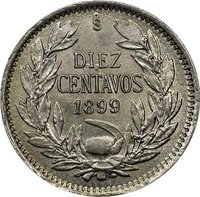
Reverse
Edge
Reeded
Categories
| Animal> Bird |
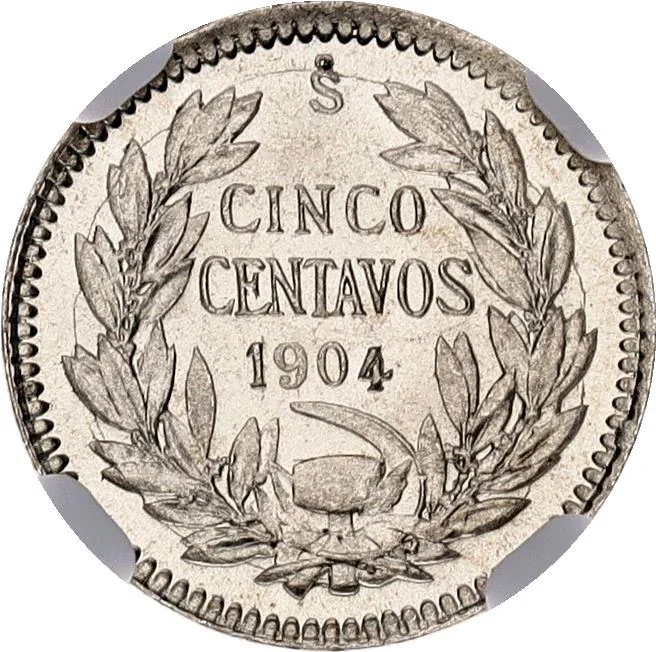
| Symbol> Hammer and sickle |
Mints
| Name | Mark |
|---|---|
| Casa de Moneda de Chile | S0 |
Mintings
| Year | Mint Mark | Mintage | Quality | Collection |
|---|---|---|---|---|
| 1899 | So | 1,794,000 | ||
| 1901 | So | 2,109,000 | ||
| 1904 | So | — | ||
| 1906 | So | — | ||
| 1907 | So | 2,791,000 |
Historical background
In 1899, Chile's currency situation was defined by the severe inflation and monetary instability of the papel moneda (paper money) period. Following the War of the Pacific (1879–1883), the government, facing fiscal strain and holding vast new nitrate revenues, had abandoned the gold standard and begun issuing increasing amounts of inconvertible banknotes to finance public spending and private credit. This led to a dual-currency system where gold-backed coins (peso oro) circulated alongside a depreciating paper peso (peso papel), with the exchange rate between the two fluctuating wildly and generally trending against the paper currency.
The core problem was the lack of fiscal discipline and the absence of an independent central bank, which allowed for the unchecked expansion of the money supply. The economic boom fueled by nitrate exports masked the inflationary effects for a time, but by the late 1890s, the situation became critical. The value of the paper peso had plummeted, causing a sharp increase in the cost of living, social unrest, and significant distortions in trade and contracts, as debts could be repaid in vastly devalued currency, harming creditors and savers.
This crisis set the stage for one of the most important financial reforms in Chilean history. In 1898, the government passed the Ley de Conversión Metálica (Metallic Conversion Law), which came into full effect in 1899. This law aimed to restore stability by gradually retiring paper money and re-establishing a gold standard, pegging the currency at a rate of 18 paper pesos to 1 gold peso. While successful in ending hyperinflation and creating a stable currency for decades to come, the deflationary adjustment imposed severe short-term economic hardship, particularly on debtors and certain export sectors.
The core problem was the lack of fiscal discipline and the absence of an independent central bank, which allowed for the unchecked expansion of the money supply. The economic boom fueled by nitrate exports masked the inflationary effects for a time, but by the late 1890s, the situation became critical. The value of the paper peso had plummeted, causing a sharp increase in the cost of living, social unrest, and significant distortions in trade and contracts, as debts could be repaid in vastly devalued currency, harming creditors and savers.
This crisis set the stage for one of the most important financial reforms in Chilean history. In 1898, the government passed the Ley de Conversión Metálica (Metallic Conversion Law), which came into full effect in 1899. This law aimed to restore stability by gradually retiring paper money and re-establishing a gold standard, pegging the currency at a rate of 18 paper pesos to 1 gold peso. While successful in ending hyperinflation and creating a stable currency for decades to come, the deflationary adjustment imposed severe short-term economic hardship, particularly on debtors and certain export sectors.
Series: 1899 Chile circulation coins
🌱 Fairly Common