

5 centimes – Tunisia
Add to wishlist
Tunisia
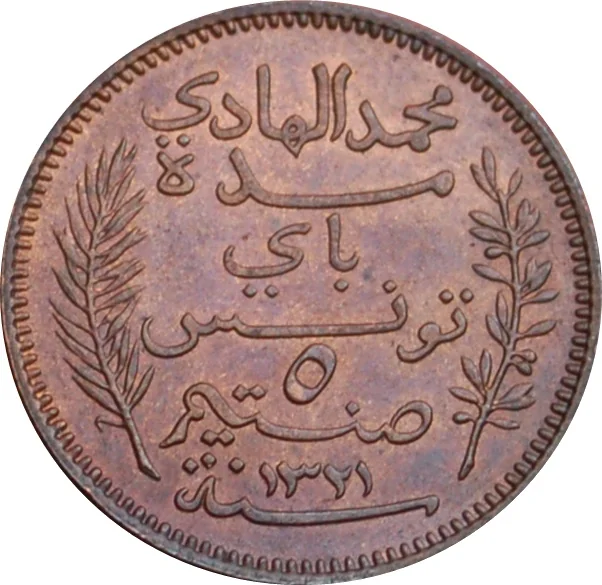
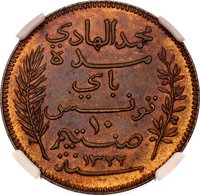
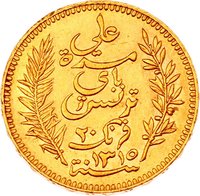
Obverse
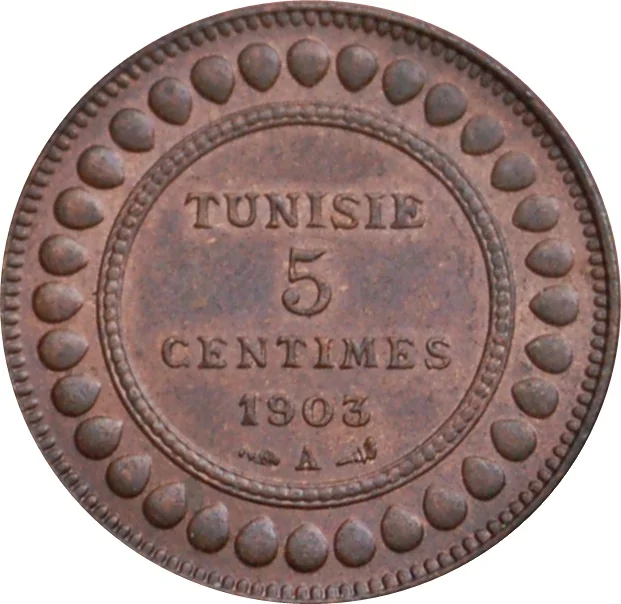
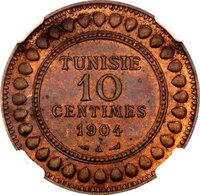
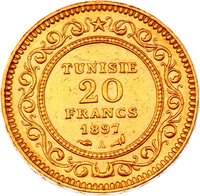
Reverse
Description:
Country, value, date, mint letter inside small beaded circle, within larger beaded circle and toothed border.
Inscription:
TUNISIE
5
CENTIMES
1903
A
5
CENTIMES
1903
A
Script: Latin
Edge
Plain
Mints
| Name | Mark |
|---|---|
| Monnaie de Paris | (A) |
Mintings
| Year | Mint Mark | Mintage | Quality | Collection |
|---|---|---|---|---|
| 1903 | — | 500,000 | ||
| 1904 | — | 1,000,000 |
Historical background
In 1903, Tunisia operated under a complex and fragmented monetary system, a direct legacy of its pre-colonial economic ties and its new status as a French protectorate, established in 1881. The official currency was the Tunisian rial, subdivided into 16 kharub, 13 buzzo, and 256 fals. However, this traditional unit served more as a money of account than a universally circulating coinage. In practice, a multitude of foreign coins circulated, primarily the French franc and gold coins like the British sovereign and the Turkish mejidie, leading to frequent confusion and exchange difficulties in daily commerce.
This monetary chaos was a significant obstacle to French colonial economic objectives, which aimed to fully integrate Tunisia into France's financial and commercial sphere. While the franc was legal tender and used for government transactions, the persistence of other currencies hindered efficient trade and administration. French authorities, therefore, were actively pursuing a policy of monetary unification and alignment with the Latin Monetary Union, seeing a single, stable currency tied to the franc as essential for encouraging French investment, simplifying tax collection, and tightening economic control.
Consequently, 1903 fell within a transitional period of reform. Just three years later, in 1906, the current monetary situation would be formally resolved with the introduction of a new fixed parity, definitively pegging the Tunisian franc (equivalent to the French franc) to the old rial at a rate of 1 rial = 60 francs. The background in 1903 was thus one of deliberate dismantling of the Ottoman-era monetary legacy, with French administration laying the groundwork for a complete currency overhaul that would firmly anchor Tunisia's economy to that of metropolitan France.
This monetary chaos was a significant obstacle to French colonial economic objectives, which aimed to fully integrate Tunisia into France's financial and commercial sphere. While the franc was legal tender and used for government transactions, the persistence of other currencies hindered efficient trade and administration. French authorities, therefore, were actively pursuing a policy of monetary unification and alignment with the Latin Monetary Union, seeing a single, stable currency tied to the franc as essential for encouraging French investment, simplifying tax collection, and tightening economic control.
Consequently, 1903 fell within a transitional period of reform. Just three years later, in 1906, the current monetary situation would be formally resolved with the introduction of a new fixed parity, definitively pegging the Tunisian franc (equivalent to the French franc) to the old rial at a rate of 1 rial = 60 francs. The background in 1903 was thus one of deliberate dismantling of the Ottoman-era monetary legacy, with French administration laying the groundwork for a complete currency overhaul that would firmly anchor Tunisia's economy to that of metropolitan France.
Series: 1903 Tunisia circulation coins
🌱 Common