

1 yuan – Yunnan Province
Add to wishlist
China
Context
Year: 1908
Country: China
Issuer: Yunnan Province
Ruler: Guangxu
Currency:
(1908—1949)
Demonetized: Yes
Material
References
Y: #
Numista: #15975
Value
Bullion value: $58.83
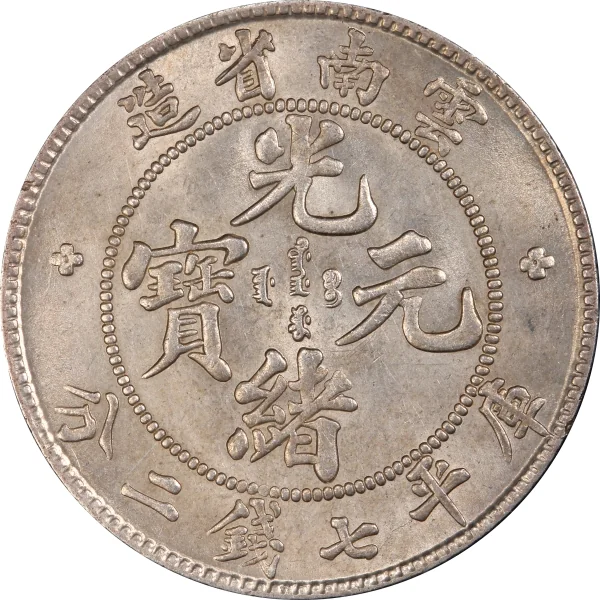
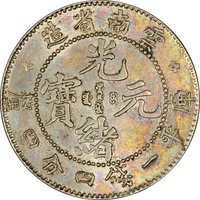
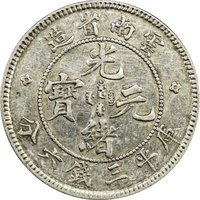
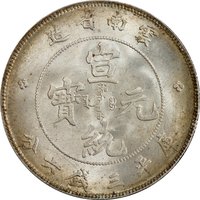
Obverse
Description:
Four Chinese ideograms read top to bottom, right to left, with central Manchu text surrounded by more ideograms.
Inscription:
造省南雲
光
ᠪᠠᡩᠠᡵᠠᠩᡤᠠ
寶 ᠶᡠᠸᠠᠨ ᠪᠣᠣ 元
ᡩᠣᡵᠣ
緒
分二錢七平庫
光
ᠪᠠᡩᠠᡵᠠᠩᡤᠠ
寶 ᠶᡠᠸᠠᠨ ᠪᠣᠣ 元
ᡩᠣᡵᠣ
緒
分二錢七平庫
Translation:
Made in the Yunnan Province
Guangxu
Badarangga
Dragon
Reign Period
Coinage
7 Mace and 2 Candareens, Treasury Standard
Guangxu
Badarangga
Dragon
Reign Period
Coinage
7 Mace and 2 Candareens, Treasury Standard
Scripts: Chinese, Mongolian / Manchu
Languages: Manchu, Classical Chinese
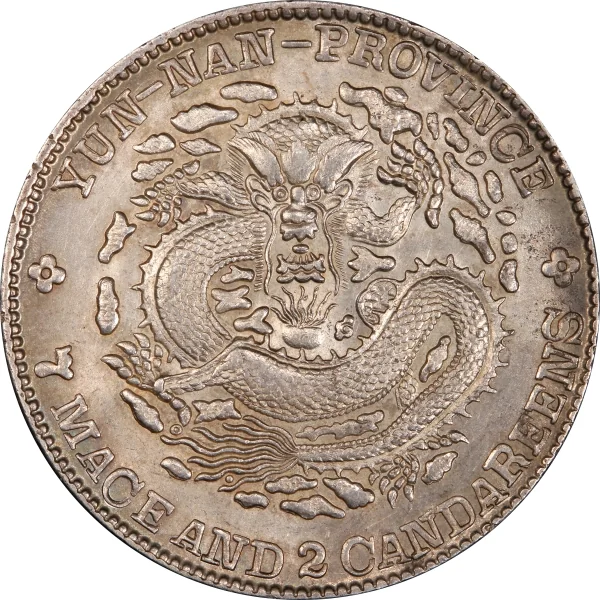
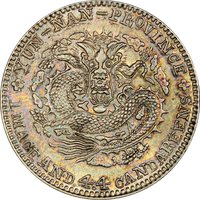
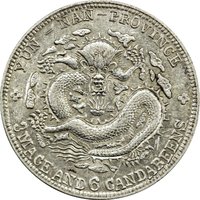
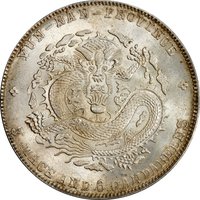
Reverse
Description:
Dragon encircling a pearl, surrounded by English text.
Inscription:
YUN-NAN-PROVINCE
7 MACE AND 2 CANDAREENS
7 MACE AND 2 CANDAREENS
Script: Latin
Edge
Reeded.
Categories
| Mythology> Fantastic animal |
Mintings
| Year | Mint Mark | Mintage | Quality | Collection |
|---|---|---|---|---|
| 1908 | — | — |
Historical background
In 1908, Yunnan Province operated within a complex and fragmented monetary system, a legacy of its remote geography, diverse local economies, and limited central control from the Qing Dynasty. The primary medium of exchange was the silver tael, but it circulated not as coinage but by weight and purity, leading to a proliferation of local standards like the Kunping tael. Concurrently, a vast quantity of debased copper cash coins, both official and privately minted, facilitated small daily transactions. This bimetallic system created constant exchange volatility, while the physical burden of "sycee" silver ingots and strings of cash coins severely hampered larger commercial and tax transactions.
The period was marked by a severe currency crisis, specifically a "copper famine" (qianhuang). A global surge in the price of copper, driven by international demand, made the metal in existing cash coins more valuable than their face value. This led to widespread hoarding and melting of copper coins for export, creating a drastic shortage of small change in the markets. The scarcity crippled local trade and caused social distress, as ordinary people struggled to obtain the necessary coins for basic purchases. Provincial authorities attempted to stem the outflow by banning the export of copper but with little success against smuggling.
In response, Yunnan, under the governance of the reformist Viceroy Xiliang, became a national pioneer in monetary modernization. 1908 saw the aggressive expansion of the newly established Yunnan Provincial Mint in Kunming, which began high-volume production of modern, machine-struck silver and copper coins. These new coins, particularly the Yunnan Silver Dollar (featuring a dragon design) and the copper xian coin (valued at 10 cash), were intended to standardize the currency, replace the old ingots and cash, and resolve the copper shortage. This provincial initiative represented a critical, albeit localized, step toward the financial integration and stability that the collapsing Qing state could not provide uniformly.
The period was marked by a severe currency crisis, specifically a "copper famine" (qianhuang). A global surge in the price of copper, driven by international demand, made the metal in existing cash coins more valuable than their face value. This led to widespread hoarding and melting of copper coins for export, creating a drastic shortage of small change in the markets. The scarcity crippled local trade and caused social distress, as ordinary people struggled to obtain the necessary coins for basic purchases. Provincial authorities attempted to stem the outflow by banning the export of copper but with little success against smuggling.
In response, Yunnan, under the governance of the reformist Viceroy Xiliang, became a national pioneer in monetary modernization. 1908 saw the aggressive expansion of the newly established Yunnan Provincial Mint in Kunming, which began high-volume production of modern, machine-struck silver and copper coins. These new coins, particularly the Yunnan Silver Dollar (featuring a dragon design) and the copper xian coin (valued at 10 cash), were intended to standardize the currency, replace the old ingots and cash, and resolve the copper shortage. This provincial initiative represented a critical, albeit localized, step toward the financial integration and stability that the collapsing Qing state could not provide uniformly.
💎 Very Rare