

Obverse
Description:
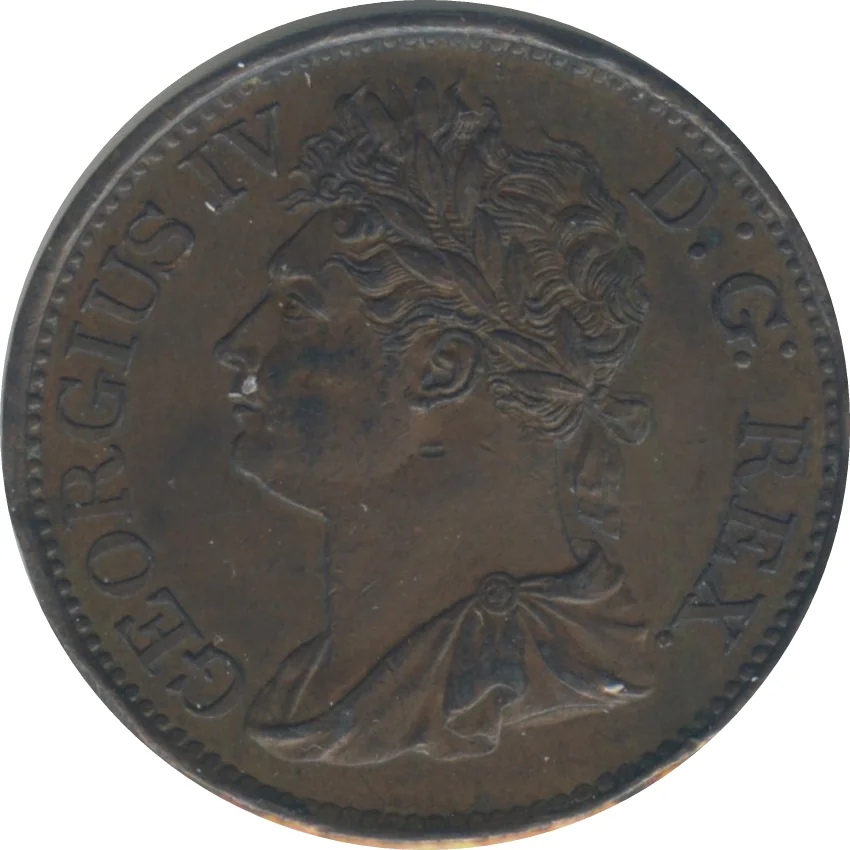
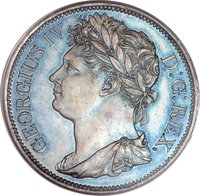
George IV left-facing bust
Inscription:
GEORGIUS IV D: G: REX
Translation:
George IV, by the Grace of God, King.
Script: Latin
Language: Latin
Engraver: William Wyon
Designer: Benedetto Pistrucci
Reverse
Description:
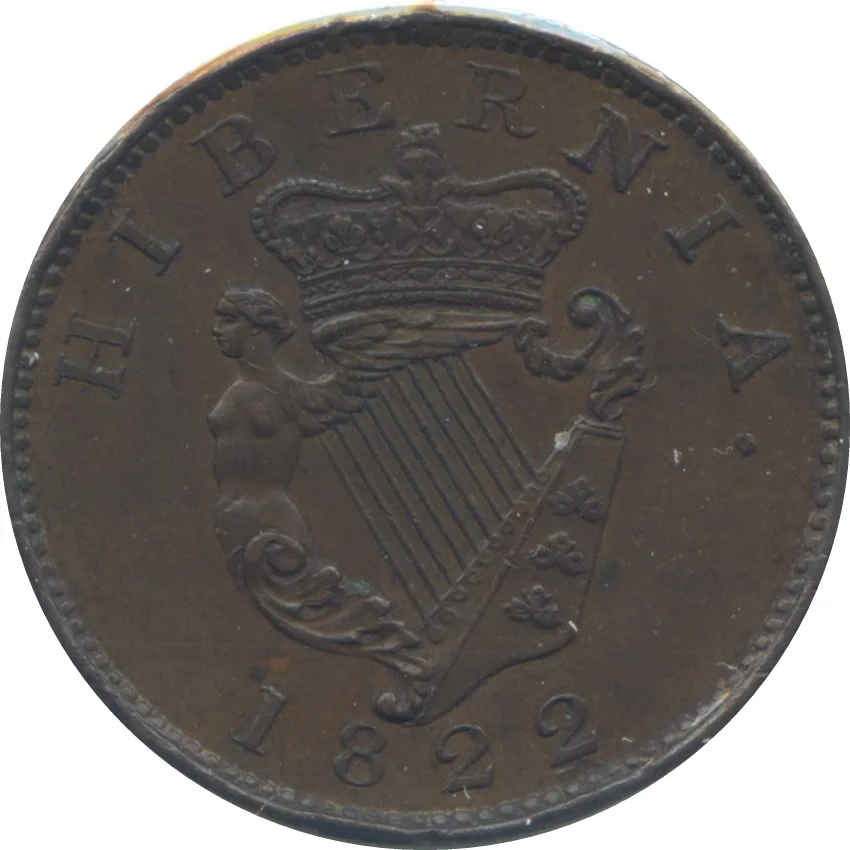
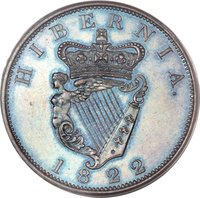
Harp centered, lettering above, date below.
Inscription:
HIBERNIA
1822
1822
Script: Latin
Engraver: William Wyon
Edge
Plain
Mints
| Name | Mark |
|---|---|
| Royal Mint (Tower Hill) | — |
Mintings
| Year | Mint Mark | Mintage | Quality | Collection |
|---|---|---|---|---|
| 1822 | — | — | ||
| 1822 | — | — | Proof | |
| 1823 | — | — | ||
| 1823 | — | — | Proof |
Historical background
In 1822, Ireland operated under a complex and strained monetary system, a legacy of its political union with Great Britain in 1801. The official currency was sterling, with banknotes issued by a handful of private and provincial banks. However, the system was fragmented and unstable. Many of these banks, especially outside Dublin, were poorly regulated and had issued excessive amounts of paper money during the Napoleonic Wars, leading to frequent bank failures and a severe loss of public confidence. This resulted in a chronic shortage of reliable small-denomination currency for everyday transactions, particularly in rural areas.
The situation was exacerbated by the economic depression that followed the war's end in 1815. Agricultural prices collapsed, unemployment soared, and widespread poverty deepened. In this climate of distress, the circulation of unreliable private banknotes and a proliferation of low-value tokens issued by merchants and tradesmen created a chaotic monetary environment. The lack of a uniform, trusted currency hindered commerce and made the economy more vulnerable to local shocks, as the failure of a single provincial bank could wipe out the circulating medium of an entire region.
The British government's response, the Bankers (Ireland) Act of 1825, was being formulated during this period and would be enacted a few years later. It aimed to address the crisis by restricting note-issuing powers, but in 1822, the immediate reality was one of monetary confusion and scarcity. This unstable financial backdrop contributed to the general economic hardship preceding the catastrophic Great Famine of the 1840s, highlighting how currency instability intertwined with deeper structural vulnerabilities within the Irish economy under the Union.
The situation was exacerbated by the economic depression that followed the war's end in 1815. Agricultural prices collapsed, unemployment soared, and widespread poverty deepened. In this climate of distress, the circulation of unreliable private banknotes and a proliferation of low-value tokens issued by merchants and tradesmen created a chaotic monetary environment. The lack of a uniform, trusted currency hindered commerce and made the economy more vulnerable to local shocks, as the failure of a single provincial bank could wipe out the circulating medium of an entire region.
The British government's response, the Bankers (Ireland) Act of 1825, was being formulated during this period and would be enacted a few years later. It aimed to address the crisis by restricting note-issuing powers, but in 1822, the immediate reality was one of monetary confusion and scarcity. This unstable financial backdrop contributed to the general economic hardship preceding the catastrophic Great Famine of the 1840s, highlighting how currency instability intertwined with deeper structural vulnerabilities within the Irish economy under the Union.
🌱 Common