

10 dollars (Bank of Namibia) – Namibia
Add to wishlist
Circulating commemorative coins
Commemoration: 20th Anniversary of the Bank of Namibia
Namibia
Obverse
Description:
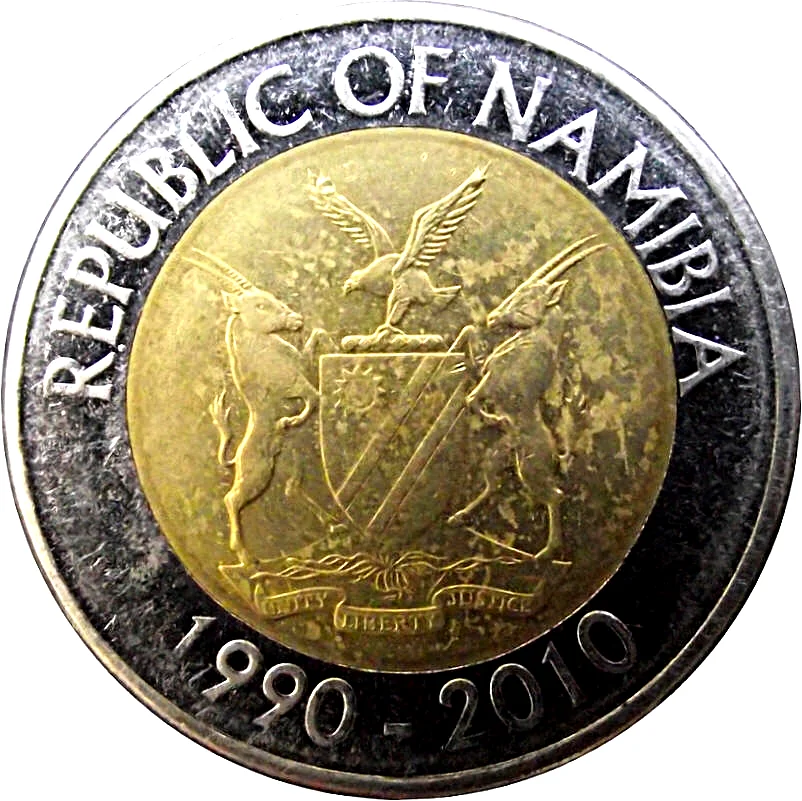
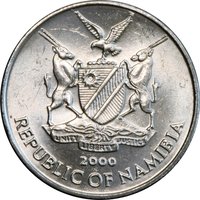
Namibia's Coat of Arms.
Inscription:
REPUBLIC OF NAMIBIA
UNITY LIBERTY JUSTICE
1990 - 2010
UNITY LIBERTY JUSTICE
1990 - 2010
Script: Latin
Reverse
Description:
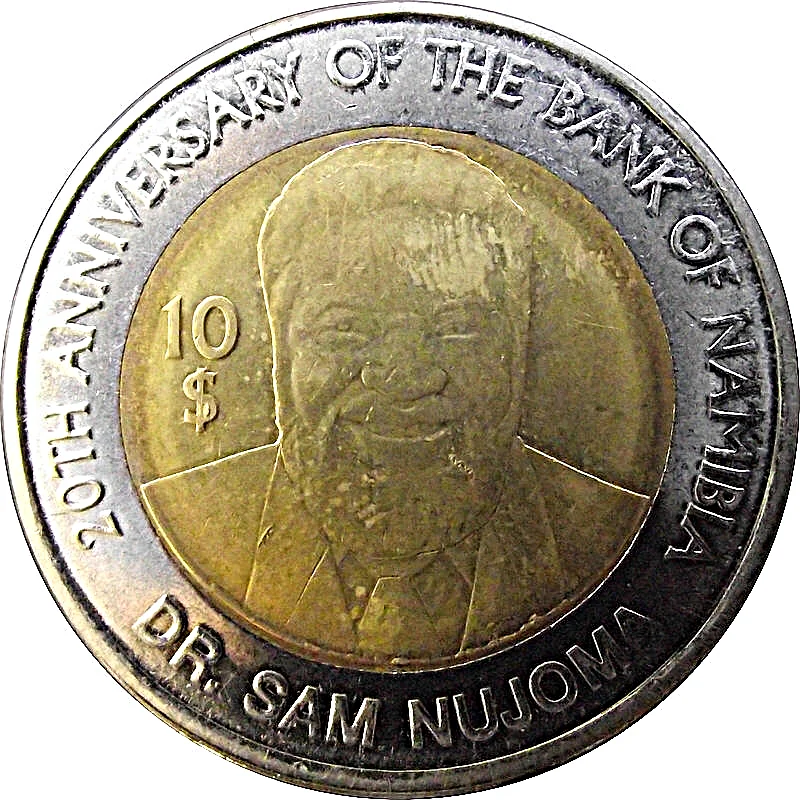
Portrait of Sam Nujoma, Namibia's first president (1990–2005).
Inscription:
20TH ANNIVERSARY OF THE BANK OF NAMIBIA
10
$
DR. SAM NUJOMA
10
$
DR. SAM NUJOMA
Script: Latin
Edge
4 reeded and 4 plain segments
Categories
| Symbols> Coat of Arms |
| Animal> Bird> Eagle |
| Animal> Sheep |
| Person> Politician |
Mints
| Name | Mark |
|---|---|
| Royal Mint | — |
Mintings
| Year | Mint Mark | Mintage | Quality | Collection |
|---|---|---|---|---|
| 2010 | — | 5,000,000 |
Historical background
In 2010, Namibia's currency situation was fundamentally defined by its membership in the Common Monetary Area (CMA) and its peg to the South African Rand. The Namibian Dollar (NAD), introduced in 1993, was fixed at a 1:1 parity with the Rand, which served as legal tender within the country alongside the NAD. This arrangement meant Namibia did not have an independent monetary policy; its interest rates and money supply were largely determined by the South African Reserve Bank's decisions aimed at the larger South African economy. This provided stability and facilitated seamless trade with its largest trading partner, but it also meant Namibia imported South Africa's inflation and economic vulnerabilities.
The year 2010 fell within a period of recovery from the global financial crisis, which had significantly impacted the CMA region via reduced commodity exports and capital outflows. While the peg provided a stable anchor, it also exposed Namibia to the Rand's volatility. During this time, the Rand was strengthening against major currencies, which, combined with a relatively high inflation differential between Namibia and South Africa, raised concerns about the competitiveness of Namibian exports. Domestically, there were ongoing debates about the costs and benefits of the peg, with some stakeholders questioning whether Namibia should consider greater monetary sovereignty.
Despite these debates, the institutional framework remained firmly in place. The Bank of Namibia, established in 1990, managed the currency's issuance and foreign reserves but its policy tools were constrained by the peg. The focus in 2010 was therefore less on exchange rate manoeuvres and more on using fiscal policy and macro-prudential measures to address domestic economic priorities like growth, unemployment, and managing the burgeoning household debt. The currency situation was thus characterized by a stable but imported monetary regime, with authorities navigating its constraints while the economy gradually rebounded from the global downturn.
The year 2010 fell within a period of recovery from the global financial crisis, which had significantly impacted the CMA region via reduced commodity exports and capital outflows. While the peg provided a stable anchor, it also exposed Namibia to the Rand's volatility. During this time, the Rand was strengthening against major currencies, which, combined with a relatively high inflation differential between Namibia and South Africa, raised concerns about the competitiveness of Namibian exports. Domestically, there were ongoing debates about the costs and benefits of the peg, with some stakeholders questioning whether Namibia should consider greater monetary sovereignty.
Despite these debates, the institutional framework remained firmly in place. The Bank of Namibia, established in 1990, managed the currency's issuance and foreign reserves but its policy tools were constrained by the peg. The focus in 2010 was therefore less on exchange rate manoeuvres and more on using fiscal policy and macro-prudential measures to address domestic economic priorities like growth, unemployment, and managing the burgeoning household debt. The currency situation was thus characterized by a stable but imported monetary regime, with authorities navigating its constraints while the economy gradually rebounded from the global downturn.
🌱 Common