

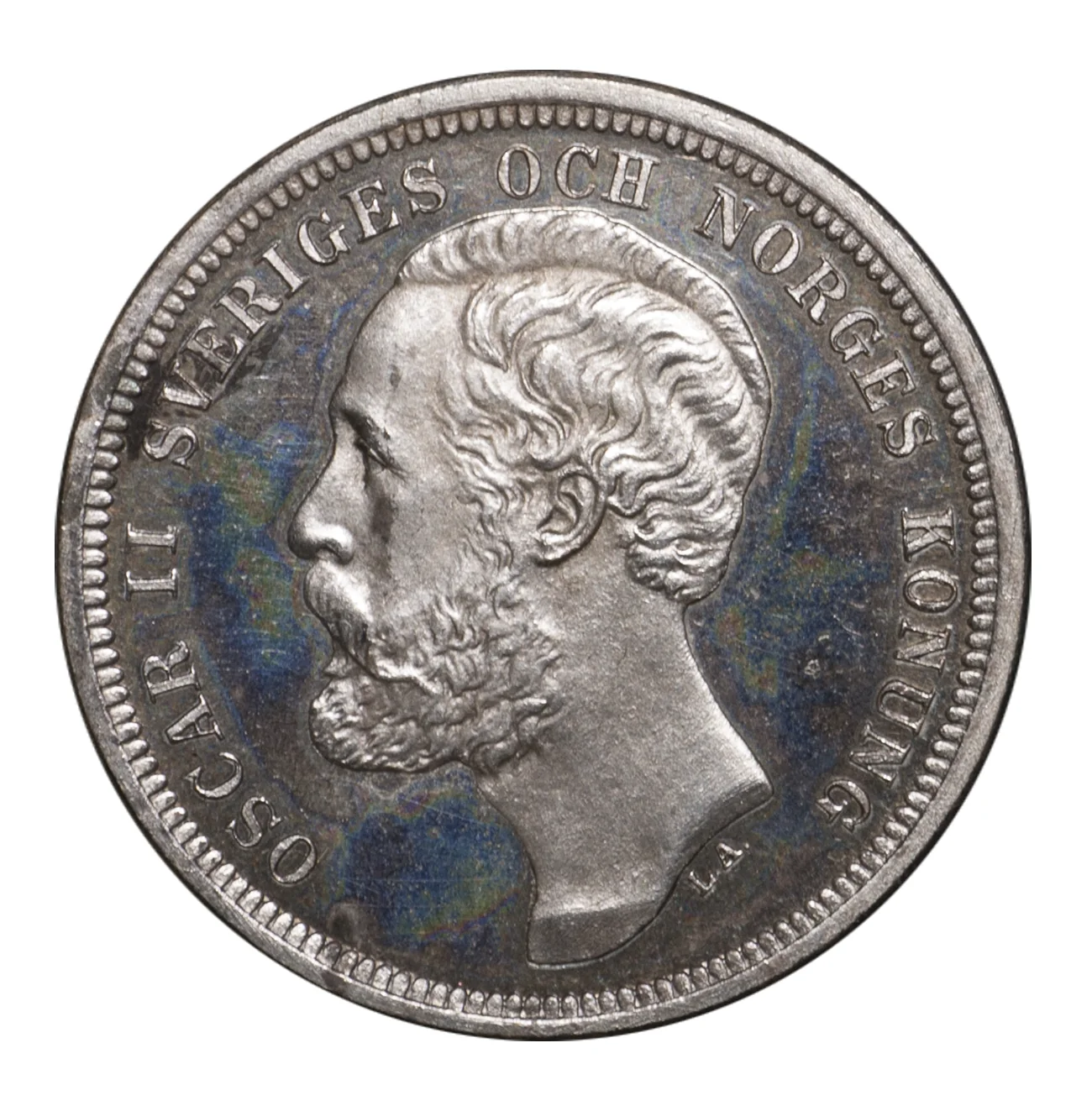
Obverse
Description:
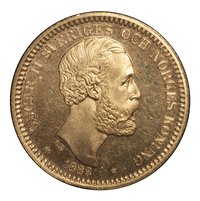
King Oscar II facing left, engraver initials below neck, legend around rim.
Inscription:
OSCAR II SVERIGES OCH NORGES KONUNG
L.A.
L.A.
Translation:
OSCAR II KING OF SWEDEN AND NORWAY
L.A.
L.A.
Script: Latin
Engraver: Lea Ahlborn
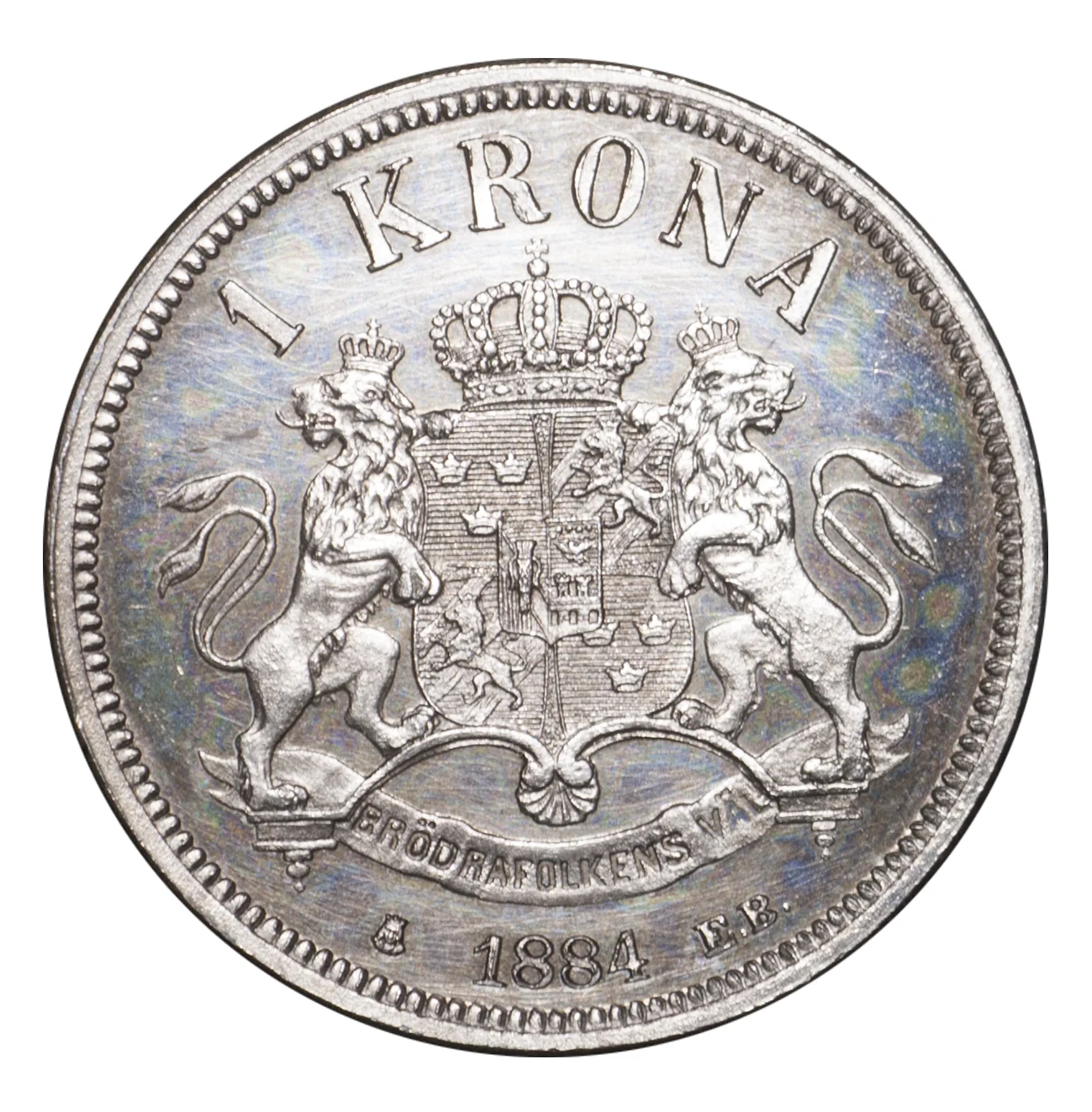
Reverse
Description:
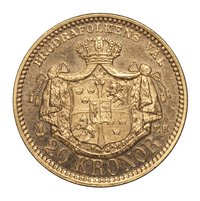
Sweden’s crowned coat of arms, supported by lions, with the value above and the date and mintmarks below the King’s motto.
Inscription:
1 KRONA
BRÖDRAFOLKENS VÄL
1887 E.B.
BRÖDRAFOLKENS VÄL
1887 E.B.
Translation:
1 KRONA
THE WELFARE OF THE BROTHER PEOPLES
1887 E.B.
THE WELFARE OF THE BROTHER PEOPLES
1887 E.B.
Script: Latin
Language: Swedish
Engraver: Lea Ahlborn
Edge
Reeded
Mints
| Name | Mark |
|---|---|
| Kungliga Myntet | — |
Mintings
| Year | Mint Mark | Mintage | Quality | Collection |
|---|---|---|---|---|
| 1877 | — | 554,263 | ||
| 1879 | — | 77,254 | ||
| 1880 | — | 177,121 | ||
| 1881 | — | 619,147 | ||
| 1883 | — | 205,088 | ||
| 1884 | — | 381,909 | ||
| 1887 | — | 57,988 | ||
| 1888 | — | 62,368 | ||
| 1889 | — | 425,397 |
Historical background
In 1877, Sweden was in the final stages of a complex monetary transition, operating under a de facto silver standard while formally adhering to the Scandinavian Monetary Union (SMU) established with Denmark in 1873 (and joined by Norway in 1875). The union created a common gold standard, with the Swedish krona (crown) replacing the former riksdaler riksmynt as the new unit of currency, pegged to gold at a rate of 2,480 kronor per kilogram of fine gold. However, the practical shift was gradual; older silver coins remained legal tender alongside the new gold coins, creating a period of bimetallic circulation.
The year 1877 itself was significant for a key legislative change within this framework. The Swedish Riksdag passed a law that demonetized the old silver riksdaler coins, which had continued to circulate at a fixed value relative to the new gold krona. This move was crucial for fully realizing the intent of the Monetary Union, as it aimed to remove the last major vestige of the previous silver-based system and solidify the gold standard as the sole basis for the currency. The goal was to achieve monetary uniformity and stability, both domestically and across the union's borders, facilitating trade and economic integration.
Despite this formal shift, the international economic landscape posed challenges. The late 1870s were a period of global deflation and falling silver prices, which put pressure on bimetallic systems worldwide. Sweden's commitment to gold within the SMU, reinforced by the 1877 law, insulated it from the direct disruptions of the silver glut but tied its economy to the international gold standard's discipline. This meant that Sweden's money supply and credit conditions were increasingly influenced by international gold flows rather than domestic policy, embedding the nation more deeply into the global financial system of the era.
The year 1877 itself was significant for a key legislative change within this framework. The Swedish Riksdag passed a law that demonetized the old silver riksdaler coins, which had continued to circulate at a fixed value relative to the new gold krona. This move was crucial for fully realizing the intent of the Monetary Union, as it aimed to remove the last major vestige of the previous silver-based system and solidify the gold standard as the sole basis for the currency. The goal was to achieve monetary uniformity and stability, both domestically and across the union's borders, facilitating trade and economic integration.
Despite this formal shift, the international economic landscape posed challenges. The late 1870s were a period of global deflation and falling silver prices, which put pressure on bimetallic systems worldwide. Sweden's commitment to gold within the SMU, reinforced by the 1877 law, insulated it from the direct disruptions of the silver glut but tied its economy to the international gold standard's discipline. This meant that Sweden's money supply and credit conditions were increasingly influenced by international gold flows rather than domestic policy, embedding the nation more deeply into the global financial system of the era.
Series: 1877 Sweden circulation coins
🌱 Fairly Common