

1500 rupees – Nepal
Add to wishlist
Nepal
Context
Year: 2000
Issuer: Nepal
Ruler: Birendra Bir Bikram Shah
Currency:
(since 1932)
Total mintage: 15,000
Material
References
KM: #
Numista: #158880
Value
Exchange value: 1500 NPR
Bullion value: $47.09
Obverse
Description:
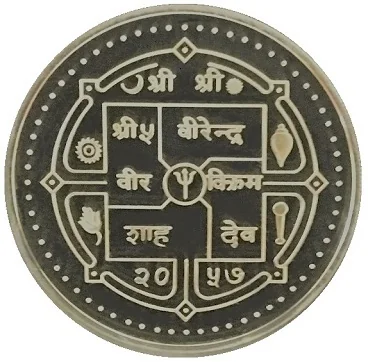
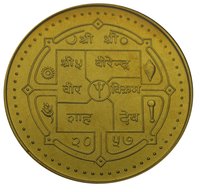
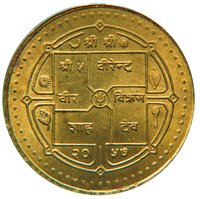
The obverse features King Birendra Bir Bikram and Hindu symbols: the Chandra (moon) and Surya (sun) above, a central Trishul (trident), flanked by a Chakra (discus) and Sankha (conch), with a Padma (lotus) and Gada (mace) below.
Inscription:
श्री श्री
श्री५ वीरेन्द्र वीर विक्रम शाह देव
२०५७
श्री५ वीरेन्द्र वीर विक्रम शाह देव
२०५७
Translation:
Shri Shri
Shri 5 Virendra Veer Vikram Shah Dev
2057
Shri 5 Virendra Veer Vikram Shah Dev
2057
Reverse
Description:
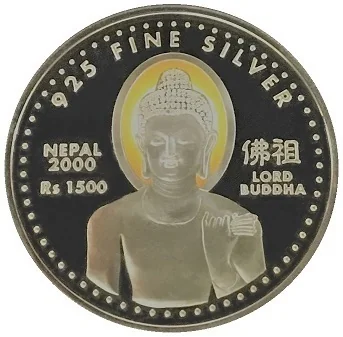
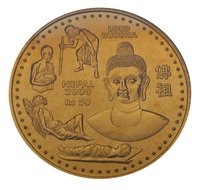
Reverse: Lord Buddha with a golden aura.
Inscription:
925 FINE SILVER
NEPAL 2000
Rs 1500
佛神
LORD BUDDHA
NEPAL 2000
Rs 1500
佛神
LORD BUDDHA
Translation:
925 Fine Silver
Nepal 2000
Rs 1500
Lord Buddha
Nepal 2000
Rs 1500
Lord Buddha
Language: English
Edge
Reeded
Mintings
| Year | Mint Mark | Mintage | Quality | Collection |
|---|---|---|---|---|
| 2000 | — | 15,000 | Proof |
Historical background
In the year 2000, Nepal's currency situation was characterized by a stable but tightly controlled exchange rate regime, underpinned by a long-standing peg to the Indian rupee (INR). The Nepalese rupee (NPR) was fixed at a rate of NPR 1.60 = INR 1, a parity maintained since 1993 through the Nepal Rastra Bank (NRB), the country's central bank. This peg provided crucial stability for trade, as India was and remains Nepal's largest trading partner, facilitating cross-border commerce and reducing exchange rate volatility for a significant portion of Nepal's imports and exports. The system was managed under a dual-currency environment in the border region, where the Indian rupee circulated freely alongside the Nepalese rupee.
However, this stability came with significant constraints. The peg necessitated that Nepal's monetary policy closely shadow that of the Reserve Bank of India, limiting the NRB's ability to set independent interest rates or use monetary tools to address domestic economic conditions. Furthermore, the fixed exchange rate exposed the economy to vulnerabilities from India's economic performance and required substantial foreign exchange reserves to defend the parity. By 2000, pressures were emerging from a growing trade deficit with India, which strained forex reserves, and from the need to maintain competitiveness beyond the Indian market.
The broader economic context of 2000 was one of post-conflict uncertainty and low growth, following a decade of political instability. While the currency peg provided an anchor, it also masked underlying structural weaknesses in the economy, including low productivity and a narrow export base beyond hydropower potential and tourism. The fixed exchange rate was thus a double-edged sword: a necessary pillar for economic predictability during a turbulent period, but also a mechanism that limited policy flexibility and highlighted Nepal's deep economic interdependence with its southern neighbor.
However, this stability came with significant constraints. The peg necessitated that Nepal's monetary policy closely shadow that of the Reserve Bank of India, limiting the NRB's ability to set independent interest rates or use monetary tools to address domestic economic conditions. Furthermore, the fixed exchange rate exposed the economy to vulnerabilities from India's economic performance and required substantial foreign exchange reserves to defend the parity. By 2000, pressures were emerging from a growing trade deficit with India, which strained forex reserves, and from the need to maintain competitiveness beyond the Indian market.
The broader economic context of 2000 was one of post-conflict uncertainty and low growth, following a decade of political instability. While the currency peg provided an anchor, it also masked underlying structural weaknesses in the economy, including low productivity and a narrow export base beyond hydropower potential and tourism. The fixed exchange rate was thus a double-edged sword: a necessary pillar for economic predictability during a turbulent period, but also a mechanism that limited policy flexibility and highlighted Nepal's deep economic interdependence with its southern neighbor.
✨ Legendary