

10 Cents – Hong Kong
China
Context
Years: 1993–2017
Country: China 
Issuer: Hong Kong 
Period:
(since 1997)
Ruler: Elizabeth II
Currency:
(since 1863)
Material
References
KM: #Click to copy to clipboard66
Numista: #1579
Value
Exchange value: 0.10 HKD = $0.01
Inflation-adjusted value: 0.30 HKD
Obverse
Description:
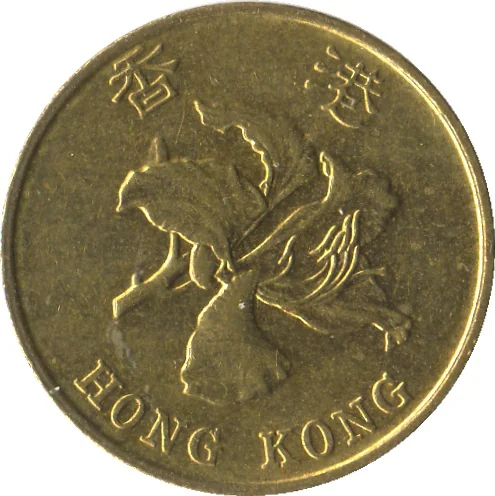
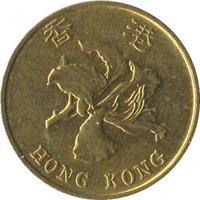
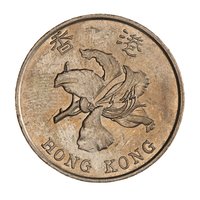
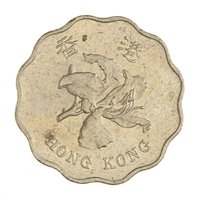
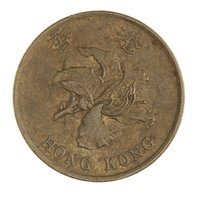
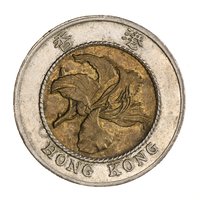
Bauhinia blakeana, the Hong Kong orchid tree.
Inscription:
香 港
HONG KONG
HONG KONG
Translation:
HONG KONG
Engraver: Joseph Yam
Reverse
Description:
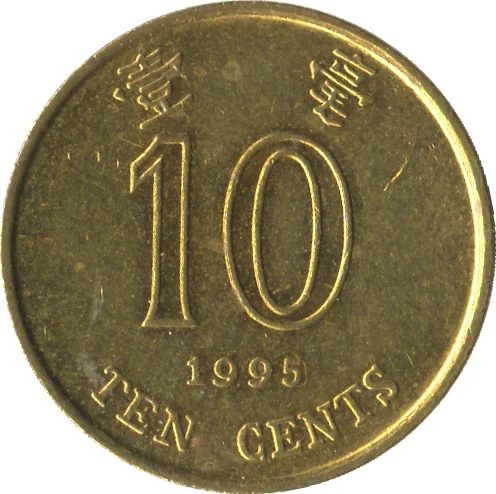
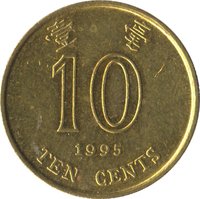
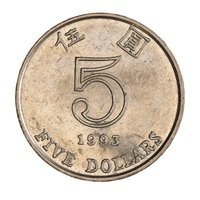
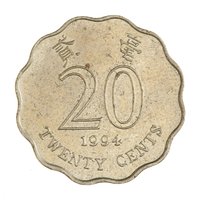
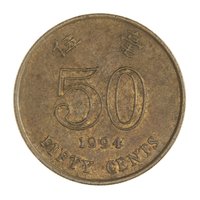
Amount in numerals above, denomination in words below.
Inscription:
壹 毫
10
1995
TEN CENTS
10
1995
TEN CENTS
Translation:
One Cent
10
1995
TEN CENTS
10
1995
TEN CENTS
Language: Chinese
Engraver: Joseph Yam
Edge
Plain
Mints
| Name | Mark |
|---|---|
| Royal Mint | — |
Mintings
| Year | Mint Mark | Mintage | Quality | Collection |
|---|---|---|---|---|
| 1993 | — | — | Proof | |
| 1993 | — | — | ||
| 1994 | — | — | ||
| 1995 | — | — | ||
| 1996 | — | — | ||
| 1997 | — | — | ||
| 1998 | — | — | ||
| 2017 | — | — |
Historical background
In 1993, Hong Kong operated under the unique and highly successful Linked Exchange Rate System (LERS), established a decade earlier in 1983. This system pegged the Hong Kong dollar (HKD) at a fixed rate of HK$7.80 to one US dollar (USD), a direct response to a crisis of confidence during Sino-British negotiations over the territory's future. The mechanism was (and remains) a currency board system, requiring the Hong Kong Monetary Authority (HKMA, established in 1993) to back all Hong Kong dollar notes in circulation with US dollar reserves at the fixed rate, ensuring full convertibility and automatic adjustment of the local money supply based on capital flows.
The year 1993 was a period of relative stability and confidence for the Hong Kong dollar, situated between the system's initial turbulence in the 1980s and the severe speculative attacks it would later face during the 1997-98 Asian Financial Crisis. This stability was crucial as Hong Kong was in the final phase of its transition from British to Chinese sovereignty, set for 1997. The currency peg provided a predictable monetary environment, fostering robust economic growth, booming property and stock markets, and positioning the city as a premier international financial hub. The formal creation of the HKMA in 1993 centralized and strengthened oversight of the currency system and banking sector.
However, the peg also meant that Hong Kong imported the monetary policy of the United States, relinquishing its ability to set independent interest rates. In 1993, with U.S. rates relatively low, this was not a major point of strain, but it laid the groundwork for future vulnerabilities. The system's rigidity meant Hong Kong could not devalue its currency to regain competitiveness during economic downturns, and asset price inflation became a growing concern. Thus, while the currency situation in 1993 was outwardly calm and functionally effective, it locked Hong Kong into a monetary framework whose trade-offs—prioritizing stability over flexibility—would be tested in the dramatic years immediately ahead.
The year 1993 was a period of relative stability and confidence for the Hong Kong dollar, situated between the system's initial turbulence in the 1980s and the severe speculative attacks it would later face during the 1997-98 Asian Financial Crisis. This stability was crucial as Hong Kong was in the final phase of its transition from British to Chinese sovereignty, set for 1997. The currency peg provided a predictable monetary environment, fostering robust economic growth, booming property and stock markets, and positioning the city as a premier international financial hub. The formal creation of the HKMA in 1993 centralized and strengthened oversight of the currency system and banking sector.
However, the peg also meant that Hong Kong imported the monetary policy of the United States, relinquishing its ability to set independent interest rates. In 1993, with U.S. rates relatively low, this was not a major point of strain, but it laid the groundwork for future vulnerabilities. The system's rigidity meant Hong Kong could not devalue its currency to regain competitiveness during economic downturns, and asset price inflation became a growing concern. Thus, while the currency situation in 1993 was outwardly calm and functionally effective, it locked Hong Kong into a monetary framework whose trade-offs—prioritizing stability over flexibility—would be tested in the dramatic years immediately ahead.
Series: 1993 Hong Kong circulation coins
🌱 Very Common