

2 Euro (Magellan Circumnavigation) – Portugal
Circulating commemorative coins
Commemoration: 500th anniversary of Magellan Circumnavigation
Portugal
Context
Material

References
KM: #Click to copy to clipboard895
Numista: #157844
Value
Exchange value: 2 EUR = $2.36
Inflation-adjusted value: 2.33 EUR
Obverse
Description:
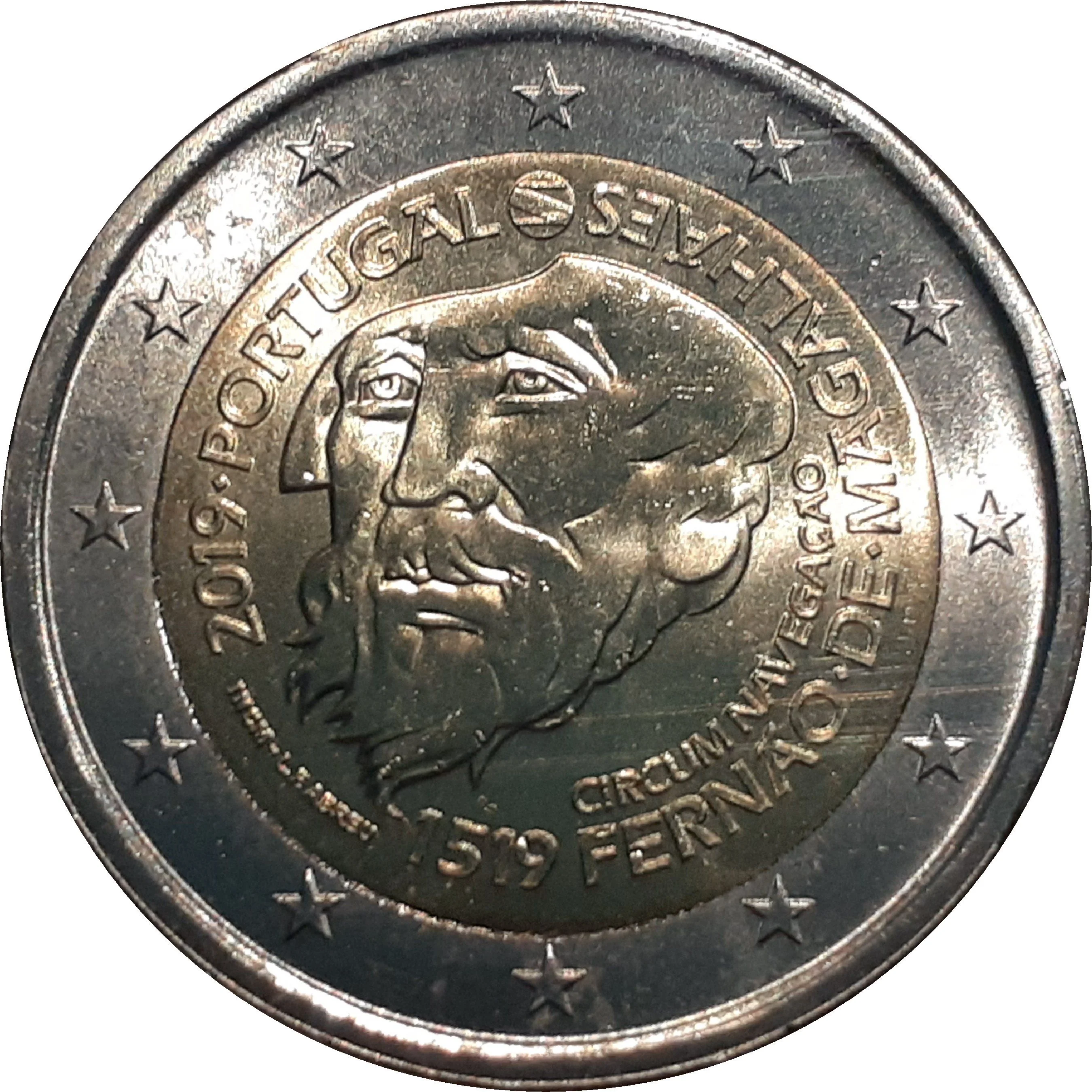
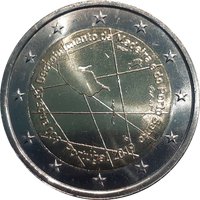
This coin commemorates the first Earth circumnavigation (1519-1522). It features the effigy of Fernão de Magalhães, with "CIRCUM NAVEGAÇÃO" and "1519 FERNÃO DE MAGALHÃES" on the right. On the left are "2019" and "PORTUGAL". The outer ring bears the 12 stars of the European flag.
Inscription:
2019 • PORTUGAL
CIRCUM NAVEGAÇÃO
1519 FERNÃO•DE•MAGALHÃES
CIRCUM NAVEGAÇÃO
1519 FERNÃO•DE•MAGALHÃES
Translation:
2019 • PORTUGAL
AROUND NAVIGATION
1519 FERNÃO•DE•MAGALHÃES
AROUND NAVIGATION
1519 FERNÃO•DE•MAGALHÃES
Script: Latin
Language: Portuguese
Engraver: Luís Filipe de Abreu
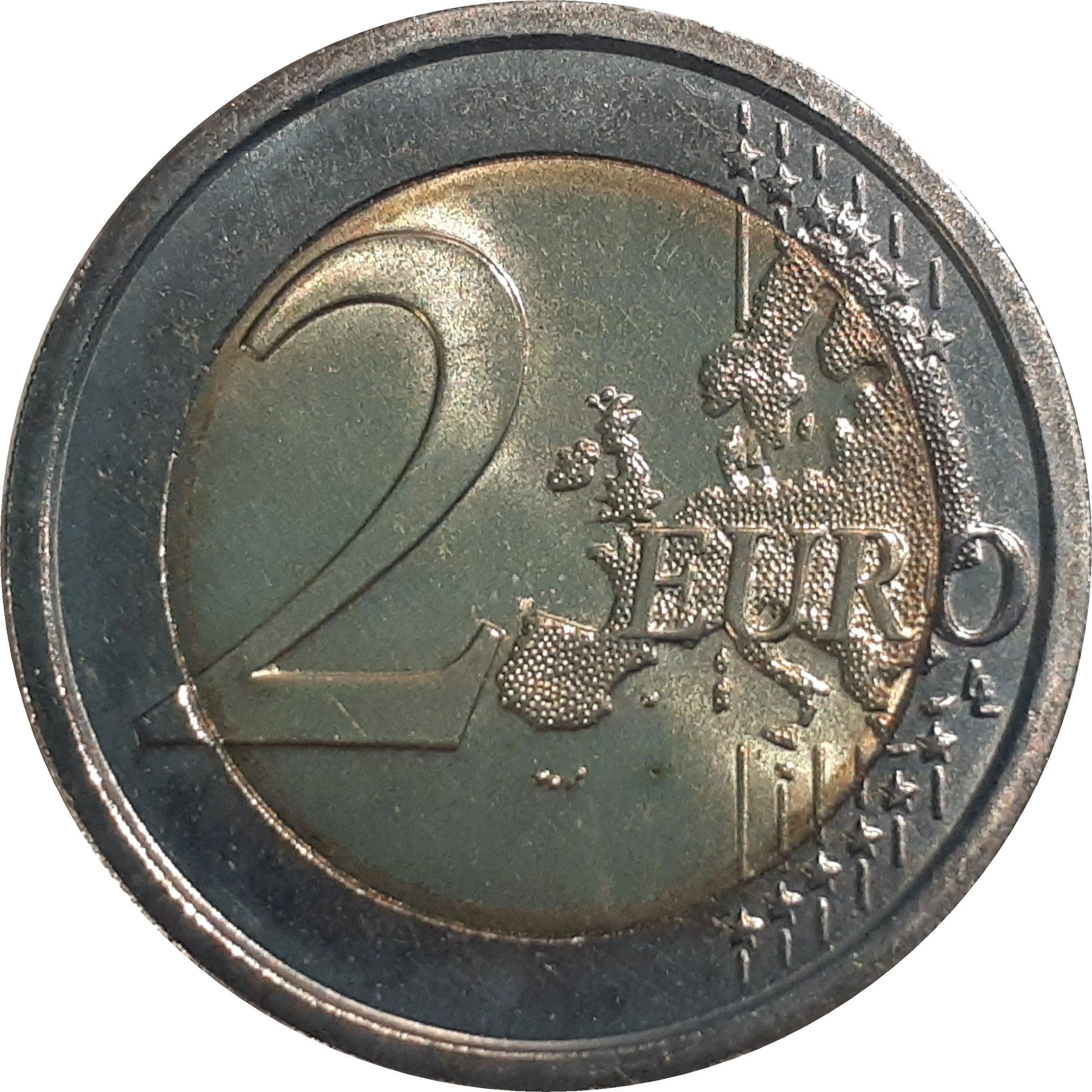
Reverse
Edge
Finely reeded with inscription: seven castles and five coats of arms
Mints
| Name | Mark |
|---|---|
| Imprensa Nacional - Casa da Moeda | — |
Mintings
| Year | Mint Mark | Mintage | Quality | Collection |
|---|---|---|---|---|
| 2019 | INCM | 500,000 | ||
| 2019 | INCM | 3,899 | BU | |
| 2019 | INCM | 3,729 | Proof |
Historical background
In 2019, Portugal's currency situation was defined by its continued and stable membership in the Eurozone, using the euro (€) as its sole legal tender. Having adopted the currency in 1999 (with notes and coins introduced in 2002), the euro was by this time deeply embedded in the national economy. This membership provided significant benefits, including monetary stability, low inflation, and elimination of exchange rate risk within the Eurozone, which was crucial for a country heavily reliant on tourism and foreign investment. The European Central Bank (ECB) set monetary policy for Portugal, meaning Lisbon had no independent control over interest rates or money supply.
The broader context, however, was one of post-austerity recovery. Portugal had successfully exited its international bailout program in 2014 and by 2019 was experiencing steady, though modest, economic growth. Public debt remained high but was on a declining trajectory, and the government was running a budget surplus. The stable euro provided a foundation for this recovery, fostering investor confidence and facilitating trade. Domestically, there was little mainstream political debate about leaving the euro, as "Grexit" fears from earlier in the decade had subsided and the currency was widely seen as integral to Portugal's modern economic identity.
Nevertheless, some underlying challenges persisted. As a southern European member, Portugal had no mechanism to devalue its currency to boost competitiveness, relying instead on internal devaluation (wage restraint and structural reforms). Furthermore, the one-size-fits-all ECB policy sometimes did not perfectly align with Portugal's specific economic cycle needs. Overall, 2019 represented a period of normalization and consolidation for Portugal within the Eurozone framework, with the currency situation marked by stability and a focus on sustaining fiscal discipline within the single currency area.
The broader context, however, was one of post-austerity recovery. Portugal had successfully exited its international bailout program in 2014 and by 2019 was experiencing steady, though modest, economic growth. Public debt remained high but was on a declining trajectory, and the government was running a budget surplus. The stable euro provided a foundation for this recovery, fostering investor confidence and facilitating trade. Domestically, there was little mainstream political debate about leaving the euro, as "Grexit" fears from earlier in the decade had subsided and the currency was widely seen as integral to Portugal's modern economic identity.
Nevertheless, some underlying challenges persisted. As a southern European member, Portugal had no mechanism to devalue its currency to boost competitiveness, relying instead on internal devaluation (wage restraint and structural reforms). Furthermore, the one-size-fits-all ECB policy sometimes did not perfectly align with Portugal's specific economic cycle needs. Overall, 2019 represented a period of normalization and consolidation for Portugal within the Eurozone framework, with the currency situation marked by stability and a focus on sustaining fiscal discipline within the single currency area.
Series: Portugal 2 euro commemoratives


🌱 Very Common