

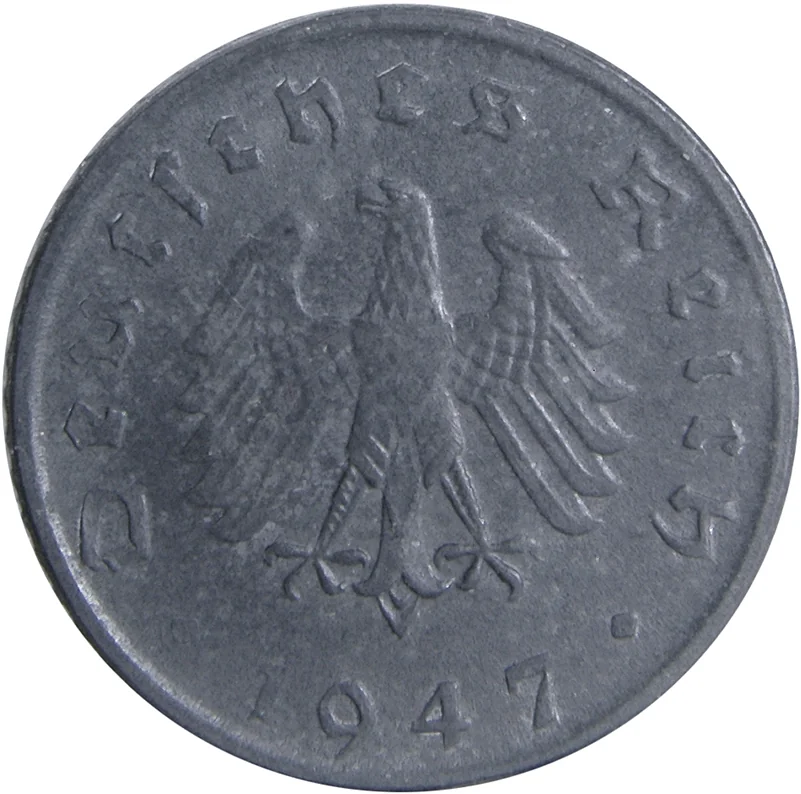
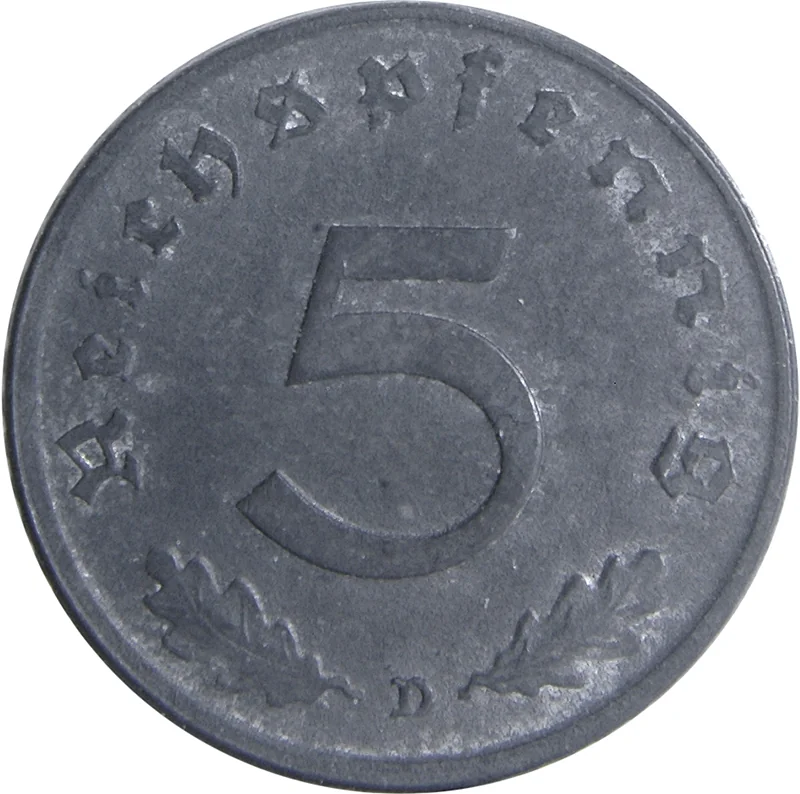
5 pfennigs – Germany
Add to wishlist
Germany
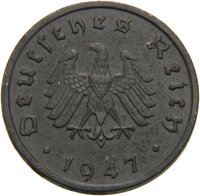
Obverse
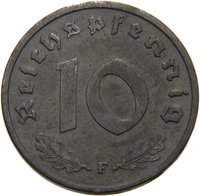
Reverse
Inscription:
Reichspfennig
5
D
5
D
Edge
Reeded
Mints
| Name | Mark |
|---|---|
| Berlin | A |
| Munich | D |
| Muldenhütten | E |
Historical background
By 1947, the currency situation in occupied Germany was catastrophic, a direct legacy of the Nazi war economy. The Third Reich had financed its war effort through massive borrowing and printing money, while strictly controlling prices and wages. This created a vast overhang of Reichsmarks with no corresponding goods to purchase, as industrial production had collapsed. The result was a rampant black market where cigarettes, coffee, and barter replaced worthless cash, and the official economy stagnated because no one would sell goods for a currency doomed to fail.
The occupying powers—the United States, Britain, France, and the Soviet Union—recognized the need for radical reform but were deeply divided. A joint currency reform was planned, but growing East-West tensions, particularly over reparations and economic ideology, led the Soviet Union to withdraw from the quadripartite negotiations. This deadlock meant the monetary paralysis continued, crippling any meaningful recovery. In the Western zones, economic activity was stifled as people hoarded any tangible assets, waiting for the inevitable day when the old Reichsmark would be abolished.
Consequently, 1947 served as the final, tense year of the old currency system. Secret planning for a new Deutsche Mark proceeded in the Western zones, with notes printed in the United States and stored under tight security. The stage was set for a unilateral Western reform, which would be enacted in June 1948. The currency situation of 1947, therefore, was the critical prelude to the dramatic Wirtschaftswunder (economic miracle) in the West and, simultaneously, a major catalyst for the formal division of Germany, as the Soviets responded with the Berlin Blockade and the introduction of their own separate currency in the East.
The occupying powers—the United States, Britain, France, and the Soviet Union—recognized the need for radical reform but were deeply divided. A joint currency reform was planned, but growing East-West tensions, particularly over reparations and economic ideology, led the Soviet Union to withdraw from the quadripartite negotiations. This deadlock meant the monetary paralysis continued, crippling any meaningful recovery. In the Western zones, economic activity was stifled as people hoarded any tangible assets, waiting for the inevitable day when the old Reichsmark would be abolished.
Consequently, 1947 served as the final, tense year of the old currency system. Secret planning for a new Deutsche Mark proceeded in the Western zones, with notes printed in the United States and stored under tight security. The stage was set for a unilateral Western reform, which would be enacted in June 1948. The currency situation of 1947, therefore, was the critical prelude to the dramatic Wirtschaftswunder (economic miracle) in the West and, simultaneously, a major catalyst for the formal division of Germany, as the Soviets responded with the Berlin Blockade and the introduction of their own separate currency in the East.
🌱 Fairly Common