

10 Pfennigs – Germany
Germany

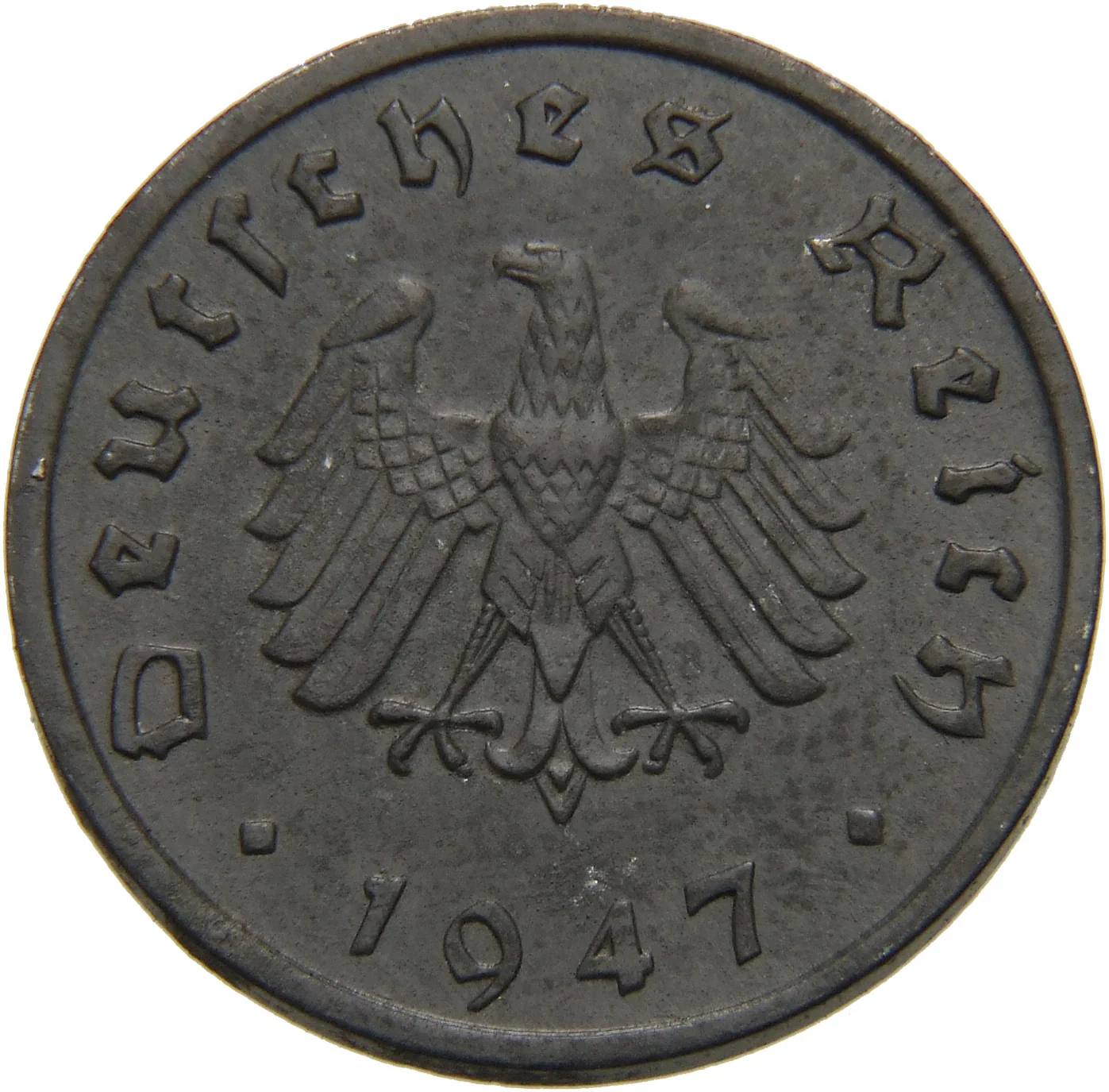
Obverse
Description:
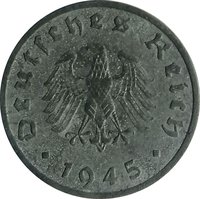
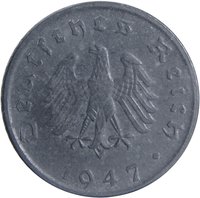
Imperial eagle, head right, within legend; date in exergue between rhombuses.
Inscription:
Deutsches Reich
1947
1947
Translation:
German Empire
1947
1947
Language: German
Reverse
Description:
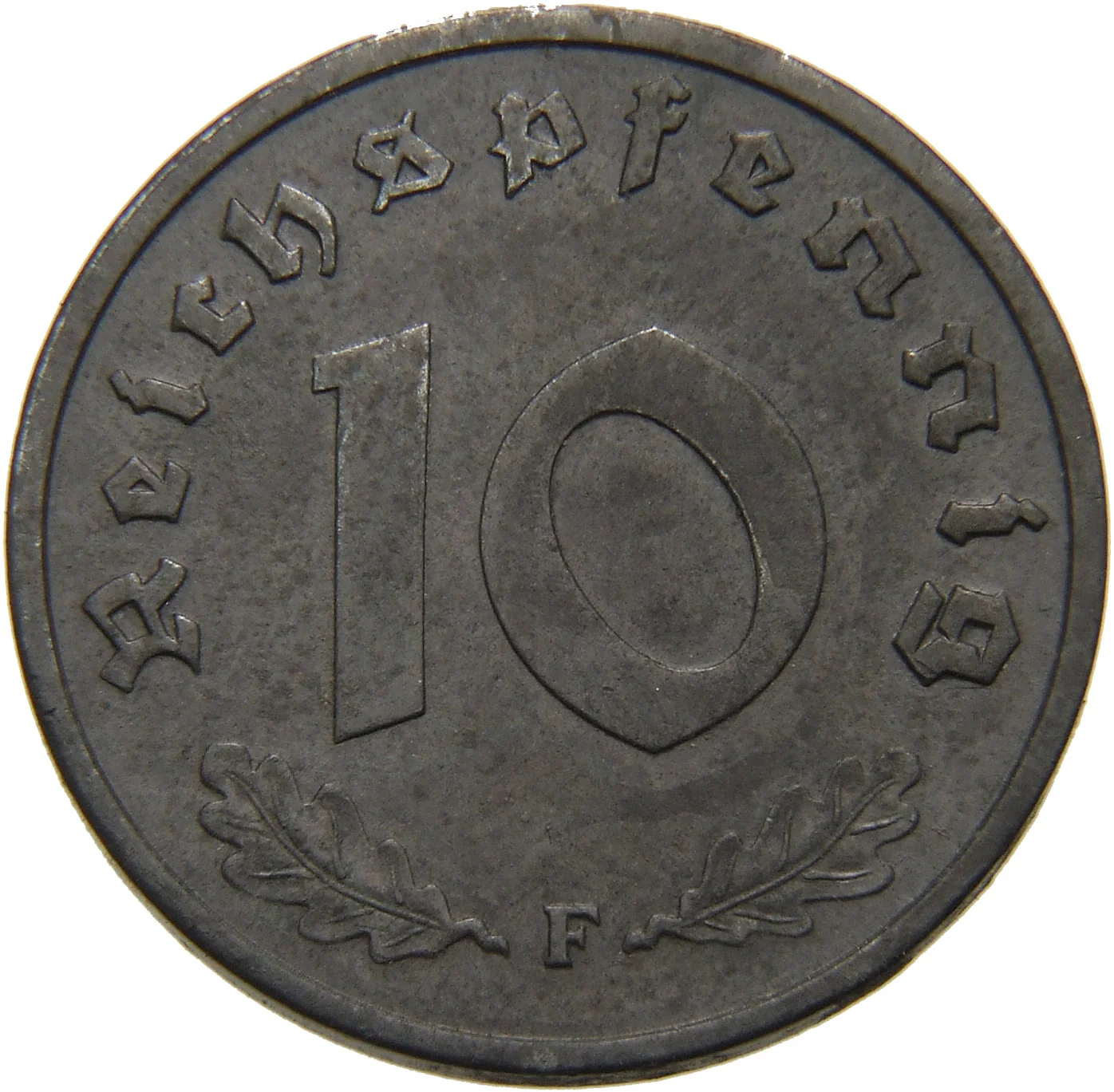
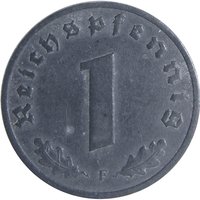
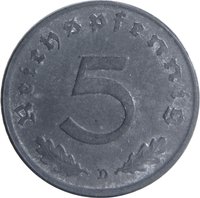
Field: face value. Legend above. Exergue: workshop letter between oak branches.
Inscription:
Reichspfennig
10
F
10
F
Edge
Plain
Mints
| Name | Mark |
|---|---|
| Berlin | A |
| Muldenhütten | E |
| Staatliche Münze Baden-Württemberg | F |
| Staatliche Münze Baden-Württemberg | G |
Mintings
Historical background
By May 1945, Germany's currency situation was one of catastrophic collapse. The Reichsmark, already heavily devalued by years of war financing, became virtually worthless in the immediate postwar period. The Nazi regime had funded the war through massive borrowing and money printing, while strict price and wage controls masked the underlying inflation. With the economy destroyed, industrial output shattered, and the country divided into Allied occupation zones, there was a severe shortage of all goods. This led to a rampant black market where transactions increasingly relied on barter or stable foreign currencies, especially American cigarettes, which became a de facto currency.
The Allied authorities initially continued to use the existing Reichsmark, but they faced an impossible monetary overhang. An enormous amount of currency was in circulation—much of it hoarded or even forged—with no corresponding goods to purchase. This situation paralyzed the economy, as farmers refused to sell food for worthless paper and workers had little incentive to work for meaningless wages. The monetary system had broken down completely, threatening the survival of the population and hindering any efforts at economic recovery or political stabilization across the four occupied zones.
Recognizing the crisis, the Western Allies (the U.S., Britain, and France) began secret planning for a radical currency reform, which would be implemented in their zones in June 1948. In the Soviet zone, a different reform had already taken place in 1947, primarily to expropriate savings. The stage was thus set for the 1948 Western Deutsche Mark reform, a dramatic "day zero" monetary reset that would swiftly end the barter economy, launch the West German economic miracle, and tragically solidify the division of Germany through the subsequent Berlin Blockade. The currency chaos of 1945 was the direct and desperate precursor to this pivotal Cold War event.
The Allied authorities initially continued to use the existing Reichsmark, but they faced an impossible monetary overhang. An enormous amount of currency was in circulation—much of it hoarded or even forged—with no corresponding goods to purchase. This situation paralyzed the economy, as farmers refused to sell food for worthless paper and workers had little incentive to work for meaningless wages. The monetary system had broken down completely, threatening the survival of the population and hindering any efforts at economic recovery or political stabilization across the four occupied zones.
Recognizing the crisis, the Western Allies (the U.S., Britain, and France) began secret planning for a radical currency reform, which would be implemented in their zones in June 1948. In the Soviet zone, a different reform had already taken place in 1947, primarily to expropriate savings. The stage was thus set for the 1948 Western Deutsche Mark reform, a dramatic "day zero" monetary reset that would swiftly end the barter economy, launch the West German economic miracle, and tragically solidify the division of Germany through the subsequent Berlin Blockade. The currency chaos of 1945 was the direct and desperate precursor to this pivotal Cold War event.
🌱 Common