

10 Rubles – Russian Federation
Circulating commemorative coins
Commemoration: Historical cities of Russia series
Series: Ancient Towns of Russia
Russia
Context
Year: 2010
Country: Russia 
Issuer: Russian Federation
Period:
(since 1991)
Currency:
(since 1998)
Total mintage: 5,000,000
Material
Diameter: 27 mm
Weight: 8.4 g
Thickness: 2.1 mm
Shape: Round
Techniques: Latent image, Milled
Alignment: Medal alignment
flip
References
Value
Exchange value: 10 RUB
Inflation-adjusted value: 33.96 RUB
Obverse
Description:
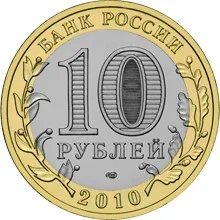
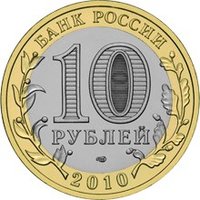
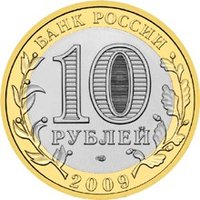
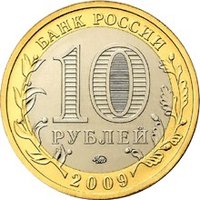
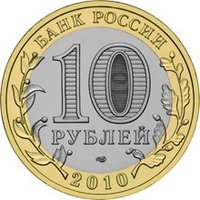
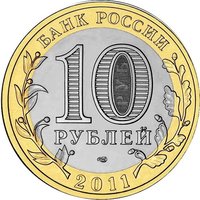
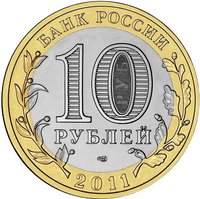
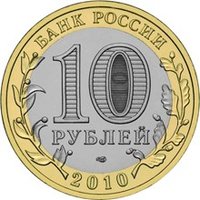
The central disc features the face value "10 РУБЛЕЙ". Inside the "0", hidden images of "10" and "РУБ" appear as the coin is tilted. The mint mark is below. The ring reads "БАНК РОССИИ" above and "2010" below, with stylized plant branches extending from the ring onto the disc.
Inscription:
БАНК РОССИИ
10
РУБЛЕЙ
СПМД
2010
10
РУБЛЕЙ
СПМД
2010
Translation:
BANK OF RUSSIA
10
RUBLES
SPMD
2010
10
RUBLES
SPMD
2010
Script: Cyrillic
Language: Russian
Designer and engraver: Alexander Vasilyevich Baklanov
Reverse
Description:
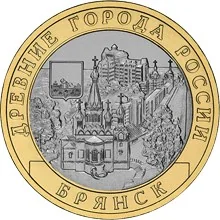
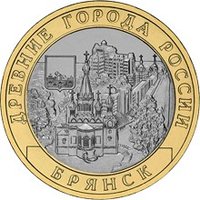
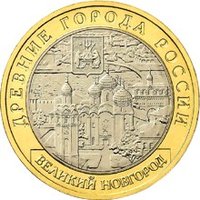
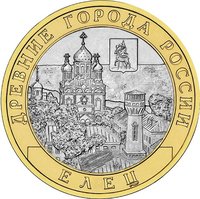
City panorama with Bryansk's coat of arms. Rim inscription: "ДРЕВНИЕ ГОРОДА РОССИИ" (ANCIENT TOWNS OF RUSSIA) above "БРЯНСК" (BRYANSK).
Inscription:
ДРЕВНИЕ ГОРОДА РОССИИ
БРЯНСК
БРЯНСК
Translation:
Ancient Cities of Russia
Bryansk
Bryansk
Script: Cyrillic
Language: Russian
Engraver: Alexandra Arsenyevna Dolgopolova
Designer: Andrey Anatolyevich Brynza
Edge
Categories
| Symbols> Coat of Arms |
| Building> Religious building |
| Geography> Town |
Mints
| Name | Mark |
|---|---|
| Saint Petersburg | (СПМД) |
Mintings
| Year | Mint Mark | Mintage | Quality | Collection |
|---|---|---|---|---|
| 2010 | СПМД | 5,000,000 |
Historical background
In 2010, the Russian Federation's currency situation was characterized by a cautious and managed recovery from the severe shocks of the 2008-2009 global financial crisis. The ruble, which had been devalued in a controlled stepwise manner by the Central Bank of Russia (CBR) during the crisis to protect reserves, had stabilized. By 2010, the CBR was maintaining a de facto dual-currency basket peg (55% USD, 45% EUR) within a fluctuating band, aiming to curb volatility and rebuild confidence. This policy resulted in a relatively stable nominal exchange rate, with the ruble trading in a narrow corridor around 30 RUB/USD for much of the year, supported by recovering oil prices and a return of capital inflows.
The economic backdrop was one of fragile rebound. After a sharp 7.8% GDP contraction in 2009, Russia's economy returned to growth in 2010 (4.5%), primarily driven by the rising price of Urals crude oil, which averaged around $78 per barrel. This commodity dependence remained the fundamental driver of ruble strength, as hydrocarbon exports continued to dominate foreign exchange earnings. However, inflation remained a persistent concern, ending the year at 8.8%, which constrained the CBR's ability to lower interest rates aggressively to stimulate growth and placed a floor under how weak it would allow the ruble to become to avoid imported inflation.
Looking forward, the currency regime of 2010 was under growing scrutiny. The CBR faced a policy trilemma, balancing exchange rate stability, independent monetary policy, and free capital flows. There was increasing domestic debate and international pressure, notably from the IMF, to allow greater ruble flexibility to absorb external shocks and to modernize monetary policy towards inflation targeting. Thus, 2010 served as a transitional year of stability, setting the stage for the announced policy shift—a gradual widening of the ruble's trading band that would culminate in the free float adopted in late 2014.
The economic backdrop was one of fragile rebound. After a sharp 7.8% GDP contraction in 2009, Russia's economy returned to growth in 2010 (4.5%), primarily driven by the rising price of Urals crude oil, which averaged around $78 per barrel. This commodity dependence remained the fundamental driver of ruble strength, as hydrocarbon exports continued to dominate foreign exchange earnings. However, inflation remained a persistent concern, ending the year at 8.8%, which constrained the CBR's ability to lower interest rates aggressively to stimulate growth and placed a floor under how weak it would allow the ruble to become to avoid imported inflation.
Looking forward, the currency regime of 2010 was under growing scrutiny. The CBR faced a policy trilemma, balancing exchange rate stability, independent monetary policy, and free capital flows. There was increasing domestic debate and international pressure, notably from the IMF, to allow greater ruble flexibility to absorb external shocks and to modernize monetary policy towards inflation targeting. Thus, 2010 served as a transitional year of stability, setting the stage for the announced policy shift—a gradual widening of the ruble's trading band that would culminate in the free float adopted in late 2014.
Series: Ancient Towns of Russia
🌱 Common