

10 paisa – Nepal
Add to wishlist
Nepal
Context
Years: 1972–1974
Issuer: Nepal
Ruler: Birendra Bir Bikram Shah
Currency:
(since 1932)
Total mintage: 8,990,377
Material
References
KM: #
Numista: #15684
Value
Exchange value: 0.10 NPR
Obverse
Description:
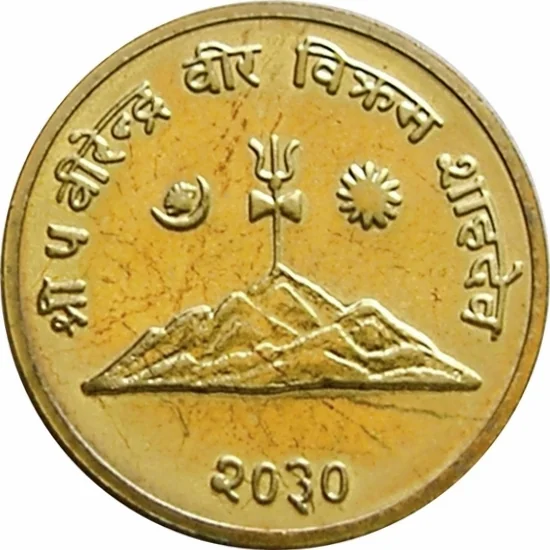
Trident over Himalayas, sun and moon on sides. Date below with "Shri Virendra Veer Vikram Shahdev" in Devanagari.
Inscription:
श्री ५ वीरेन्द्र वीर विक्रम शाहदेव
२०३०
२०३०
Translation:
Shri 5 Virendra Vir Vikram Shahdev
2030
2030
Script: Devanagari
Language: Nepali
Reverse
Description:
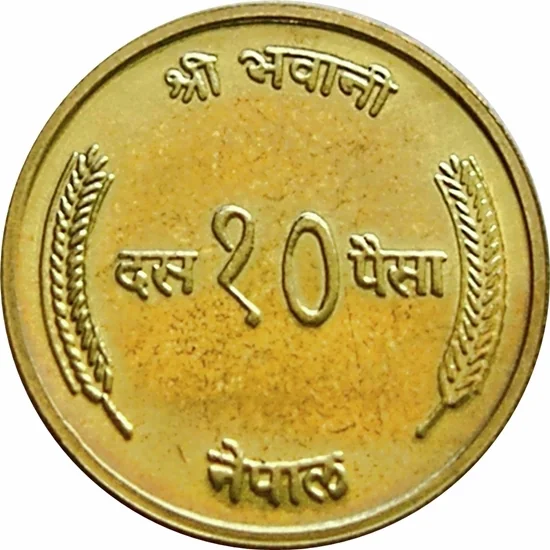
"Shree Bhavani," "Dus paisa," and "Nepal" in Nagari, flanked by ears of grain.
Inscription:
श्री भवानी
दस १० पैसा
नेपाल
दस १० पैसा
नेपाल
Translation:
Shri Bhawani
Ten 10 Paisa
Nepal
Ten 10 Paisa
Nepal
Script: Devanagari
Edge
Plain
Mints
| Name | Mark |
|---|---|
| United States Mint of San Francisco | — |
Mintings
| Year | Mint Mark | Mintage | Quality | Collection |
|---|---|---|---|---|
| 1972 | — | 3,297,000 | ||
| 1972 | — | 3,943 | Proof | |
| 1973 | — | 5,670,000 | ||
| 1973 | — | 8,891 | Proof | |
| 1974 | — | 10,543 | Proof |
Historical background
In 1972, Nepal's currency situation was fundamentally defined by its fixed exchange rate system and close economic ties with India. The Nepalese rupee (NPR) was pegged to the Indian rupee (INR) at a rate of 1:1.25, a parity established in 1960. This arrangement facilitated extensive cross-border trade, but it also meant Nepal's monetary policy was largely influenced by India's economic decisions, limiting autonomous control over its own currency valuation and money supply. The country operated a dual currency system, where the Indian rupee circulated freely alongside the Nepalese rupee, particularly in the southern Terai region, reflecting deep economic integration.
This period fell within the later years of the Panchayat autocratic system (1960-1990), a time of centralized economic planning focused on development. The currency stability provided by the peg was seen as crucial for financing imports and infrastructure projects outlined in Nepal's Fifth Five-Year Plan (1975-1980), which was in its formative stages. However, the system also presented challenges, including susceptibility to inflationary pressures imported from India and constraints on using exchange rate adjustments as a tool for economic management. The Nepal Rastra Bank, the central bank, had limited scope to independently address domestic economic issues through monetary policy.
Overall, the currency situation in 1972 was one of managed stability with inherent dependencies. The fixed peg to the Indian rupee provided a predictable framework for trade and investment but came at the cost of monetary sovereignty. This arrangement underscored Nepal's broader economic strategy of the era, which balanced a desire for development with the practical realities of its geographic and economic relationship with its much larger neighbor.
This period fell within the later years of the Panchayat autocratic system (1960-1990), a time of centralized economic planning focused on development. The currency stability provided by the peg was seen as crucial for financing imports and infrastructure projects outlined in Nepal's Fifth Five-Year Plan (1975-1980), which was in its formative stages. However, the system also presented challenges, including susceptibility to inflationary pressures imported from India and constraints on using exchange rate adjustments as a tool for economic management. The Nepal Rastra Bank, the central bank, had limited scope to independently address domestic economic issues through monetary policy.
Overall, the currency situation in 1972 was one of managed stability with inherent dependencies. The fixed peg to the Indian rupee provided a predictable framework for trade and investment but came at the cost of monetary sovereignty. This arrangement underscored Nepal's broader economic strategy of the era, which balanced a desire for development with the practical realities of its geographic and economic relationship with its much larger neighbor.
🌱 Common