

1 cent – Cyprus
Add to wishlist
Cyprus
Context
Material
Diameter: 16.5 mm
Weight: 2 g
Thickness: 1.35 mm
Shape: Round
Composition: Nickel brass
Magnetic: No
Technique: Milled
Alignment: Medal alignment
flip
References
KM: #
Numista: #156147
Value
Exchange value: 0.01 CYP
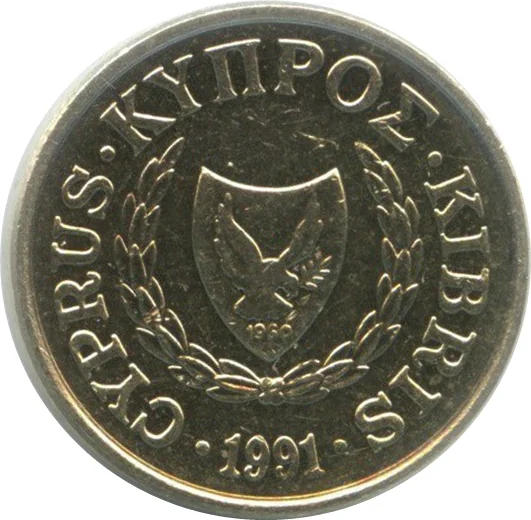
Obverse
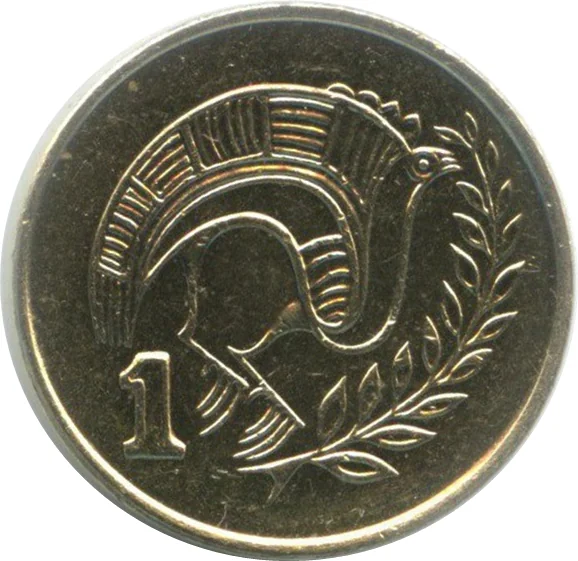
Reverse
Description:
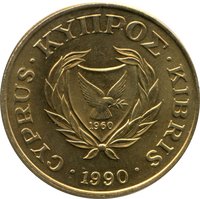
Face Value: stylized bird before a tree branch on a Cyproarchaic bichrome jug.
Inscription:
1
Script: Latin
Edge
Plain
Categories
| Animal> Bird |
| Symbols> Coat of Arms |
Mints
| Name | Mark |
|---|---|
| Royal Mint | — |
Mintings
| Year | Mint Mark | Mintage | Quality | Collection |
|---|---|---|---|---|
| 1991 | — | 4,000,000 | ||
| 1992 | — | 4,000,000 | ||
| 1993 | — | 7,000,000 | ||
| 1994 | — | — | In sets | |
| 1994 | — | 10,000,000 | ||
| 1996 | — | 12,000,000 | ||
| 1998 | — | 15,000,000 | ||
| 2003 | — | 5,000,000 | ||
| 2004 | — | 12,000,000 | ||
| 2004 | — | — | In sets |
Historical background
In 1991, the Republic of Cyprus operated under a unique and complex currency arrangement that reflected the island's political division. The internationally recognized government in the south continued to use the Cypriot pound (CYP), a currency it had issued since 1963, which was pegged to a basket of currencies, primarily weighted towards the European Currency Unit (ECU). This peg provided a degree of stability and was a strategic choice aligning with the country's aspirations for closer European integration, a process that was actively underway in the early 1990s.
Simultaneously, the northern part of the island, administered by the Turkish Republic of Northern Cyprus (recognized only by Turkey), used the Turkish lira as its de facto currency. This created a stark monetary dichotomy, with the Cypriot pound in the south being significantly stronger and more stable than the inflation-prone Turkish lira in the north. The green line dividing the island also functioned as a hard currency boundary, with limited exchange facilities, though some unofficial circulation of both currencies across the divide did occur.
Economically, the south was recovering from the crises of the 1970s and 1980s, focusing on developing services, particularly tourism and offshore banking. The stable Cypriot pound was crucial for this growth, fostering foreign investment and trade. However, the dual-currency reality underscored and reinforced the island's political and economic separation, presenting ongoing challenges for intercommunal trade and a unified national economy, a situation that would persist until the adoption of the euro in 2008 by the Republic of Cyprus.
Simultaneously, the northern part of the island, administered by the Turkish Republic of Northern Cyprus (recognized only by Turkey), used the Turkish lira as its de facto currency. This created a stark monetary dichotomy, with the Cypriot pound in the south being significantly stronger and more stable than the inflation-prone Turkish lira in the north. The green line dividing the island also functioned as a hard currency boundary, with limited exchange facilities, though some unofficial circulation of both currencies across the divide did occur.
Economically, the south was recovering from the crises of the 1970s and 1980s, focusing on developing services, particularly tourism and offshore banking. The stable Cypriot pound was crucial for this growth, fostering foreign investment and trade. However, the dual-currency reality underscored and reinforced the island's political and economic separation, presenting ongoing challenges for intercommunal trade and a unified national economy, a situation that would persist until the adoption of the euro in 2008 by the Republic of Cyprus.
Series: 1991 Cyprus circulation coins
🌱 Very Common