

50 lei – Moldova
Add to wishlist
Non-circulating coins
Commemoration: Monastery „Great holy martyr Teodor Tiron"
Series: Monasteries of Moldova
Moldova
Context
Material
References
KM: #
Numista: #156129
Value
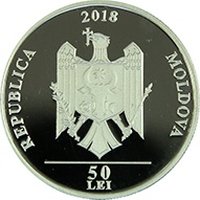
Exchange value: 50 MDL
Bullion value: $41.10
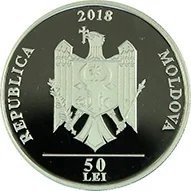
Obverse
Reverse
Description:
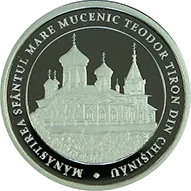
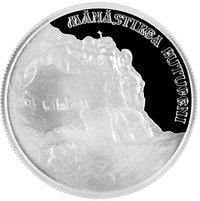
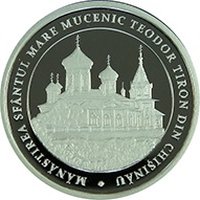
Center: Image of the "Holy Great Martyr Teodor Tiron" Monastery in Chisinau.
Exergue: Inscription "MĂNĂSTIREA „SFÂNTUL MARE MUCENIC TEODOR TIRON” DIN CHIȘINĂU" in capitals.
Exergue: Inscription "MĂNĂSTIREA „SFÂNTUL MARE MUCENIC TEODOR TIRON” DIN CHIȘINĂU" in capitals.
Inscription:
MĂNĂSTIREA SFÂNTUL MARE MUCENIC TEODOR TIRON DIN CHIȘINĂU
Translation:
MONASTERY OF SAINT GREAT MARTYR THEODORE TIRON OF CHIȘINĂU
Script: Latin
Language: Romanian
Edge
Milled
Categories
| Building> Religious building |
Mintings
| Year | Mint Mark | Mintage | Quality | Collection |
|---|---|---|---|---|
| 2018 | — | 300 | Proof |
Historical background
In 2018, Moldova's currency, the leu (MDL), operated within a managed float regime overseen by the National Bank of Moldova (NBM). The year was characterized by relative stability in the foreign exchange market, a notable achievement following a period of significant volatility earlier in the decade triggered by a major banking fraud scandal in 2014-2015. The NBM's primary focus was on maintaining price stability and building foreign exchange reserves, which had been severely depleted. Inflation, a key concern, was brought under control, ending the year at around 3.1%, within the NBM's target range, thanks in part to prudent monetary policy.
This stability occurred against a backdrop of ongoing political and economic challenges. The economy remained heavily dependent on remittances from a large diaspora working abroad, which were a crucial source of foreign currency and household income. Furthermore, the country's deep political polarization and unresolved issues of governance and judicial reform continued to pose risks to investor confidence and economic prospects. The banking sector was still in a protracted recovery phase, with the state working to recover the enormous losses from the earlier "theft of the billion" scandal.
Internationally, Moldova's currency dynamics were closely tied to its trade relationships, particularly with the European Union, its largest trading partner, and Russia. Fluctuations in the currencies of these partners, especially the euro and Russian ruble, directly impacted the Moldovan economy through trade channels and remittance flows. Overall, 2018 was a year of cautious consolidation for the leu, with the central bank successfully maintaining macroeconomic stability despite underlying structural vulnerabilities and a fragile political environment.
This stability occurred against a backdrop of ongoing political and economic challenges. The economy remained heavily dependent on remittances from a large diaspora working abroad, which were a crucial source of foreign currency and household income. Furthermore, the country's deep political polarization and unresolved issues of governance and judicial reform continued to pose risks to investor confidence and economic prospects. The banking sector was still in a protracted recovery phase, with the state working to recover the enormous losses from the earlier "theft of the billion" scandal.
Internationally, Moldova's currency dynamics were closely tied to its trade relationships, particularly with the European Union, its largest trading partner, and Russia. Fluctuations in the currencies of these partners, especially the euro and Russian ruble, directly impacted the Moldovan economy through trade channels and remittance flows. Overall, 2018 was a year of cautious consolidation for the leu, with the central bank successfully maintaining macroeconomic stability despite underlying structural vulnerabilities and a fragile political environment.
Series: Monasteries of Moldova

✨ Legendary