

1 paisa – Nepal
Add to wishlist
Nepal
Context
Years: 1933–1940
Issuer: Nepal
Ruler: Tribhuvan Bir Bikram Shah
Currency:
(since 1932)
Demonetized: Yes
Total mintage: 456,000
Material
References
KM: #
Numista: #15570
Value
Exchange value: 0.01 NPR
Obverse
Description:
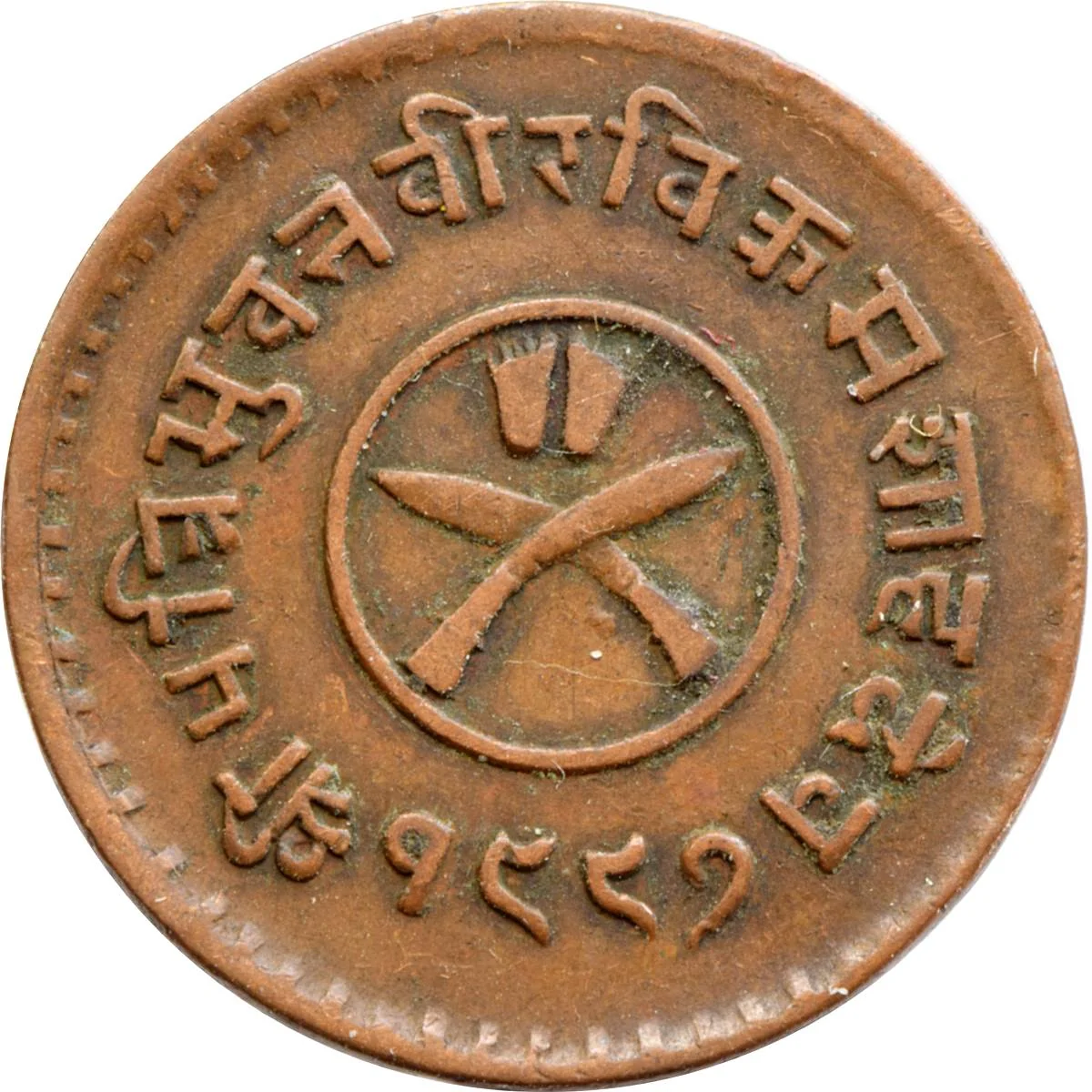
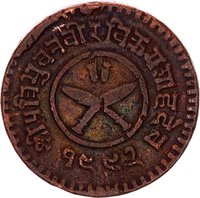
Inner Circle: Footprints above crossed khukris.
Outer Circle: Devnagari legend "Shree 5 Tribhuvan Veer Vikram Shahdev."
Date below.
Outer Circle: Devnagari legend "Shree 5 Tribhuvan Veer Vikram Shahdev."
Date below.
Inscription:
श्री ५ त्रिभुवन वीर विक्रम शाहदेव
१९९७
१९९७
Translation:
Shri 5 Tribhuvan Veer Vikram Shah Dev
1997
1997
Language: Nepali
Reverse
Edge
Plain
Mintings
| Year | Mint Mark | Mintage | Quality | Collection |
|---|---|---|---|---|
| 1933 | — | — | ||
| 1934 | — | — | ||
| 1935 | — | — | ||
| 1936 | — | — | ||
| 1937 | — | 456,000 | ||
| 1938 | — | — | ||
| 1939 | — | — | ||
| 1940 | — | — |
Historical background
In 1933, Nepal's currency situation was characterized by a complex and evolving dual system, deeply tied to its political relationship with British India. The primary circulating medium was the Nepalese mohar, but the economy was practically dominated by the Indian rupee. This was a result of the 1924 Nepal-Britain Treaty, which fixed the exchange rate at 1 Indian rupee = 1.5 Nepalese mohars. The Indian rupee was not only legal tender within Nepal but was essential for all foreign trade, which was almost exclusively conducted with India. This created a de facto currency board system, where Nepal's money supply was effectively backed by and dependent on Indian rupee reserves held by the Nepal government.
Internally, the monetary system was somewhat fragmented. While the government minted silver mohars and copper paisas, the value and acceptance of these coins could vary. Furthermore, the Nepal Rastra Bank, the country's central bank, would not be established for another two decades (1956), meaning there was no unified authority to regulate currency or conduct monetary policy. The government's treasury, under the direct control of the Rana Prime Minister, managed the nation's finances and foreign exchange reserves, which were largely accumulated from the pensions of Gurkha soldiers serving in the British Indian Army—a critical source of hard currency.
The year 1933 itself fell within a period of relative monetary stability under the Rana regime, but the system's inherent vulnerabilities were clear. Nepal's economy and currency were inextricably linked to India's, leaving it exposed to shifts in the Indian economy and monetary policy. This subordinate currency relationship reflected Nepal's broader geopolitical and economic dependence during this era, setting the stage for future monetary reforms and the eventual push for financial sovereignty in the mid-20th century.
Internally, the monetary system was somewhat fragmented. While the government minted silver mohars and copper paisas, the value and acceptance of these coins could vary. Furthermore, the Nepal Rastra Bank, the country's central bank, would not be established for another two decades (1956), meaning there was no unified authority to regulate currency or conduct monetary policy. The government's treasury, under the direct control of the Rana Prime Minister, managed the nation's finances and foreign exchange reserves, which were largely accumulated from the pensions of Gurkha soldiers serving in the British Indian Army—a critical source of hard currency.
The year 1933 itself fell within a period of relative monetary stability under the Rana regime, but the system's inherent vulnerabilities were clear. Nepal's economy and currency were inextricably linked to India's, leaving it exposed to shifts in the Indian economy and monetary policy. This subordinate currency relationship reflected Nepal's broader geopolitical and economic dependence during this era, setting the stage for future monetary reforms and the eventual push for financial sovereignty in the mid-20th century.
🌟 Uncommon