

10 paisa – Nepal
Add to wishlist
Nepal
Context
Years: 1966–1971
Issuer: Nepal
Ruler: Mahendra Bir Bikram Shah
Currency:
(since 1932)
Total mintage: 4,567
Material
References
KM: #
Numista: #10531
Value
Exchange value: 0.10 NPR
Obverse
Description:
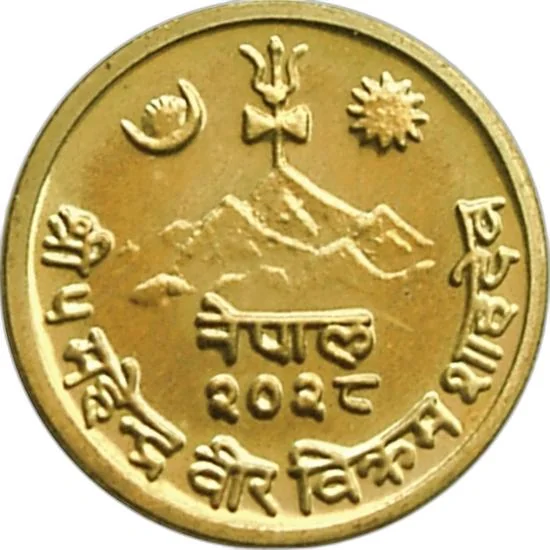
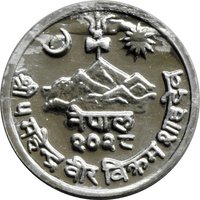
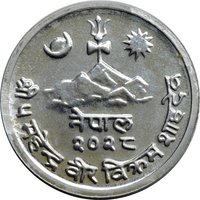
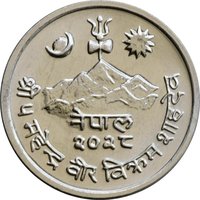
Trident over hills, flanked by sun and moon. "Nepal" and date below, with "Shri Mahendra Veer Vikram Shahdev" in Devanagari.
Inscription:
नेपाल
२०२८
श्री ५ महेन्द्र वीर विक्रम शाहदेव
२०२८
श्री ५ महेन्द्र वीर विक्रम शाहदेव
Translation:
Nepal
2028
Shri 5 Mahendra Bir Bikram Shah Dev
2028
Shri 5 Mahendra Bir Bikram Shah Dev
Script: Devanagari
Language: Nepali
Reverse
Description:
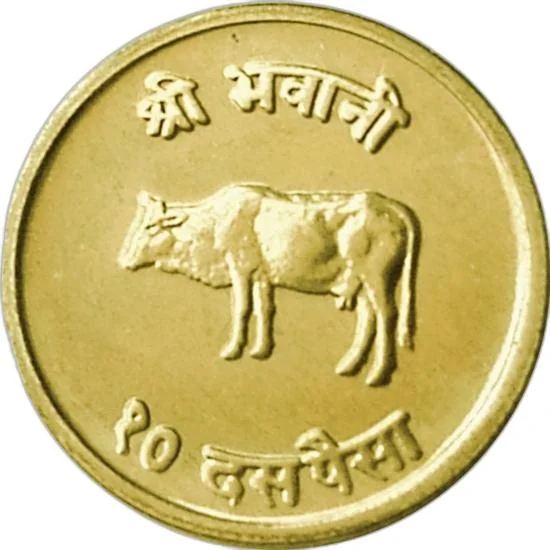
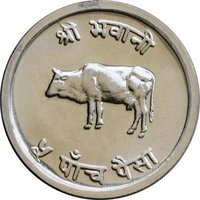
Cow left "श्री भवानी" 10 "दस पैसा"
Inscription:
श्री भवानी
१० दस पैसा
१० दस पैसा
Translation:
Shri Bhavani
10 Ten Paisa
10 Ten Paisa
Script: Devanagari
Language: Hindi
Edge
Plain
Mints
| Name | Mark |
|---|---|
| United States Mint of San Francisco | — |
Mintings
| Year | Mint Mark | Mintage | Quality | Collection |
|---|---|---|---|---|
| 1966 | — | — | ||
| 1967 | — | — | ||
| 1968 | — | — | ||
| 1969 | — | — | ||
| 1970 | — | — | ||
| 1970 | — | 2,187 | Proof | |
| 1971 | — | — | ||
| 1971 | — | 2,380 | Proof |
Historical background
In 1966, Nepal's currency situation was defined by its transition towards a more independent and formalized monetary system, albeit one still heavily influenced by its giant neighbors. The country had historically used a bimetallic system and Indian rupees extensively, but the Nepal Rastra Bank Act of 1955 and the Nepal Rastra Bank Currency Act of 1962 laid the groundwork for the central bank to assume greater control. By 1966, the Nepal Rastra Bank was actively managing the issuance of the Nepalese rupee (NPR), moving away from the earlier "Mohar" system and establishing a distinct national currency.
However, the Nepalese rupee remained pegged to the Indian rupee at a fixed rate of 1.6 NPR to 1 INR, a formalization of a long-standing economic linkage. This peg facilitated crucial cross-border trade with India, which accounted for the vast majority of Nepal's commerce, but it also meant Nepal's monetary policy was largely dictated by India's economic conditions. The currency was not freely convertible on the international market, and foreign exchange reserves were limited, managed with strict controls to support essential imports and maintain the peg's stability.
Overall, the currency situation in 1966 reflected a nation cautiously building its modern financial infrastructure while pragmatically acknowledging its economic dependence. The framework for a sovereign currency was being implemented, yet the fixed peg to the Indian rupee underscored the reality of an economy deeply integrated with India's, prioritizing stability and trade facilitation over independent monetary maneuvering. This period was a foundational step in Nepal's long journey toward a more autonomous financial system.
However, the Nepalese rupee remained pegged to the Indian rupee at a fixed rate of 1.6 NPR to 1 INR, a formalization of a long-standing economic linkage. This peg facilitated crucial cross-border trade with India, which accounted for the vast majority of Nepal's commerce, but it also meant Nepal's monetary policy was largely dictated by India's economic conditions. The currency was not freely convertible on the international market, and foreign exchange reserves were limited, managed with strict controls to support essential imports and maintain the peg's stability.
Overall, the currency situation in 1966 reflected a nation cautiously building its modern financial infrastructure while pragmatically acknowledging its economic dependence. The framework for a sovereign currency was being implemented, yet the fixed peg to the Indian rupee underscored the reality of an economy deeply integrated with India's, prioritizing stability and trade facilitation over independent monetary maneuvering. This period was a foundational step in Nepal's long journey toward a more autonomous financial system.
Series: 1966 Nepal circulation coins

🌱 Common