

50 sen – Irian Jaya
Add to wishlist
Indonesia
Context
Year: 1962
Country: Indonesia
Issuer: Irian Jaya
Currency:
(1962—1971)
Demonetization: 30 April 1971
Material
Diameter: 28.9 mm
Weight: 3.1 g
Thickness: 2 mm
Shape: Round
Composition: Aluminium
Standard: Gold tenth ounce
Magnetic: No
Technique: Milled
Alignment: Coin alignment
flip
References
KM: #
Numista: #15508
Obverse
Description:
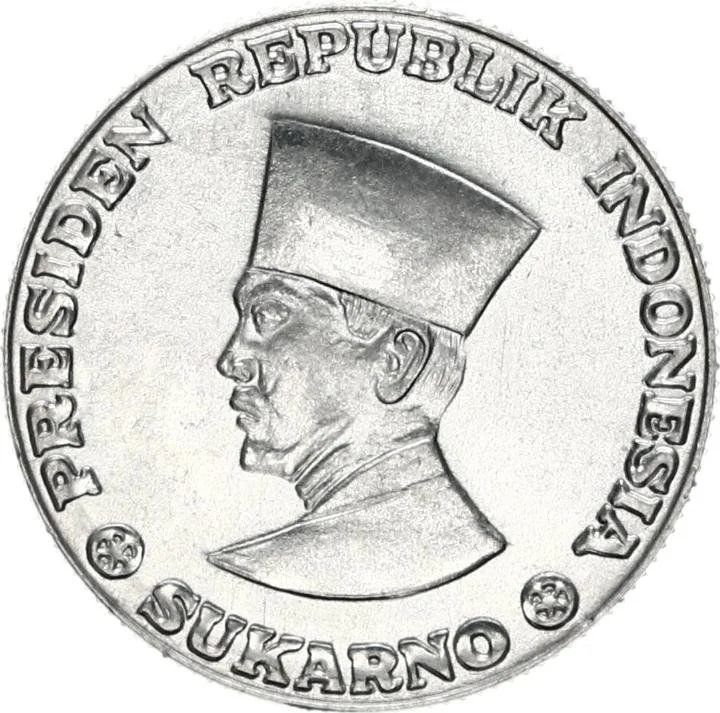
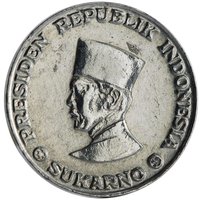
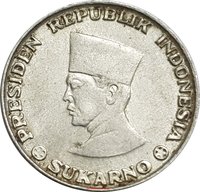
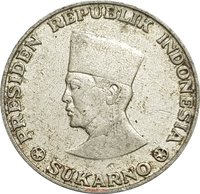
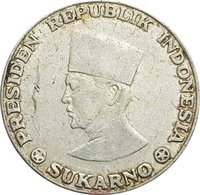
Sukarno's head facing left, encircled by legend.
Inscription:
PRESIDEN REPUBLIK INDONESIA
SUKARNO
SUKARNO
Translation:
President of the Republic of Indonesia
Sukarno
Sukarno
Script: Latin
Language: Indonesian
Reverse
Edge
Reeded
Mints
| Name | Mark |
|---|---|
| PN Artha Yasa | — |
Mintings
| Year | Mint Mark | Mintage | Quality | Collection |
|---|---|---|---|---|
| 1962 | — | — |
Historical background
In 1962, the currency situation in Irian Jaya (then known as Netherlands New Guinea) was a direct reflection of the intense political struggle over the territory's sovereignty. Following the Indonesian independence revolution, the Dutch had retained control of the western half of New Guinea, administering it separately from the former Dutch East Indies. Consequently, the official currency remained the Netherlands New Guinean gulden, introduced in 1950, which was distinct from the Indonesian rupiah and pegged to the Dutch guilder. This separate monetary system was a tangible symbol of Dutch administrative continuity and their claim to the territory.
The currency landscape became unstable and complex as the political crisis escalated. In late 1961, Indonesia launched a campaign of infiltration and military pressure, leading to armed clashes. In response to the deteriorating situation, the Dutch began withdrawing their administration throughout 1962. This created a practical vacuum, with reports of both Dutch and Indonesian currencies circulating unofficially in different areas, especially near zones of military activity. The situation was one of monetary limbo, mirroring the unresolved and contested political status.
The currency question was formally resolved by the New York Agreement of August 1962, which transferred administration from the Netherlands to a United Nations Temporary Executive Authority (UNTEA) on October 1, 1962. A key provision of the agreement stipulated that UNTEA would replace the Netherlands New Guinean gulden with the Indonesian rupiah as the official currency. This monetary transition, completed under UN supervision, was a critical and deliberate step in integrating the territory into the Republic of Indonesia, which assumed full control in May 1963. Thus, the fate of the currency was inextricably tied to the diplomatic settlement of the conflict.
The currency landscape became unstable and complex as the political crisis escalated. In late 1961, Indonesia launched a campaign of infiltration and military pressure, leading to armed clashes. In response to the deteriorating situation, the Dutch began withdrawing their administration throughout 1962. This created a practical vacuum, with reports of both Dutch and Indonesian currencies circulating unofficially in different areas, especially near zones of military activity. The situation was one of monetary limbo, mirroring the unresolved and contested political status.
The currency question was formally resolved by the New York Agreement of August 1962, which transferred administration from the Netherlands to a United Nations Temporary Executive Authority (UNTEA) on October 1, 1962. A key provision of the agreement stipulated that UNTEA would replace the Netherlands New Guinean gulden with the Indonesian rupiah as the official currency. This monetary transition, completed under UN supervision, was a critical and deliberate step in integrating the territory into the Republic of Indonesia, which assumed full control in May 1963. Thus, the fate of the currency was inextricably tied to the diplomatic settlement of the conflict.
🌟 Uncommon