

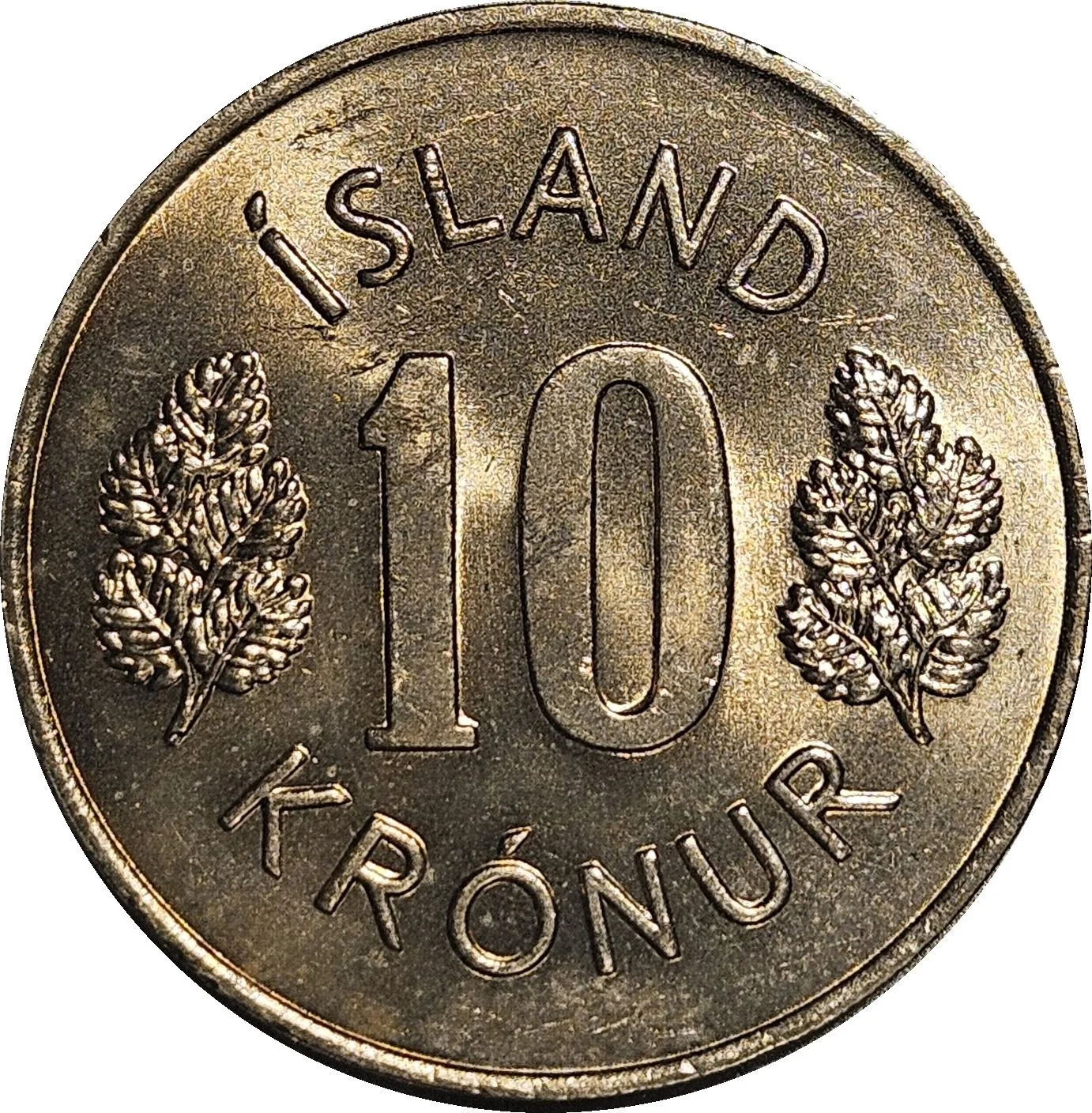
10 Krónur – Iceland
Iceland
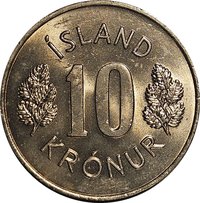
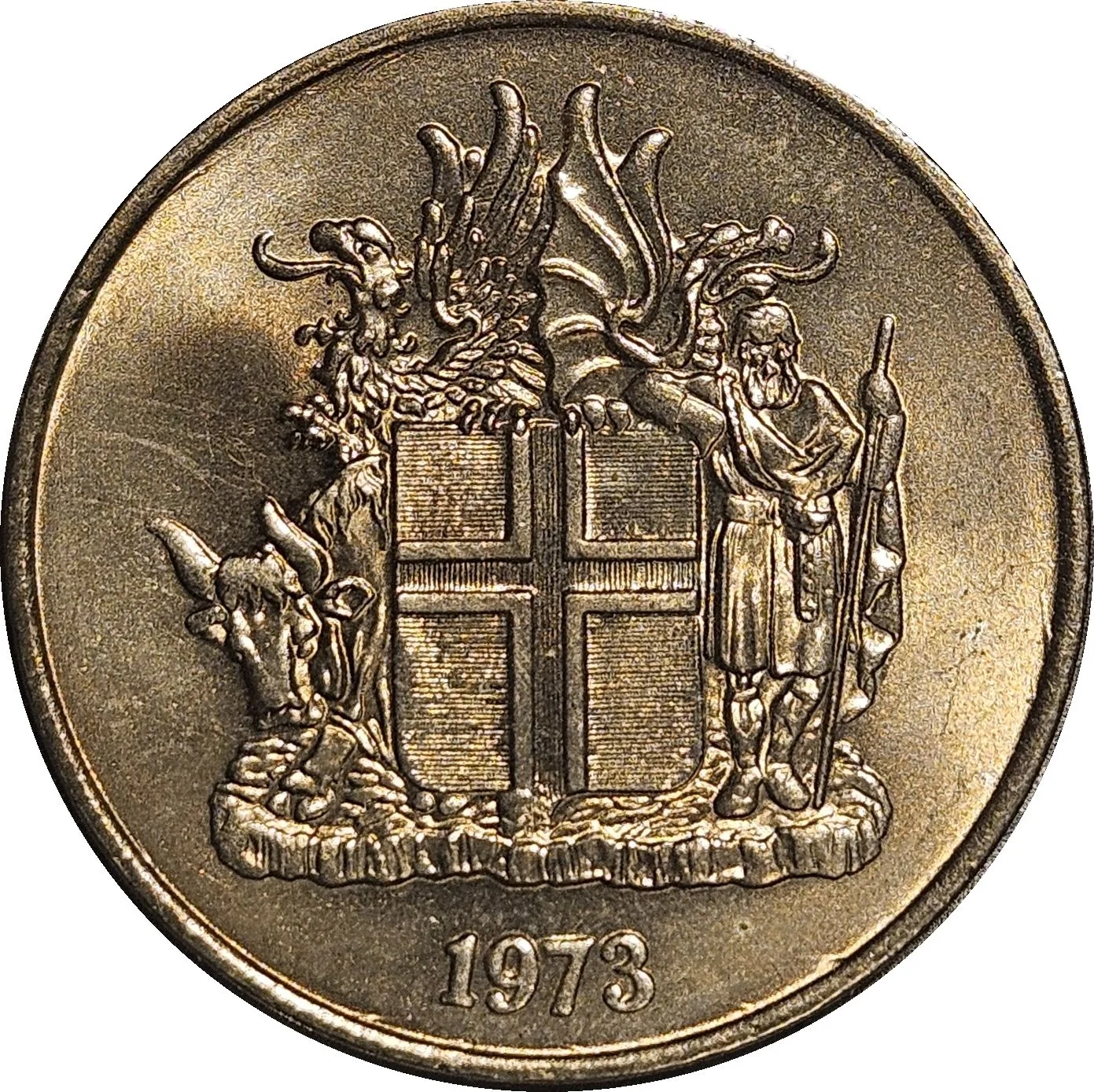
Obverse
Description:
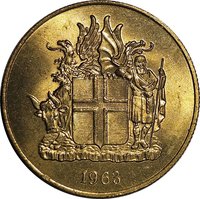
Iceland's coat of arms encircled by its four guardian spirits (Landvættir): the bull, eagle, dragon, and giant.
Inscription:
1973
Script: Latin
Reverse
Edge
Plain
Categories
| Animal> Bird |
| Symbols> Coat of Arms |
| Animal> Cow |
| Mythology> Fantastic animal |
Mints
| Name | Mark |
|---|---|
| Royal Mint (Tower Hill) | — |
| Royal Mint | — |
Mintings
| Year | Mint Mark | Mintage | Quality | Collection |
|---|---|---|---|---|
| 1967 | — | 1,000,000 | ||
| 1969 | — | 500,000 | ||
| 1970 | — | 1,500,000 | ||
| 1971 | — | 1,500,000 | ||
| 1973 | — | 1,500,000 | ||
| 1974 | — | 2,000,000 | ||
| 1975 | — | 2,500,000 | ||
| 1976 | — | 2,500,000 | ||
| 1977 | — | 2,000,000 | ||
| 1978 | — | 10,500,000 | ||
| 1980 | — | 15,000 | Proof | |
| 1980 | — | 4,600,000 |
Historical background
In 1967, Iceland’s currency situation was defined by chronic inflation and a heavily controlled economic system. Since gaining full independence in 1944, the country had pursued rapid industrialization and modernization, largely financed by significant government spending. This, combined with a reliance on imported goods and indexation of wages to prices, created a persistent inflationary spiral. The Icelandic króna was not a freely convertible currency; its exchange rate was fixed by the Central Bank of Iceland within a complex system of multiple exchange rates and strict capital controls, designed to manage the balance of payments and protect foreign reserves.
The year itself was marked by a major devaluation, a recurring tool used to correct economic imbalances. On November 22, 1967, the króna was devalued by 35.4%, reducing its value from 43 krónur to 57 krónur per US dollar. This drastic measure was primarily a response to a deteriorating trade deficit and declining fish catch exports, the cornerstone of the economy. The devaluation aimed to make Icelandic exports cheaper and imports more expensive, thereby strengthening the trade balance. It followed a pattern of similar devaluations in 1960 and 1961, highlighting the structural weaknesses in the economy.
This devaluation occurred against the backdrop of global monetary instability, notably the devaluation of the British pound earlier that same month, which impacted one of Iceland's key trading partners. Domestically, the move intensified inflationary pressures, as the cost of imported goods surged, triggering the wage-indexation mechanism and fueling further price rises. Thus, the 1967 devaluation was a stark illustration of Iceland's vulnerable economic position—caught between the need for external adjustment and a domestic structure that perpetuated inflation, setting the stage for continued economic challenges in the decades to follow.
The year itself was marked by a major devaluation, a recurring tool used to correct economic imbalances. On November 22, 1967, the króna was devalued by 35.4%, reducing its value from 43 krónur to 57 krónur per US dollar. This drastic measure was primarily a response to a deteriorating trade deficit and declining fish catch exports, the cornerstone of the economy. The devaluation aimed to make Icelandic exports cheaper and imports more expensive, thereby strengthening the trade balance. It followed a pattern of similar devaluations in 1960 and 1961, highlighting the structural weaknesses in the economy.
This devaluation occurred against the backdrop of global monetary instability, notably the devaluation of the British pound earlier that same month, which impacted one of Iceland's key trading partners. Domestically, the move intensified inflationary pressures, as the cost of imported goods surged, triggering the wage-indexation mechanism and fueling further price rises. Thus, the 1967 devaluation was a stark illustration of Iceland's vulnerable economic position—caught between the need for external adjustment and a domestic structure that perpetuated inflation, setting the stage for continued economic challenges in the decades to follow.
🌱 Very Common