

Obverse
Description:
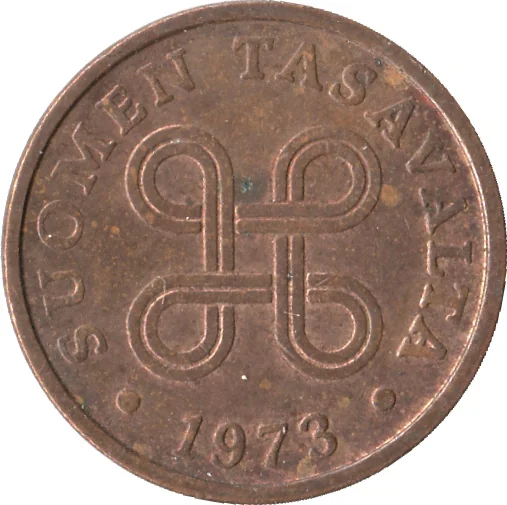
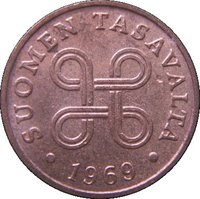
Four loops form a Saint Hannes cross, date below.
Inscription:
SUOMEN TASAVALTA
• 1973 •
• 1973 •
Translation:
REPUBLIC OF FINLAND
• 1973 •
• 1973 •
Script: Latin
Language: Finnish
Engraver: Peippo Uolevi Helle
Reverse
Description:
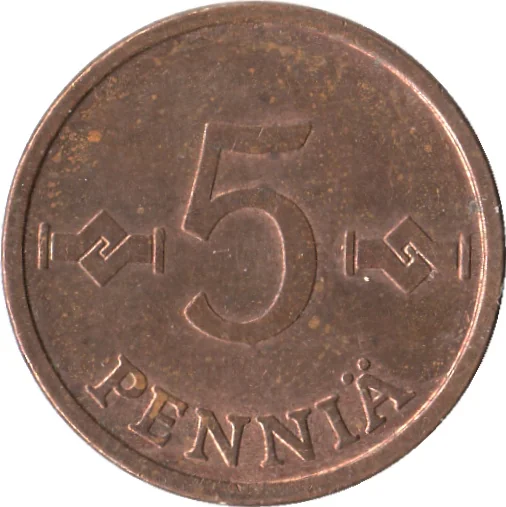
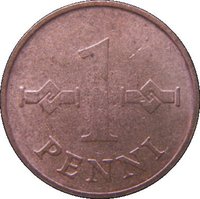
Hands clasp the bill.
Inscription:
5
PENNIÄ
PENNIÄ
Translation:
Five Penniä
Script: Latin
Language: Finnish
Engraver: Peippo Uolevi Helle
Edge
Plain
Mints
| Name | Mark |
|---|---|
| Mint of Finland | — |
Mintings
| Year | Mint Mark | Mintage | Quality | Collection |
|---|---|---|---|---|
| 1963 | — | 60,320,000 | ||
| 1964 | — | 4,634,000 | ||
| 1965 | — | 10,264,000 | ||
| 1966 | — | 8,064,000 | ||
| 1967 | — | 9,968,000 | ||
| 1968 | — | 6,144,000 | ||
| 1969 | — | 3,598,000 | ||
| 1970 | — | 13,772,000 | ||
| 1971 | — | 20,010,000 | ||
| 1972 | — | 24,122,000 | ||
| 1973 | — | 25,644,000 | ||
| 1974 | — | 21,530,000 | ||
| 1975 | — | 25,010,000 | ||
| 1976 | — | 25,551,000 | ||
| 1977 | — | 1,489,000 |
Historical background
In 1963, Finland's currency situation was defined by the Finnish markka (FIM) operating under a fixed exchange rate system, tightly managed by the Bank of Finland. The markka was pegged to the US dollar, a common practice in the Bretton Woods era, which provided stability for international trade but required strict monetary discipline. However, the peg was not rigid; the central bank maintained a "currency band" allowing for minor fluctuations, and it actively intervened in foreign exchange markets to maintain the desired parity, reflecting a controlled rather than a purely free-floating system.
This period was one of cautious economic transition. Finland was experiencing strong post-war industrialization and a deepening integration with Western markets, but its economy remained vulnerable to trade cycles with its primary partners, the Soviet Union and Western Europe. To combat persistent domestic inflation and protect the fixed exchange rate, the Bank of Finland relied heavily on credit rationing and regulation rather than just interest rate adjustments. This meant strict limits on bank lending, making credit scarce for businesses and households, a policy aimed at curbing demand and thus supporting the markka's external value.
The backdrop of 1963 was one of underlying pressure. While the fixed rate provided a facade of stability, it masked growing competitiveness challenges. Wages were rising faster than productivity, and inflation consistently outpaced that of key trading partners. This gradual erosion of competitiveness led to recurring balance of payments difficulties, setting the stage for the inevitable. Just a few years later, in 1967, these accumulated pressures forced Finland to undertake a significant devaluation of the markka to restore its trade balance, a pivotal moment that ended the relative calm of the early 1960s.
This period was one of cautious economic transition. Finland was experiencing strong post-war industrialization and a deepening integration with Western markets, but its economy remained vulnerable to trade cycles with its primary partners, the Soviet Union and Western Europe. To combat persistent domestic inflation and protect the fixed exchange rate, the Bank of Finland relied heavily on credit rationing and regulation rather than just interest rate adjustments. This meant strict limits on bank lending, making credit scarce for businesses and households, a policy aimed at curbing demand and thus supporting the markka's external value.
The backdrop of 1963 was one of underlying pressure. While the fixed rate provided a facade of stability, it masked growing competitiveness challenges. Wages were rising faster than productivity, and inflation consistently outpaced that of key trading partners. This gradual erosion of competitiveness led to recurring balance of payments difficulties, setting the stage for the inevitable. Just a few years later, in 1967, these accumulated pressures forced Finland to undertake a significant devaluation of the markka to restore its trade balance, a pivotal moment that ended the relative calm of the early 1960s.
Series: 1963 Finland circulation coins
🌱 Very Common