

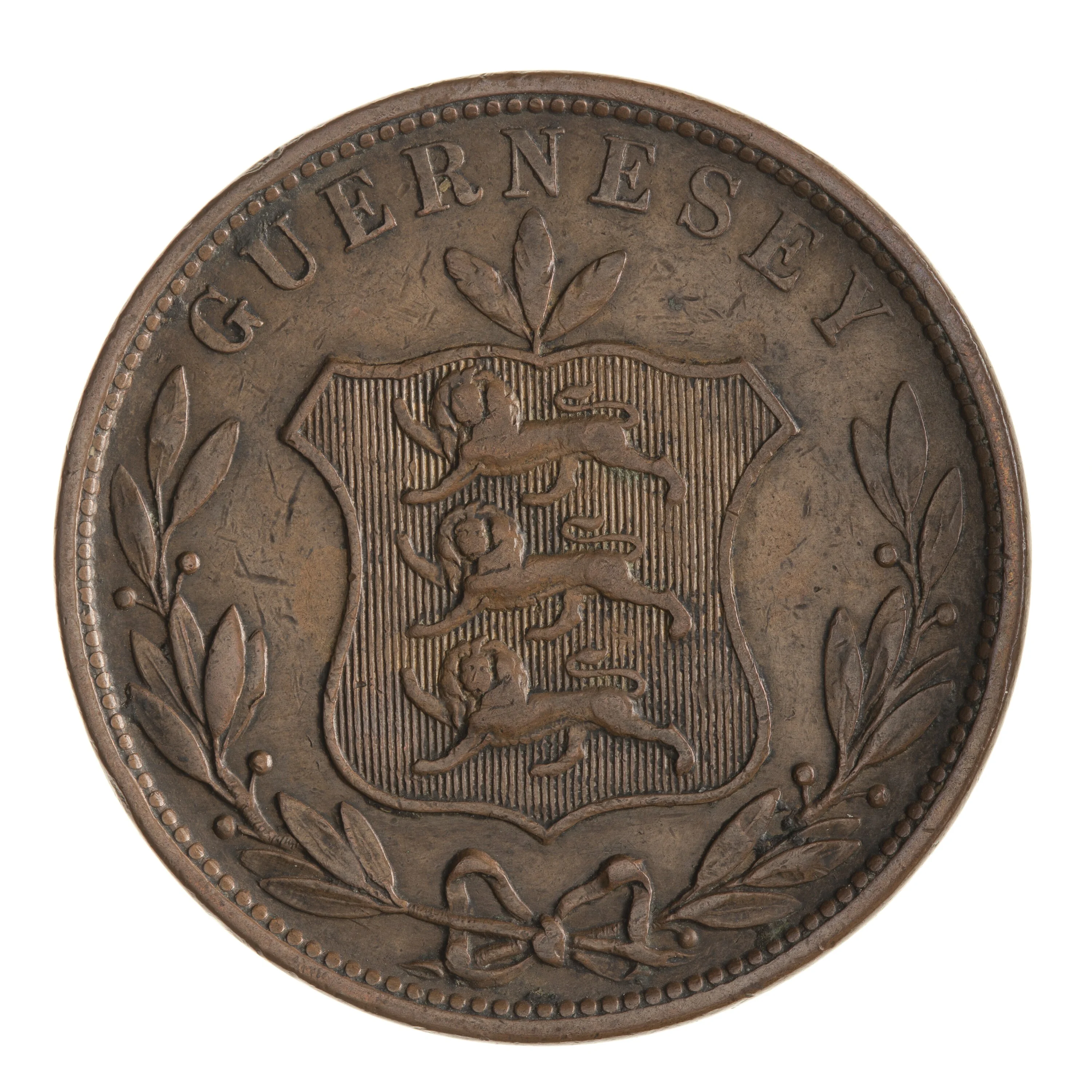
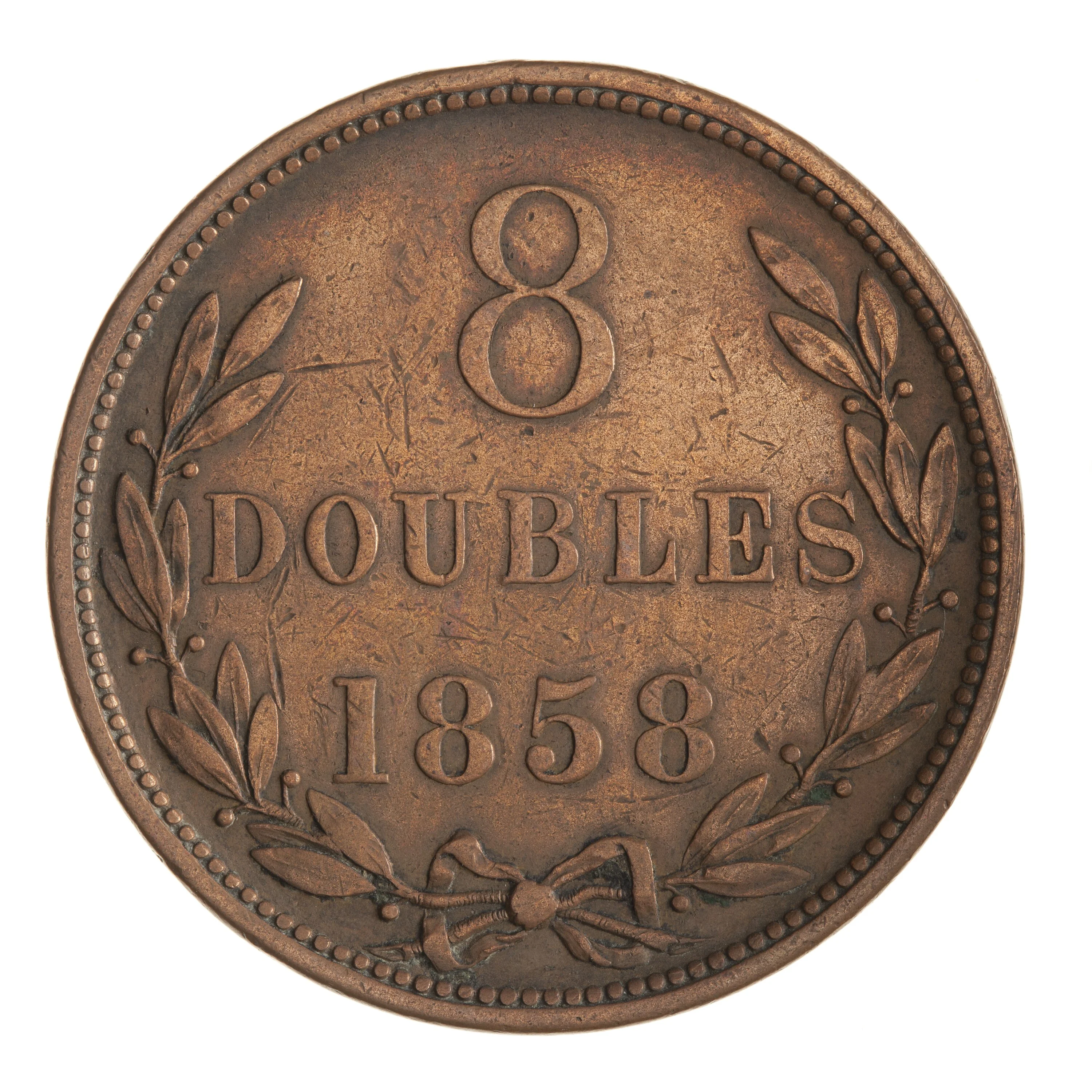
8 doubles – Guernsey
Add to wishlist
Context
Years: 1834–1858
Country: British Crown dependencies
Issuer: Guernsey
Ruler: Victoria
Currency:
(1808—1971)
Demonetized: Yes
Total mintage: 333,000
Material
References
KM: #
Numista: #15318
Categories
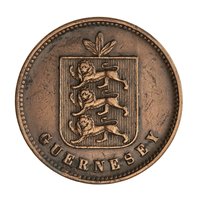
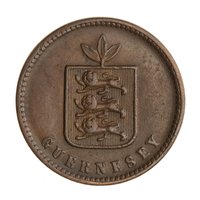
| Symbols> Coat of Arms |
Mints
| Name | Mark |
|---|---|
| Soho Mint | — |
Mintings
| Year | Mint Mark | Mintage | Quality | Collection |
|---|---|---|---|---|
| 1834 | — | — | Proof | |
| 1834 | — | 222,000 | ||
| 1858 | — | 111,000 | ||
| 1858 | — | — | Proof |
Historical background
In 1834, the currency situation in Guernsey was complex and locally unique, operating outside the formal British monetary system. The island's official tender was theoretically sterling, but in practice, everyday commerce was dominated by a mix of foreign coins, primarily French currency. This was a legacy of Guernsey's historical trade links with Normandy and continental Europe, as well as the chronic shortage of official British coinage on the island. Transactions were commonly conducted in livres tournois and francs, creating a dual-currency environment that was confusing and prone to exchange rate fluctuations.
This monetary confusion hampered trade and created practical difficulties for both residents and the States of Guernsey, the island's government. The problem was exacerbated by the widespread circulation of worn and debased foreign coins, leading to disputes over real value. In response to this ongoing crisis, the States took a decisive step in 1834 by authorising the issuance of the first Guernsey one-pound note. This was not a note from a commercial bank, but a form of public money issued directly by the States themselves to provide a reliable local medium of exchange.
Thus, 1834 stands as a pivotal year, marking the beginning of Guernsey's distinctive tradition of issuing its own currency. The one-pound note was a pragmatic solution to an acute local problem, intended to supplement the scarce sterling and displace the unreliable foreign coinage. While the full transition to a stable local currency would take further decades, this initial foray into issuing States' notes laid the foundational principle for the island's financial autonomy, which continues to characterise Guernsey's monetary system to this day.
This monetary confusion hampered trade and created practical difficulties for both residents and the States of Guernsey, the island's government. The problem was exacerbated by the widespread circulation of worn and debased foreign coins, leading to disputes over real value. In response to this ongoing crisis, the States took a decisive step in 1834 by authorising the issuance of the first Guernsey one-pound note. This was not a note from a commercial bank, but a form of public money issued directly by the States themselves to provide a reliable local medium of exchange.
Thus, 1834 stands as a pivotal year, marking the beginning of Guernsey's distinctive tradition of issuing its own currency. The one-pound note was a pragmatic solution to an acute local problem, intended to supplement the scarce sterling and displace the unreliable foreign coinage. While the full transition to a stable local currency would take further decades, this initial foray into issuing States' notes laid the foundational principle for the island's financial autonomy, which continues to characterise Guernsey's monetary system to this day.
🌱 Common