

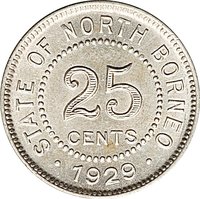
25 Cents – North Borneo
Malaysia
Context
Year: 1929
Country: Malaysia 
Issuer: North Borneo
Period:
(1881—1941)
Currency:
(1882—1941)
Demonetized: Yes
Total mintage: 400,000
Material
References
KM: #Click to copy to clipboard6
Numista: #15246
Value
Bullion value: $4.00
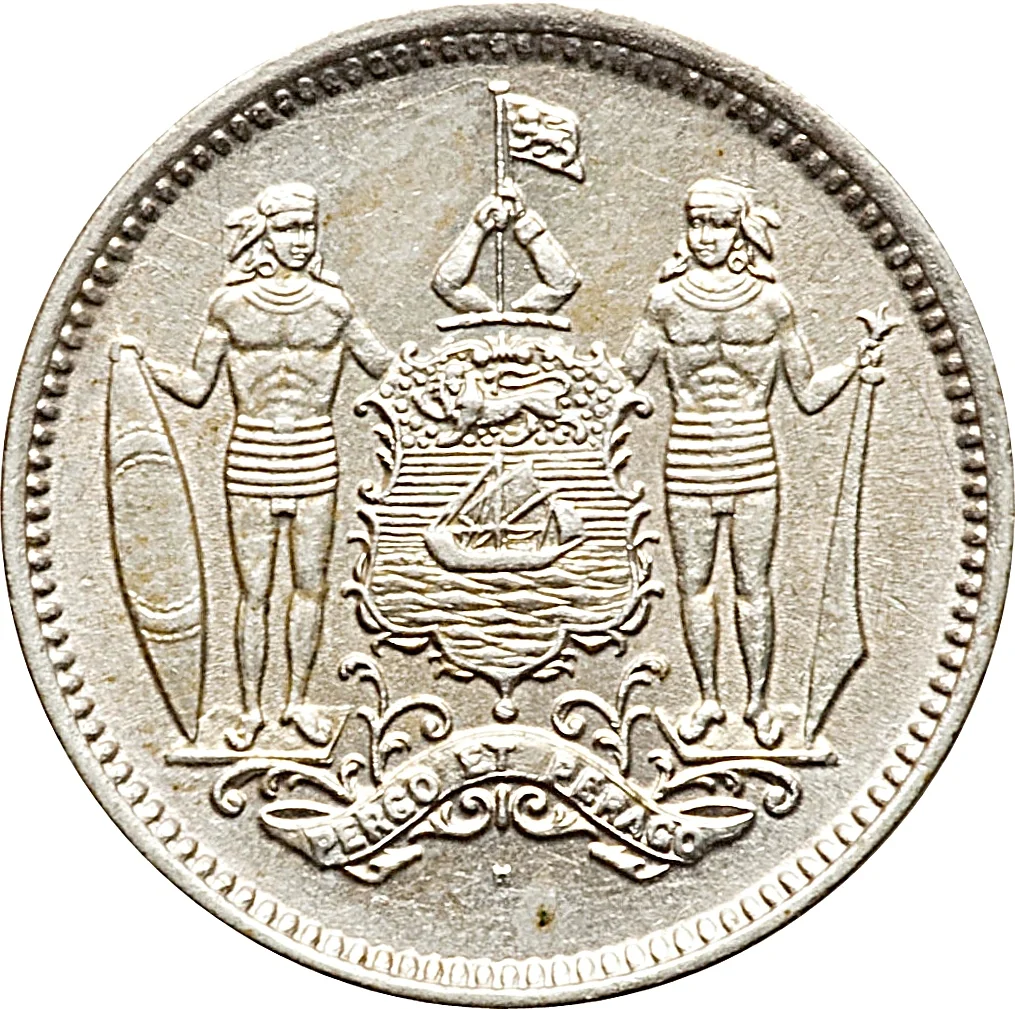
Obverse
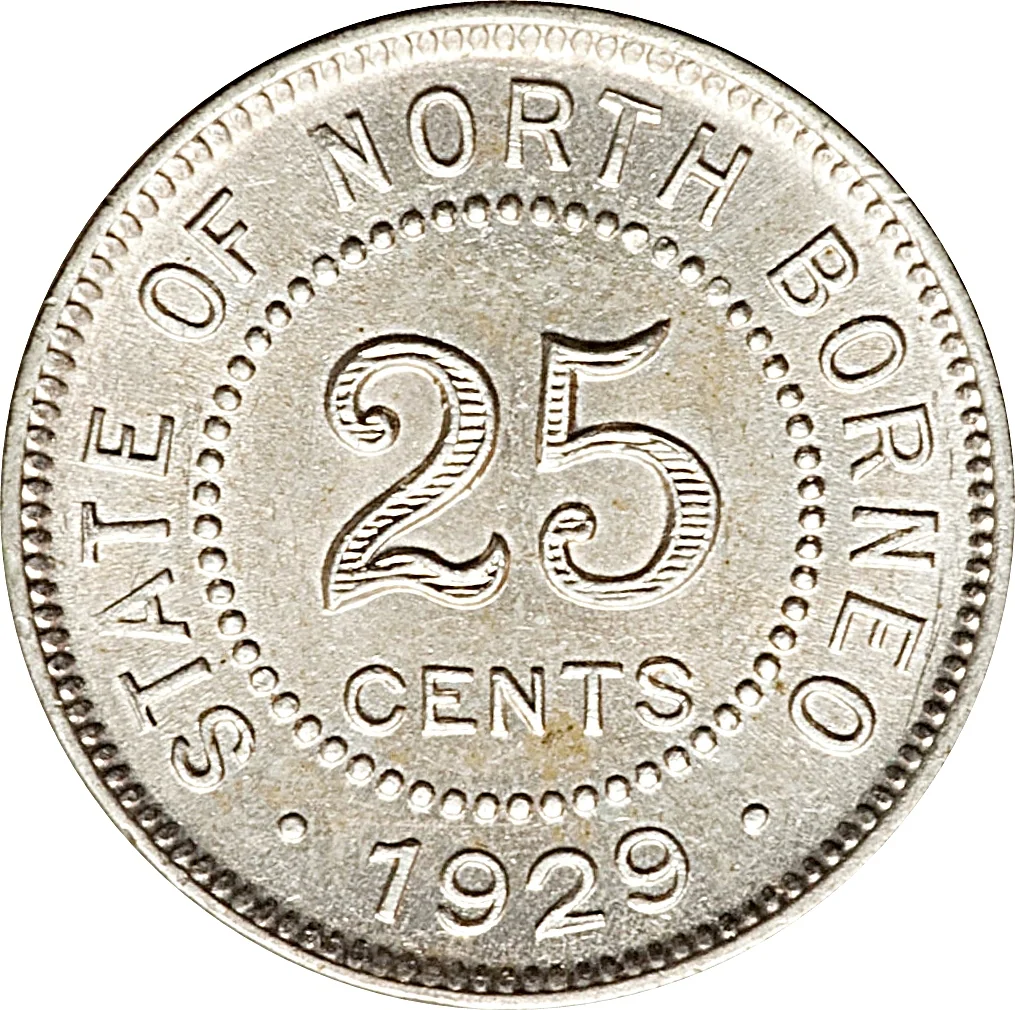
Reverse
Edge
Plain
Mints
| Name | Mark |
|---|---|
| Heaton and Sons / The Mint Birmingham | H |
Historical background
In 1929, the currency situation in North Borneo (present-day Sabah, Malaysia) was defined by its administration under the British North Borneo Chartered Company. The official currency was the British North Borneo dollar, which had been introduced in 1882. It was pegged at a fixed parity to the silver dollar standards of the neighbouring Straits Settlements and Hong Kong, ensuring stability and facilitating regional trade. This dollar was issued by the Chartered Company's own government and circulated alongside smaller denominations of coins, forming a coherent colonial monetary system.
However, the year 1929 marked the beginning of a significant transition. Global economic pressures and a worldwide shift away from the silver standard prompted a major monetary reform. The British North Borneo dollar was demonetized and replaced by the Straits Settlements dollar, which operated on a gold-exchange standard managed by a Currency Board based in Singapore. This move, completed in 1939, was initiated in 1929 to align the territory more closely with the financial systems of other British Malayan territories, aiming for greater economic integration and stability.
Consequently, the currency situation in 1929 was one of relative stability on the surface, but it stood at a pivotal crossroads. The familiar Company-issued notes and coins remained in daily use, yet the administrative decision to adopt the Straits currency had been set in motion. This change reflected both the Chartered Company's ongoing financial pragmatism and the broader imperial trend of consolidating colonial currencies under a stronger, gold-backed system in the wake of post-World War I monetary instability.
However, the year 1929 marked the beginning of a significant transition. Global economic pressures and a worldwide shift away from the silver standard prompted a major monetary reform. The British North Borneo dollar was demonetized and replaced by the Straits Settlements dollar, which operated on a gold-exchange standard managed by a Currency Board based in Singapore. This move, completed in 1939, was initiated in 1929 to align the territory more closely with the financial systems of other British Malayan territories, aiming for greater economic integration and stability.
Consequently, the currency situation in 1929 was one of relative stability on the surface, but it stood at a pivotal crossroads. The familiar Company-issued notes and coins remained in daily use, yet the administrative decision to adopt the Straits currency had been set in motion. This change reflected both the Chartered Company's ongoing financial pragmatism and the broader imperial trend of consolidating colonial currencies under a stronger, gold-backed system in the wake of post-World War I monetary instability.
⭐ Somewhat Rare