

2½ Cents – Rhodesia
Zimbabwe
Context
Material
Diameter: 16.3 mm
Weight: 1.4 g
Thickness: 0.99 mm
Shape: Round
Composition: Copper-nickel
Technique: Milled
Alignment: Medal alignment
flip
References
KM: #Click to copy to clipboard11
Numista: #10511
Value
Exchange value: 0.025 RHD
Obverse
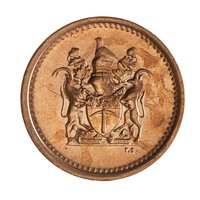
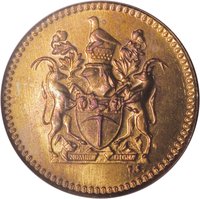
Description:
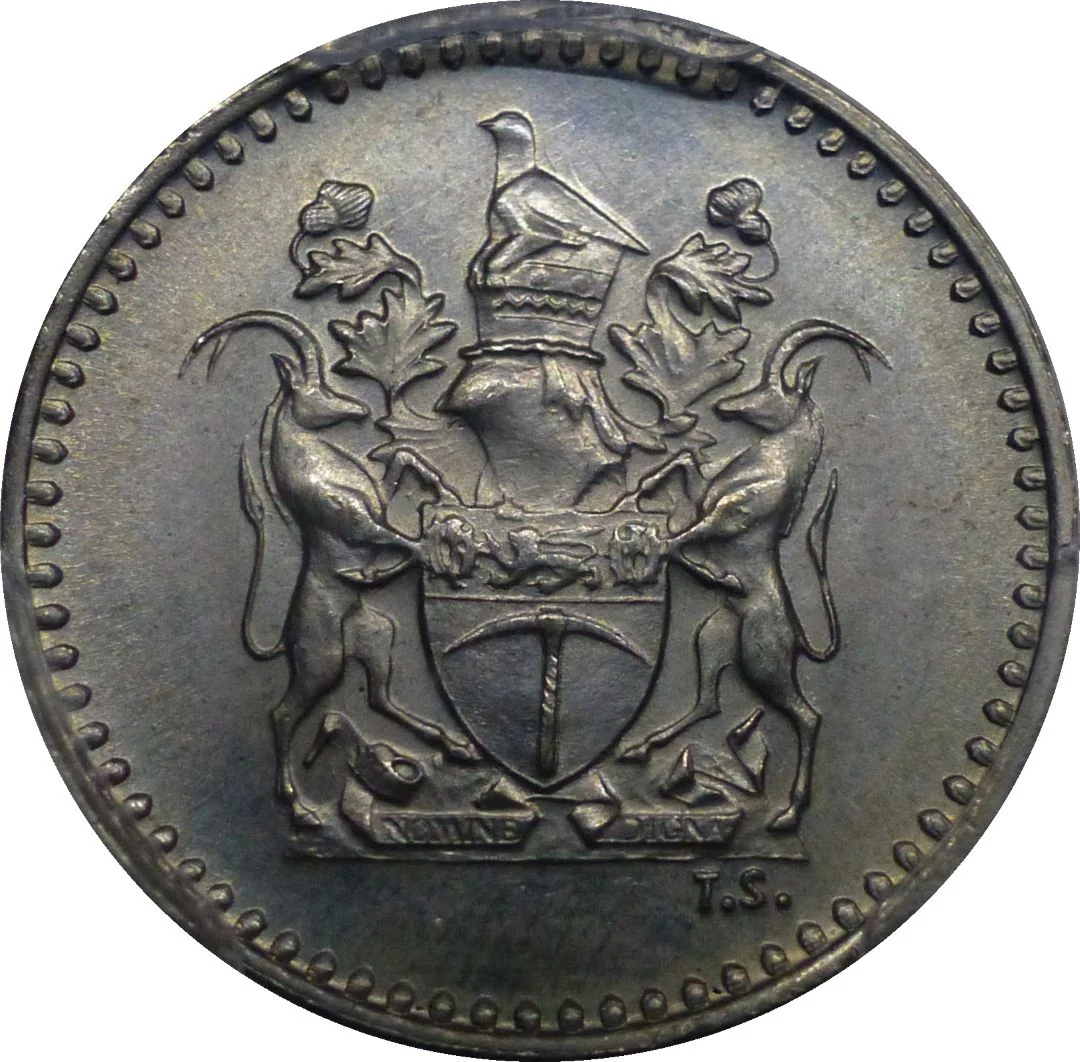
Rhodesian coat of arms, text removed.
Inscription:
SIT NOMINE DIGNA ·
Script: Latin
Engraver: Tommy Sasseen
Reverse
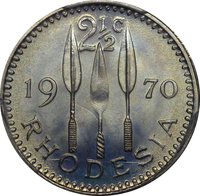
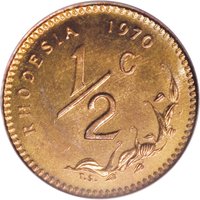
Description:
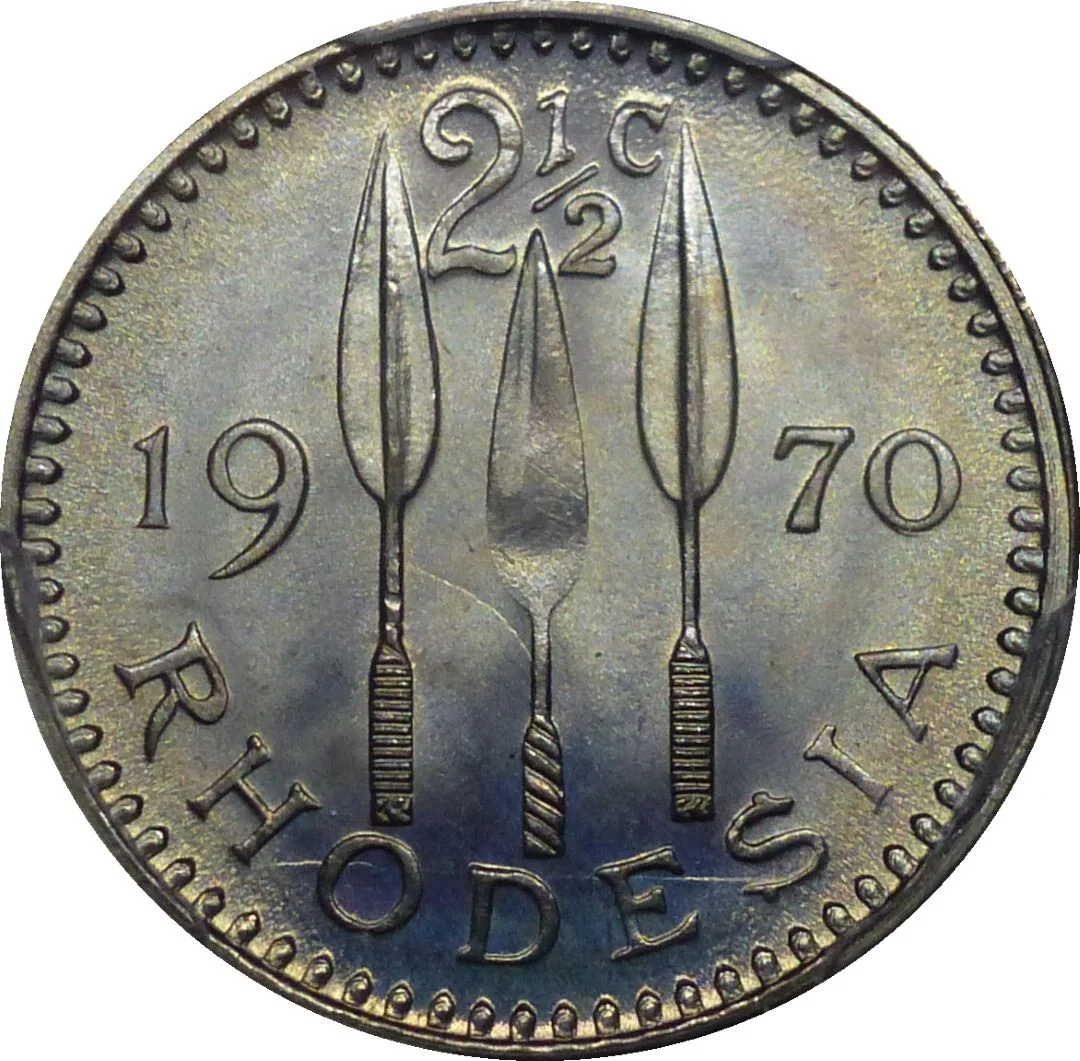
Date, value, name — separated by three spears.
Inscription:
2½c
19 70
RHODESIA
19 70
RHODESIA
Script: Latin
Engraver: Tommy Sasseen
Edge
Plain
Categories
| Animal> Bird |
| Animal> Cow |
| Object> Cold weapons |
| Symbols> Coat of Arms |
Mints
| Name | Mark |
|---|---|
| Pretoria | — |
Mintings
| Year | Mint Mark | Mintage | Quality | Collection |
|---|---|---|---|---|
| 1970 | — | 4,000,000 | ||
| 1970 | — | 12 | Proof |
Historical background
By 1970, Rhodesia’s currency situation was a direct consequence of its political isolation following the Unilateral Declaration of Independence (UDI) from Britain in 1965. The nation, under the white-minority government of Ian Smith, faced comprehensive international sanctions aimed at crippling its economy and forcing political change. These sanctions severed Rhodesia from the Sterling Area and cut off access to the London capital markets, forcing the government to establish its own central bank, the Reserve Bank of Rhodesia, in 1965. The Rhodesian pound, initially pegged at par with sterling, became a symbol of de facto sovereignty, though its value and stability were artificially maintained in a besieged economy.
The government managed the currency through strict exchange controls and a policy of import substitution, which, coupled with a strong agricultural and mineral export base, initially prevented a collapse. However, by 1970, the pressures were intensifying. To mark a further political break and simplify the decimal system, the government introduced the Rhodesian dollar on February 17, 1970, replacing the pound at a rate of 2 dollars to 1 pound. This move coincided with the declaration of a republic, severing the final constitutional links to Britain. The new currency was not internationally recognized, and its value was managed within a controlled, sanctioned economy.
Despite the regime's efforts, the currency's stability was precarious and largely artificial. Its value was propped up by rigorous internal controls and trade with a handful of nations that circumvented sanctions, notably South Africa and Portugal (through Mozambique). Inflation, however, was a growing concern as the costs of the escalating Bush War against nationalist guerrilla forces strained the national budget. Thus, in 1970, the Rhodesian dollar represented a paradox: a technically strong and stable currency within its borders, but an illegitimate and fundamentally fragile instrument in the wider world, entirely dependent on the unsustainable political and military status quo.
The government managed the currency through strict exchange controls and a policy of import substitution, which, coupled with a strong agricultural and mineral export base, initially prevented a collapse. However, by 1970, the pressures were intensifying. To mark a further political break and simplify the decimal system, the government introduced the Rhodesian dollar on February 17, 1970, replacing the pound at a rate of 2 dollars to 1 pound. This move coincided with the declaration of a republic, severing the final constitutional links to Britain. The new currency was not internationally recognized, and its value was managed within a controlled, sanctioned economy.
Despite the regime's efforts, the currency's stability was precarious and largely artificial. Its value was propped up by rigorous internal controls and trade with a handful of nations that circumvented sanctions, notably South Africa and Portugal (through Mozambique). Inflation, however, was a growing concern as the costs of the escalating Bush War against nationalist guerrilla forces strained the national budget. Thus, in 1970, the Rhodesian dollar represented a paradox: a technically strong and stable currency within its borders, but an illegitimate and fundamentally fragile instrument in the wider world, entirely dependent on the unsustainable political and military status quo.
🌱 Common