

1 crown – United Kingdom
Add to wishlist
United Kingdom
Context
Years: 1818–1820
Issuer: United Kingdom
Ruler: George III
Currency:
(1158—1970)
Total mintage: 1,286,800
Material
References
KM: #
Numista: #13172
Value
Bullion value: $65.66
Obverse
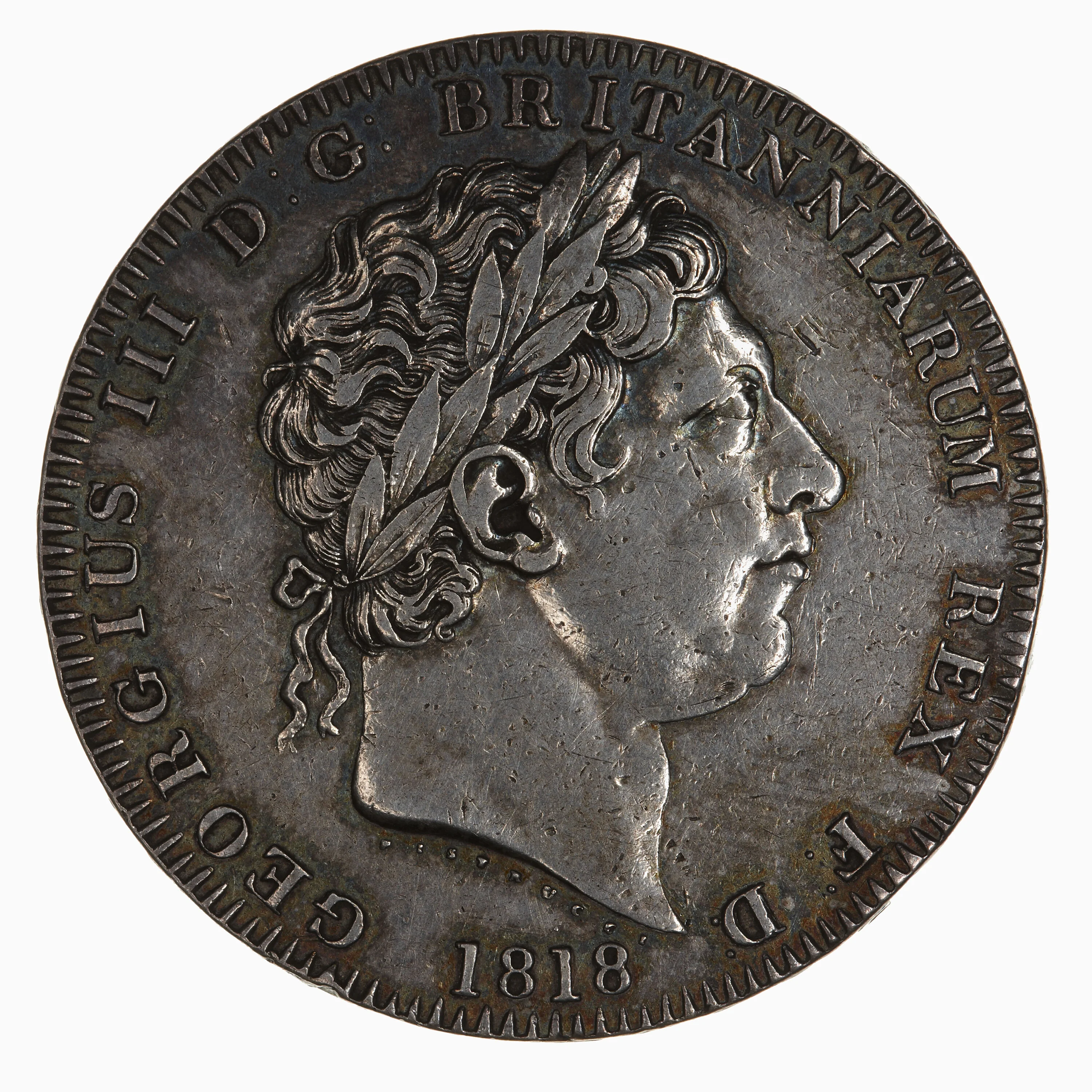
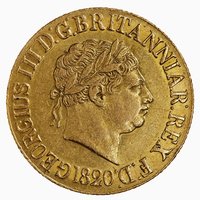
Description:
King George III portrait right, legend around, date below.
Inscription:
GEORGIUS III D:G: BRITANNIARUM REX F: D:
P I S T R U C C I
1818
P I S T R U C C I
1818
Translation:
George the Third, by the Grace of God, King of the Britains, Defender of the Faith.
Pistrucci
1818
Pistrucci
1818
Script: Latin
Engraver: Benedetto Pistrucci
Reverse
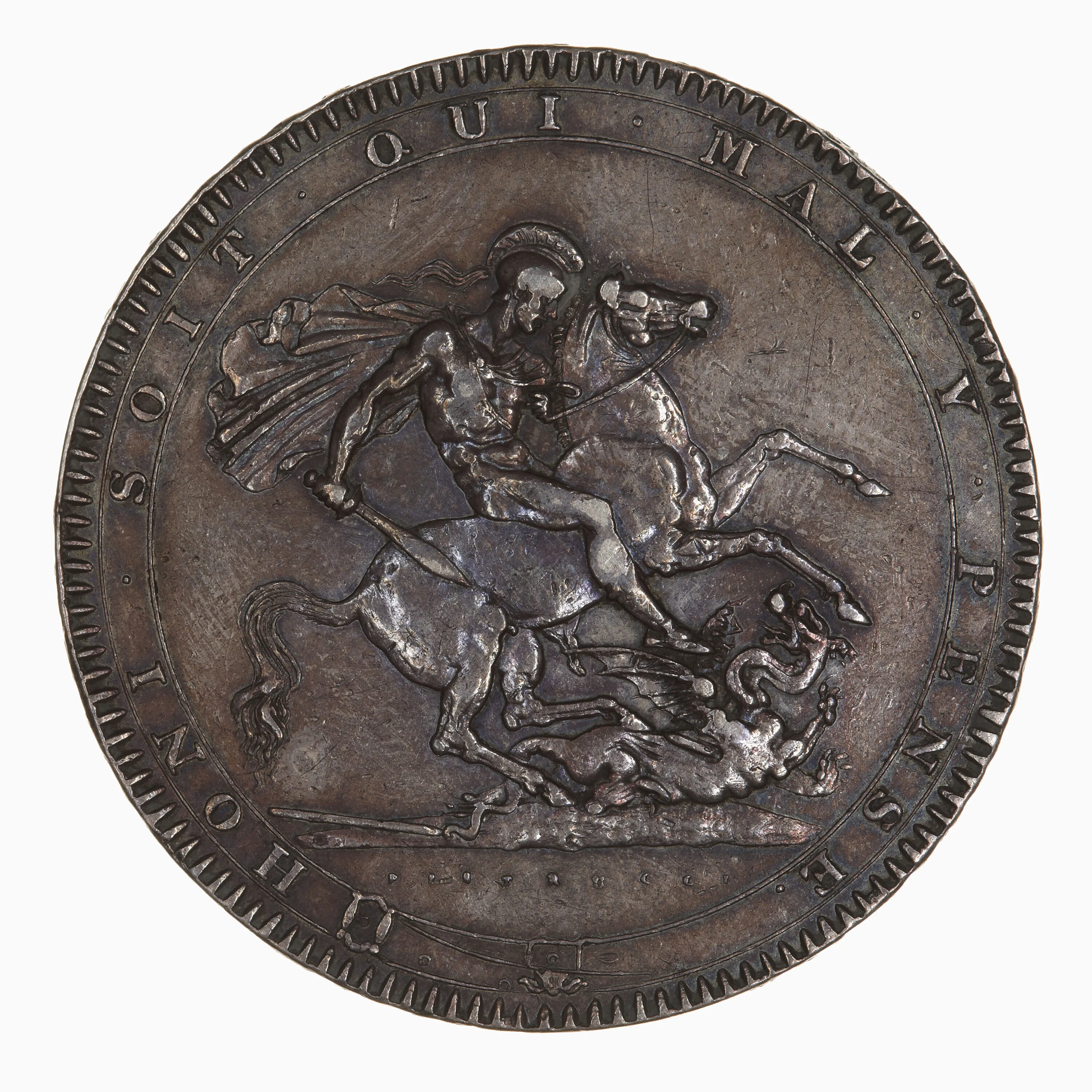
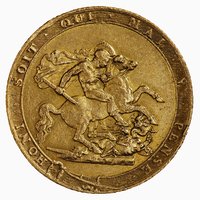
Description:
St. George slaying the dragon inside the Garter, with legend encircling.
Inscription:
HONI · SOIT · QUI · MAL · Y · PENSE.
P I S T R U C C I
P I S T R U C C I
Translation:
Shamed be he who thinks evil of it.
P I S T R U C C I
P I S T R U C C I
Script: Latin
Languages: French, Old French
Engraver: Benedetto Pistrucci
Edge
Inscribed
Legend:
DECUS ET TUTAMEN ANNO REGNI LVIII
Translation:
An ornament and a safeguard in the fifty-eighth year of the reign.
Language: Latin
Categories
| Mythology> Fantastic animal |
| Animal> Horse |
| Object> Cold weapons |
Mints
| Name | Mark |
|---|---|
| Royal Mint (Tower Hill) | — |
Mintings
| Year | Mint Mark | Mintage | Quality | Collection |
|---|---|---|---|---|
| 1818 | — | 155,200 | ||
| 1819 | — | — | Proof | |
| 1819 | — | 683,400 | ||
| 1820 | — | 448,200 |
Historical background
In 1818, the United Kingdom was navigating the complex aftermath of the Napoleonic Wars, with its currency system at a critical juncture. Since 1797, the country had operated under a "paper pound" as the Bank of England had been relieved of its obligation to convert banknotes into gold—a period known as the Restriction. This had led to significant inflation and a depreciation of the pound's value against gold. By 1818, the government, led by Lord Liverpool, was firmly committed to a return to the gold standard, seeking to restore monetary stability and London's financial credibility. The pivotal Resumption Act of 1819 was being prepared, which would mandate the full return to convertibility by 1823.
The immediate currency situation was one of tension and debate. While paper notes circulated widely, their value was unstable, and the gap between the paper pound and its nominal gold value created economic uncertainty. "Bullionists," who advocated for a swift return to gold convertibility, argued that this was essential to curb inflation and discipline government spending. Opposing them were "anti-bullionists" and many landowners and industrialists, who feared that a sudden contraction of the money supply and a stronger pound would lead to crippling deflation, falling agricultural prices, and increased burden of debt.
Thus, 1818 represents the calm before a monumental policy shift. The decision to resume cash payments in gold was effectively being made, setting the stage for the deflationary pressures of the 1820s. This move would firmly re-establish the gold standard for over a century, prioritizing international financial prestige and price stability, but at a significant short-term cost to parts of the domestic economy, particularly agriculture, which faced falling prices as the pound regained its pre-war gold value.
The immediate currency situation was one of tension and debate. While paper notes circulated widely, their value was unstable, and the gap between the paper pound and its nominal gold value created economic uncertainty. "Bullionists," who advocated for a swift return to gold convertibility, argued that this was essential to curb inflation and discipline government spending. Opposing them were "anti-bullionists" and many landowners and industrialists, who feared that a sudden contraction of the money supply and a stronger pound would lead to crippling deflation, falling agricultural prices, and increased burden of debt.
Thus, 1818 represents the calm before a monumental policy shift. The decision to resume cash payments in gold was effectively being made, setting the stage for the deflationary pressures of the 1820s. This move would firmly re-establish the gold standard for over a century, prioritizing international financial prestige and price stability, but at a significant short-term cost to parts of the domestic economy, particularly agriculture, which faced falling prices as the pound regained its pre-war gold value.
🌱 Common